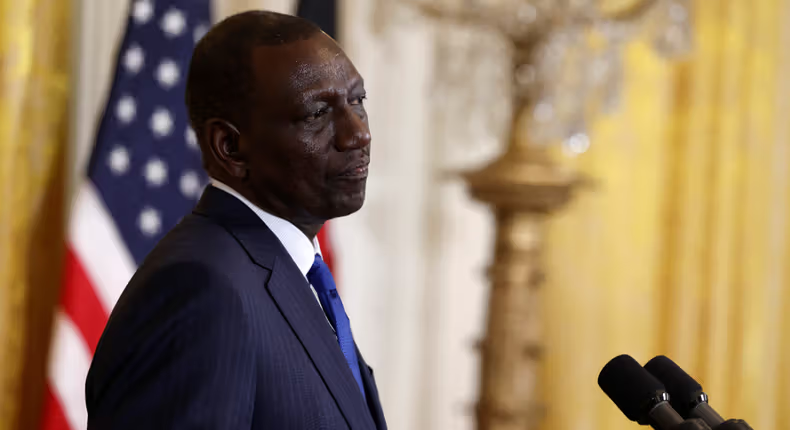
A flagship $1 billion Microsoft and G42 data centre project in Kenya has stalled over power supply constraints, with President William Ruto acknowledging that the country’s electricity system cannot accommodate the scale of the proposed facility without disrupting service to households and industry.
The project was first announced during Ruto’s state visit to Washington in May 2024 and was expected to be located about 100 kilometres northwest of Nairobi, powered largely by geothermal energy. The investment was positioned as a flagship deal to deliver cloud services via Microsoft’s Azure platform to Kenyan businesses and government institutions.
Speaking in Nairobi last week, Ruto said the scale of the proposed facility exposed significant limitations in the country’s grid. Kenya’s installed capacity currently stands at about 3,000 megawatts, and the proposed data centre alone would require roughly a third of that supply. “To switch on that one data centre, we would need to shut off power for half the country,” he said. “That’s when I knew there was a problem.”
Kenya has long promoted its renewable energy credentials, particularly geothermal power, which accounts for around 40% of its energy mix. The country has positioned that as a competitive advantage in attracting energy-intensive digital infrastructure. But officials now acknowledge that existing supply remains insufficient to accommodate hyperscale data facilities without straining the national grid.
Government officials familiar with the discussions said a concept note for the project was prepared by Kenya’s technology ministry and submitted to the National Treasury for funding approval. The proposal did not receive clearance, effectively halting progress. By August 2025, meetings between Kenyan officials and Microsoft executives had already indicated the project would miss its original May 2026 completion target. Neither Microsoft nor G42 provided immediate comment on the latest developments.
The project had been viewed as a symbol of deepening ties between Kenya and the United States, particularly as Washington seeks to expand its technological footprint in East Africa amid growing competition from China. The delay highlights the risks associated with high-profile investment announcements made during diplomatic engagements, which may not always reflect underlying technical or financial feasibility.
Analysts say the setback underscores a broader structural challenge across Africa, where demand for AI and cloud services is rising faster than the infrastructure needed to support it. While Kenya’s data centre market is projected to grow significantly, existing energy demand from households and industry limits the scale at which new facilities can be deployed.
Ruto has used the stalled project to reinforce his government’s target of increasing national power capacity to 10,000 megawatts by 2030. The administration is seeking to raise about $38 billion to fund energy and infrastructure expansion, partly through asset sales and private sector participation.
Despite the uncertainty around the Microsoft-backed project, momentum in Kenya’s data centre sector continues. Airtel Africa subsidiary Nxtra is developing a 44-megawatt facility in Tatu City, expected to be the largest in East Africa upon completion.
Elsewhere on the continent, Microsoft has maintained its expansion plans. In April, the company announced a $329 million investment in South Africa to grow its cloud infrastructure and AI capabilities, including improvements in power and water readiness for future data centres.
The contrasting trajectories highlight a key reality for African markets: while investor interest in digital infrastructure remains strong, execution will depend heavily on the pace of upgrades to foundational systems — particularly energy supply.