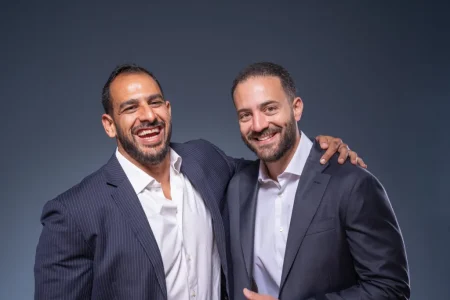
Zimbabwean entrepreneurs Michael Moyo and Louis Murerwa have raised $2 million in pre-seed funding for Ocular AI — a company that already reports seven-figure revenue and counts frontier AI labs and Fortune 100 companies among its customers.
Drive Capital led the round, with participation from Y Combinator, Alumni Ventures, 1745 Ventures (formerly Bertelsmann Digital Media Investments), Orange Collective, MyAsia VC and angel investors.
A different position in the value chain
Most African AI companies in this space build applications for African markets. Ocular AI sells into the companies building the models.
Founded in 2024, it produces datasets, evaluations and benchmarks used to train and assess advanced AI systems, with a focus on voice and audiovisual technology. Several top frontier AI labs and Fortune 100 companies now use its material, according to the company.
That places two Zimbabwean founders upstream of the model developers rather than downstream of them — supplying inputs to the labs whose outputs most of the continent consumes.
The technical argument
Traditional voice AI converts speech into text before generating a response, discarding tone, pauses, emphasis and timing along the way.
Voice-native models process speech directly — listening and speaking simultaneously, responding to interruptions and shifts in a conversation. NVIDIA, Thinking Machines Lab, OpenAI and Google have all been developing or releasing audio-native models, which has raised demand for data that reflects how people actually talk.
Ocular AI captures conversations at studio quality and builds evaluations designed to find where models fail. It has flagged the limited availability of high-quality full-duplex speech data, including continued reliance on older telephone-based datasets — a specific and checkable gap.
The company’s position is that the constraint is no longer data volume but data quality: material covering pauses, interruptions, overlapping speech and natural response, which is scarce in publicly available online sources.
It is now extending into audiovisual, producing high-fidelity datasets for models that process voice, facial expression and gesture together in real time.
Expertise as infrastructure
Ocular AI has built an Expert Network of thousands of vetted specialists who supply the human knowledge behind its datasets.
Its method pairs domain experts with research: experts establish what a correct response looks like, research identifies where models fail, and the findings become datasets and evaluations.
That is the same argument running through the benchmark problem generally — that evaluating a model requires knowing what good looks like, and that judgment has to come from somewhere.
What hasn’t been disclosed
No customers named, no revenue figure beyond “seven-figure,” no Expert Network headcount, and no detail on where the company or its expert network is based.
By Rugare Mubika, Next Africa.