Namibia and China have opened a new front in their space cooperation with the formal launch of a joint AI satellite initiative aimed at strengthening Namibian technical capabilities in satellite engineering and space science.
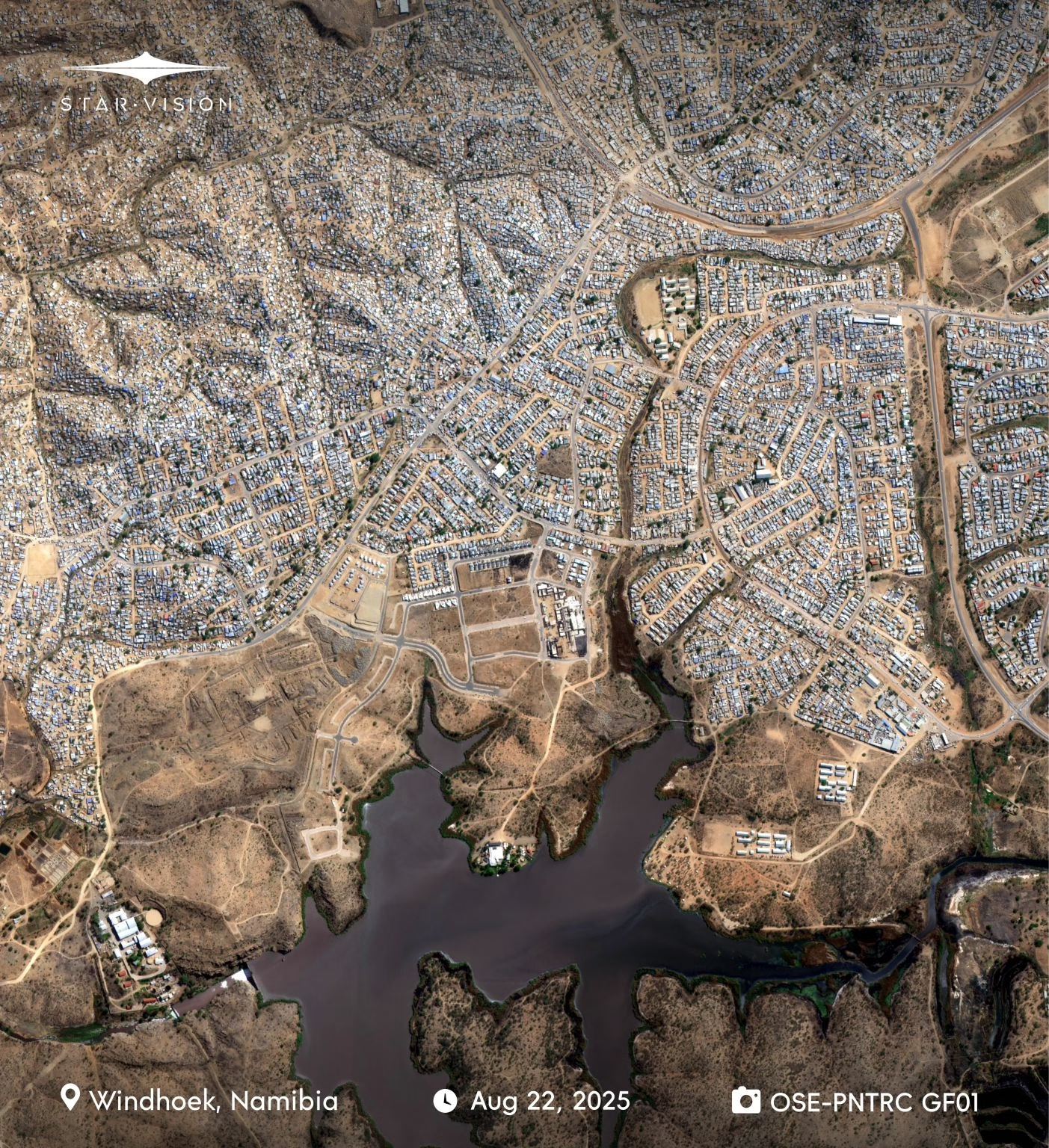
Chinese satellite company STAR.VISION confirmed on LinkedIn that it had commenced the collaborative project following discussions with Namibia’s Minister of Education, Innovation, Youth, Sports, Arts and Culture, Sanet Steenkamp. The announcement was made during the Namibian presidential delegation’s official state visit to China. To mark the launch, STAR.VISION also released a high-resolution image of Windhoek captured by its OSE Earth observation satellite constellation, as a working demonstration of the imaging capacity Namibian partners will now be building expertise around.
The initiative is centered on capacity development. Under the terms STAR.VISION has outlined, the project will establish a framework for AI satellite development while providing Namibian researchers and students with practical training in orbital engineering and satellite technologies. Whether that translates into a Namibia-owned satellite mission or remains a training-and-access arrangement is one of the details the announcement does not yet spell out.
AI-enabled satellites are becoming an increasingly central part of the Earth observation sector. Rather than routing all raw imagery to ground stations for processing, these satellites use onboard edge computing to identify events — floods, crop stress, wildfires, environmental change — while still in orbit, then transmit only the relevant data downward. That approach reduces bandwidth requirements, improves operational efficiency and shortens decision-making cycles for governments and businesses that rely on satellite intelligence. For a country like Namibia, whose Earth observation needs span drought monitoring, land-use planning and mineral prospecting across a vast and sparsely populated territory, that class of capability is directly consequential.
The deal lands inside a broader China-Africa space and AI cooperation pattern that iAfrica has been tracking. Chinese satellite partnerships already anchor Ethiopia’s ETRSS-1 satellite, Egypt’s MisrSat, Kenya’s Taifa-1 nanosatellite and Sudan’s SRSS-1, alongside recent Digital Silk Road deals stretching from Zambia’s Huawei-anchored national AI data centre commitment in May to the China-Africa AI Case Innovation Competition being run under the 2026 China-Africa Year of People-to-People Exchanges. The Lawyers Hub and Agence Française de Développement report launched at the Africa Forward Summit in Nairobi earlier this year explicitly framed China’s African AI approach as infrastructure-first — routed through Huawei, Alibaba Cloud and the Digital Silk Road — and this satellite initiative adds a new dimension of that pattern.
For Namibia specifically, the initiative dovetails with a wider domestic push. The Namibian Institute of Public Administration and Management announced structured AI training for civil servants in May, starting with senior leadership. The Bank of Namibia won the Central Banking Awards’ AI Initiative Award in March for deployed machine-learning systems, including a non-performing loans predictive model and inflation nowcasting. And Namibia’s Emma Theofelus, the country’s Information and Communication Technology Minister, was named to the AI for Good Global Commission earlier this month. A joint AI satellite programme extends that trajectory upward — literally — into a domain where African participation has typically depended on partnerships with either European agencies, US operators or, increasingly, Chinese providers.
Whether the STAR.VISION-Namibia project matures into a full national satellite programme, or settles at the level of academic exchange and shared access to Chinese-operated infrastructure, will be the test of what “capacity building” delivers in practice.