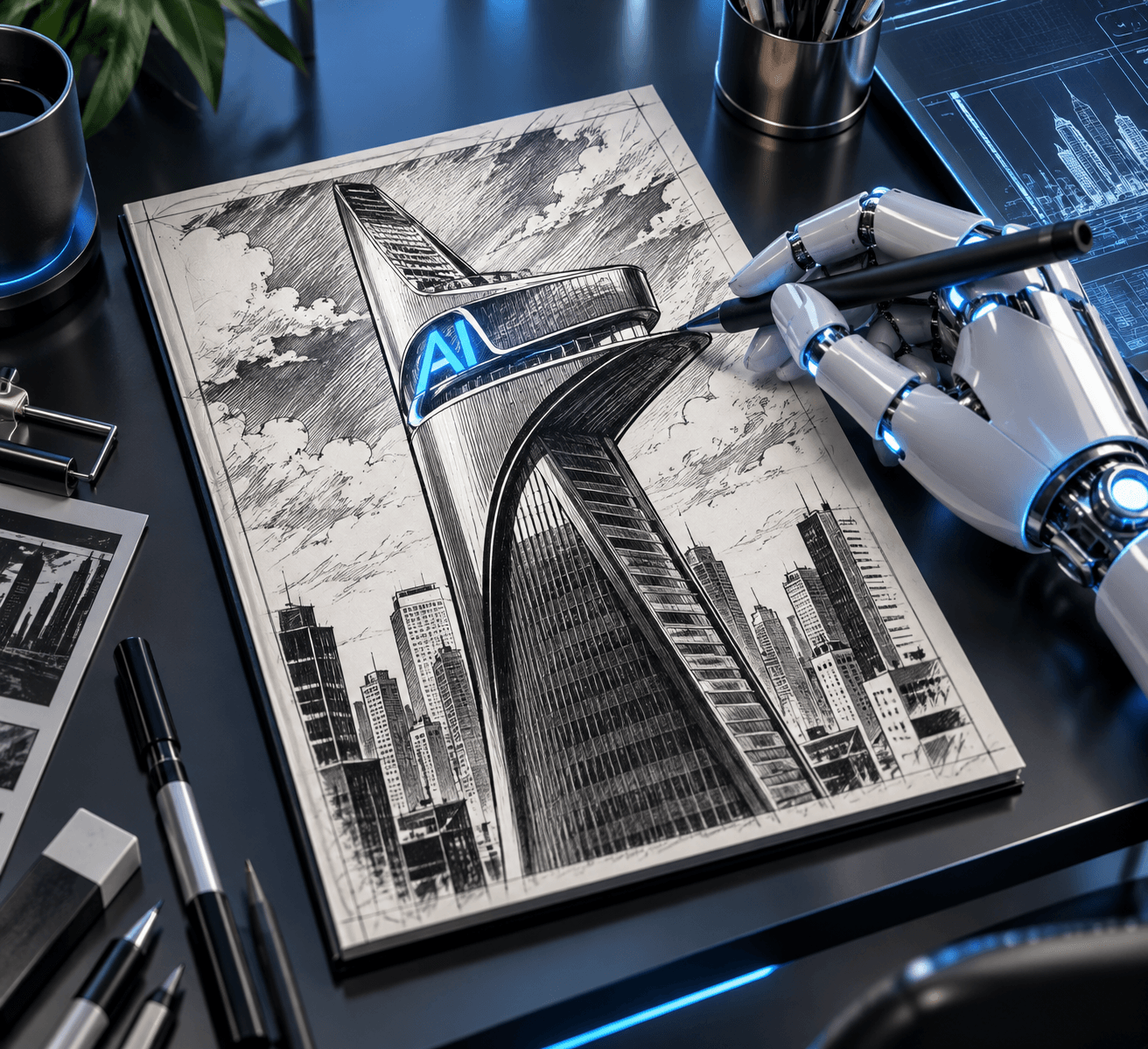
Love it, hate it, or somewhere in between, Artificial Intelligence (AI) is changing the way we create, work and think about originality.
Much focus has been on AI’s disruption of digitally based creative fields, but what does the rise of creative AI mean for conceptual artists, including illustrators creating physical art and commissioned work?
Supporting creative processes and production
AI can free up time so artists can focus more on creativity rather than repetitive or operational tasks. It can also do some of the research heavy lifting, reducing the time needed at certain stages of a project.
The vast array of free platforms available makes AI creative tools more accessible and helps bring ideas to life more quickly. Fast mock-ups and visualisation can be particularly useful when pitching for commissioned work or presenting clients with multiple ideas upfront.
By supporting prototyping and experimentation, AI could also stimulate artists’ own creativity and thought processes. Once ideas are finalised, it can help lower production barriers, which can be game-changing for artists facing budget and resource restrictions.
Impacts on artist earnings
As AI use increases, we have to consider the impact on creative income, intellectual property, the value of human-made work and how we define creativity. From an earnings standpoint, AI creates commercial pressure as clients and audiences question what they should pay for work technology can generate in seconds.
Artists may argue that AI-generated work cannot be compared to human-produced work, but clients may still settle for “good enough” – leaving artists to justify why their ideas, skill and hands-on production warrant their fees.
And while many artists may feel they should not have to “prove their worth”, freelance and commission-based work remain a significant part of the industry, often without the safety net of a fixed income. A 2026 report states that 72% of concept artists work on a freelance or contract basis at some point in their career.
Raising the value of human imagination
Conversely, the rise of AI may increase the perceived value of human creativity. From both a creative and commercial perspective, concerns remain around AI-generated art, particularly where it may reduce individuality, cultural resonance and emotional intelligence.
A recent World Economic Forum (WEF) article warns against leaving creatives out of AI discussions, arguing that human qualities must remain central as AI becomes more embedded in creative work. It cites the Dentsu Creative 2025 CMO Report, which found that 87% of CMOs believe modern strategy requires more creativity, empathy and humanity, while 78% say generative AI will never replace human imagination.
Putting the art in artificial?
Is AI art true art in the traditional sense of the word? After all, an original AI-generated piece is still an original output. But how do we measure ingenuity when the technology behind it may have been trained on the work of human artists? Where do human imagination and AI creativity meet – or split, as it may be? Art is subjective, so how do we assign meaning or classify what is or isn’t art?
Take culturally inspired work, for example. It’s far more than “just” an art piece or design – it may be shaped by an artist’s heritage, history, stories passed down through generations, personal lived experiences and unique identity. What happens when works carrying those influences are used to train AI models without recognition, consent or remuneration being given to the original creators?
Global developments
Earlier this year, San Diego Comic-Con, one of the world’s largest and most influential comic book, creative and pop-art conventions, faced backlash from artists over its policy on AI-generated artwork. Artists raised concerns that generative AI models can be trained on original creative work without permission, potentially affecting both copyright and artists’ livelihoods. In response, organisers updated the rules for the 2026 Comic-Con Art Show to prohibit material created partially or wholly by AI.
The decision is noteworthy because it shows how major creative platforms are beginning to draw clearer boundaries around the role of AI in spaces traditionally centred on human-made work.
Feedback from the Creative Community
From artists’ perspectives, impacts of AI are complex. Johannesburg-based artist TAO shared his thoughts: “I am fortunate that AI has not impacted my earnings – my client base has remained loyal and earnings have remained intact. I have, however, had to document my process as a digital artist due to claims of my work being AI-generated.
From a creative perspective, I don’t think AI inspiration inherently devalues art. Art is derivative – that is the nature of creation. I think that active devaluation of unique creativity and expression for the sake of faster, “easier” monetisation devalues art as it loses the point of why artists wish to create art (which presumably is for the love of it), and the joy such things bring to us as humans.
I am not specifically pro-AI or anti-AI. I am pro making things I care about, and I feel that AI fundamentally sits in opposition to this. I also believe that there is a need to make active efforts to crack down on AI copyright infringement, as well as opening more specific public discourse around the policing of its use and the enforcement of AI transparency.”
Mixed-media and digital artist Karin Vermeulen said: “A handcrafted piece is more than materials – it’s a slice of someone’s life. Every mark carries hours of dedication, small mistakes and the human presence of its creator. AI has data, but no lived history, rough days or sudden sparks of inspiration. It can mimic feeling, but there’s no personal risk behind the output. That’s why human art hits differently. Its true value is not just how it looks, touches and feels, but knowing another person cared enough to spend their time creating it for you.”
Visual storyteller and creative generalist Clyde Beech believes in sparking the imagination of the next generation of creatives. “Earlier this year, I served as a facilitator and mentor in the City of Cape Town’s Emerging Artist Programme. My advice to young artists is to keep creating and let your art be your voice and your mark on society. Be the outlier – make the thing nobody else has done before. The industry is tough, but human resolve will always shine through.”
However, he has also experienced more serious consequences of AI. “AI has affected my earnings drastically. Around eight years ago, my earnings as a freelancer allowed me to comfortably resign from my formal studio job and pursue freelance work full-time, where I became quite successful. However, around two years ago, with the rise of generative AI, the well began to run dry. Clients started choosing the cheaper AI route, and many creative people were left by the wayside. The comic book and animation spheres also suffered. I am still trying to weather ongoing negative impacts.”
What Comes Next for Creatives, Platforms and Events?
The conversation around how AI affects artists’ income, ownership and creative value is especially timely ahead of the Comic Con Africa event that takes place in Johannesburg this month. This event brings artists, creators and fans together at one of the continent’s biggest celebrations of creative culture. It is also a natural space for broader discussion around how AI is reshaping the future of creative work across the African continent, and globally.
Comic Con Africa Show Director Carla Massmann emphasises, “Creative industries are strongest when the people behind the work are recognised for what they create and are able to benefit from it, both creatively and commercially. AI is changing the landscape quickly, and that makes it even more important to protect the value of original talent, ideas and ownership. Our policy on AI-generated products reflects that approach, while keeping artists and independent creators at the centre of the conversation.”
Perhaps that is where the conversation needs to go next. Not simply whether AI belongs in creative industries, but how we make space for its benefits without diminishing the people whose imagination, skill and original work give those industries their value in the first place.
Article Written By Terena Chetty
Terena Chetty is an impact-driven brand and integrated communications strategist with extensive experience across pan-African and global organisations. She currently leads brand strategy at a Johannesburg-based creative agency.