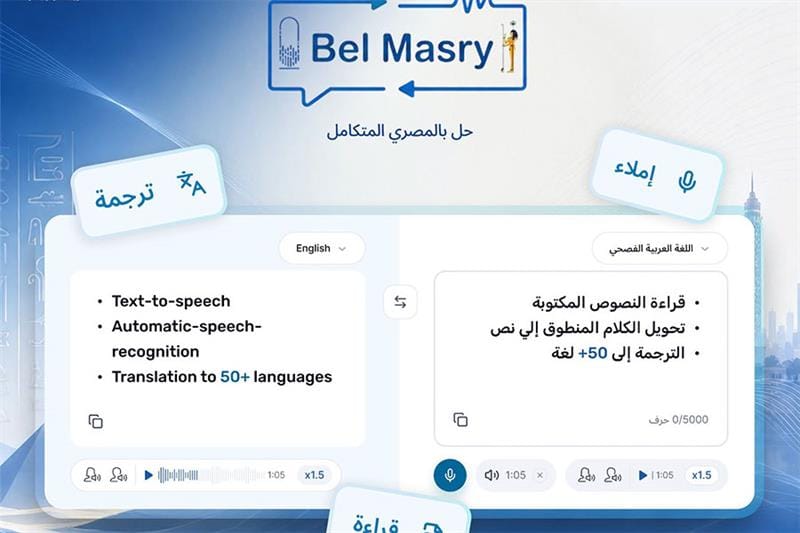
Egypt has launched BelMasry, a free AI platform built to process Egyptian colloquial Arabic and Modern Standard Arabic and translate between them and 50 foreign languages — described by the communications ministry as the country’s first sovereign AI platform of its kind.
Developed by the ministry’s Applied Innovation Center, the pilot combines three engines. Speech-to-text converts spoken Egyptian Arabic, across its regional dialects, and Modern Standard Arabic into written text, distinguishing between speakers in multi-party recordings and filtering background noise. Machine translation handles exchanges between Arabic and 50 foreign languages. Text-to-speech converts written Arabic into speech with natural pronunciation, aimed at virtual assistants, digital education, media production and voice-enabled government services.
The platform is available free to individuals, institutions and developers at belmasry.aic.gov.eg.
Why dialect matters
The ministry says BelMasry was built from the ground up on Egyptian and Arabic linguistic datasets, enabling it to recognise local expressions, cultural references and emotional nuances that global systems handle poorly. Those limitations, it argues, have created a communication gap that keeps millions of Egyptians from accessing services in the language they actually speak.
That gap is quantifiable. Arabic accounts for less than 1% of global large language model training data, according to UNESCO figures iAfrica has previously cited — and the fraction covering colloquial dialects rather than Modern Standard Arabic is smaller still. Egyptian Arabic is spoken by well over 100 million people and is the most widely understood dialect across the Arab world, largely because of the reach of Egyptian film and television. It is nonetheless a low-resource language in machine learning terms.
Egypt’s private sector has been working the same problem. Nanovate raised $2 million to build Arabic-native voice and chat agents supporting 22 dialects. Intella launched the first Arabic voice ordering system in Egyptian dialect with Jumia Egypt before extending into Swahili. Alexandria’s TokenAI released open-weight models handling colloquial Egyptian, Levantine, Gulf and North African variants alongside ancient hieroglyphics.
What separates BelMasry is that it is state-built, sovereign and free — closer in model to Nigeria’s open-sourced N-ATLAS than to a commercial platform.
Part of a wider build
BelMasry was previewed in February at the AI Everything Middle East and Africa Summit in Cairo, where Communications Minister Raafat Hindi described it as a national system capable of understanding Egyptian colloquial Arabic. That summit also saw the launch of Karnak, Egypt’s national large language model, alongside Sia, an AI tutor for secondary students; a legal and regulatory assistant for citizens and SMEs; locally trained diagnostic tools for diabetic retinopathy, macular edema and breast cancer; and Tarjuman, a translation application.
The Applied Innovation Center, established in 2019, has developed the bulk of that portfolio. Egypt is also working with the UNDP to share these tools with Arab and African countries through the AI-Share initiative — which would make BelMasry’s underlying approach exportable to other states building dialect-capable systems.
The second edition of Egypt’s National AI Strategy, covering 2025-2030, comprises six pillars and 21 initiatives spanning governance, technology, data, infrastructure, innovation ecosystem and skills. Its priorities include developing national AI models, producing high-quality Arabic-language datasets and expanding data-centre and cloud capacity. The strategy targets 30,000 trained AI specialists and a 7.7% AI contribution to GDP by 2030.
Egypt ranked first in Africa and 51st of 195 countries on Oxford Insights’ 2025 Government AI Readiness Index, climbing 14 places year on year.
The test
A free platform removes the cost barrier, but adoption will depend on quality. Speech recognition across Egyptian regional dialects — Cairene, Sa’idi, Alexandrian, Delta variants — is a materially harder problem than transcribing Modern Standard Arabic, and the ministry has not published accuracy benchmarks.
That is the number worth asking for. Nigeria’s N-ATLAS and the GSMA’s ATLAS Umoja initiative are pursuing the same objective for African languages, and the field is short of published performance data against which national language models can be compared.