The Inter-University Council for East Africa has launched a Regional AI Network of Universities and its Strategic Plan 2026-2031 at its 17th Annual Meeting and Conference in Nairobi, as the East African Community body pushes to consolidate AI capacity across a region where national efforts have largely run in parallel rather than together.
The three-day conference, convened with Kenya’s Ministry of Education under the theme “Powering the Future of Higher Education in East Africa through Strategic Partnerships and Collaborations,” drew more than 400 participants including policymakers, university leaders, higher education regulators, researchers, students, industry representatives and development partners.
The AI network is designed to connect institutions working in AI education, research and innovation, pool expertise and infrastructure, and strengthen university capacity to use artificial intelligence responsibly. It extends work IUCEA began earlier this year: the Regional Network on Artificial Intelligence in Education and Research was unveiled in Kigali in March under the EAC AI Alliance project, with a call for nodes inviting universities and research institutions across the region to join. That alliance was explicitly framed as a response to fragmented national AI efforts that have limited the scale and impact of investment across the eight EAC partner states.
Kenya’s Principal Secretary for Higher Education and Research, Dr Beatrice Muganda Inyangala, framed the conference’s central argument in terms of what universities should become. “Our universities should become living laboratories where students work alongside industry to solve real problems,” she said, calling for stronger bridges between knowledge and enterprise, discovery and deployment, and research and revenue.
IUCEA Acting Executive Secretary Professor Idris A. Rai put the collaboration question more bluntly. “The question before us is no longer whether higher education should transform. The question is how we transform it—together,” he said, arguing that the universities shaping East Africa’s future will be those collaborating across disciplines, sectors and national borders rather than working in isolation. Acting Chairperson of the IUCEA Executive Committee, Professor Rose Clarke Nanyonga, urged participants to leave with a single concrete commitment.
The Strategic Plan 2026-2031, developed through consultations with partner states, universities, regulators, students, industry and development partners, was launched alongside the network. East African Community Deputy Secretary General Annette Semuwemba pressed for it to be treated as an operational document rather than a reference one. It “must become a practical blueprint,” she said, demonstrating how IUCEA contributes to the wellbeing and prosperity of the region’s citizens.
Friederike Hemker, Deputy Head of Development Cooperation at the German Embassy in Kenya, made the specialisation case for regional integration. “No Partner State can build world-class capacity in every field alone,” she said, arguing that a Common East African Higher Education Area lets universities specialise, students move to where expertise exists, and qualifications carry across borders. Germany has been a consistent partner in the region’s digital-skills architecture — GIZ ran the three-year Digital Skills for an Innovative East African Industry project with IUCEA, training 4,000 young people across Tanzania, Kenya, Uganda, Rwanda, Burundi, South Sudan and the DRC, and the AI network is positioned as its successor.
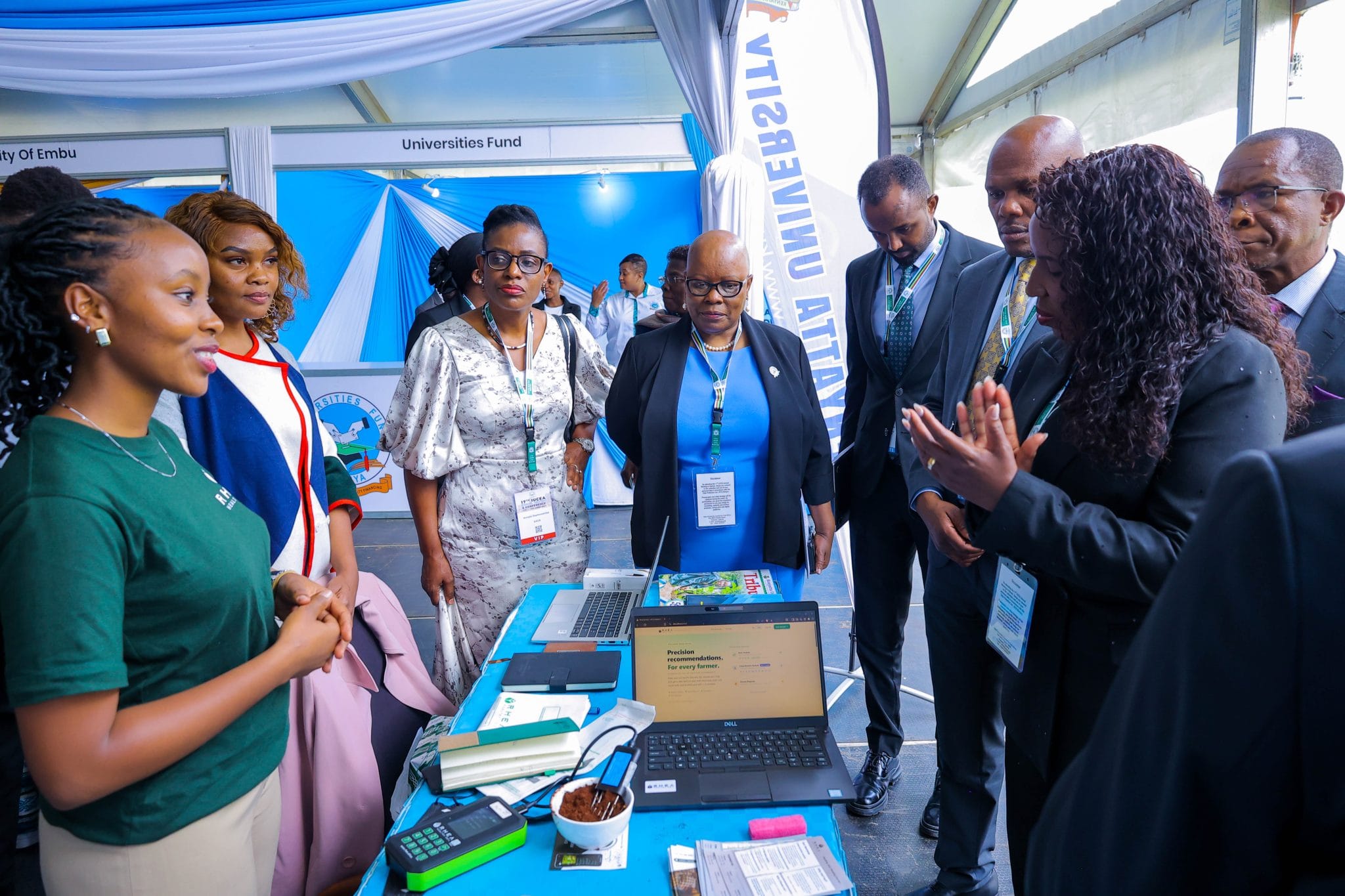
IUCEA is also expected to formalise collaborations with Italy’s Information Centre on Academic Mobility and Equivalence, France’s High Council for the Evaluation of Research and Higher Education, and the Christian Television System of South Korea. A partnership and innovation exhibition running alongside the conference is showcasing university research, innovation hubs, TVET innovations and enterprises led by young innovators.
The network joins a growing set of African university-anchored AI capacity efforts iAfrica has tracked this year — Intel’s AI education partnership with Origin Labs targeting universities continent-wide, the AI Centre pledged at the University of Benin by Tom Ilube and Hakeem Belo-Osagie, Durban University of Technology’s DataScientia Living Lab, and Vodacom’s talent pipeline partnership with the University of Johannesburg and AWS. What distinguishes IUCEA’s approach is that it operates at the regional-bloc level rather than the institutional or national one, with a mandate covering quality assurance, academic mobility and qualifications recognition across all EAC partner states. Whether that structural position translates into pooled compute, shared datasets and genuinely joint research programmes — rather than a coordinating layer above institutions that continue working separately — is what the 2026-2031 plan will be judged on.