An agency owner in Lagos and another in Paris ask an AI (artificial intelligence) assistant which project management tool to use. Both get the same shortlist: Teamwork.com, ClickUp, Asana and monday.com. Then each asks about taking payments online, and the two answers share almost nothing. Lagos is pointed to Paystack, Flutterwave and Monnify. Paris is pointed to Stripe, Mollie, SumUp and PayPal.
I played both owners. On 23 November 2026, my test day, I put identical questions to ChatGPT and Gemini, first from my usual internet connection in Nigeria and then through a VPN (virtual private network) that made my connection appear to come from France. For simplicity, I refer to the two connections as Lagos and Paris.
The gap between the cities was only part of the story. Bigger differences ran between the web pages each answer leaned on and, for Gemini, between one attempt and the next. Together, they show a good deal about how these assistants build their picture of a market.
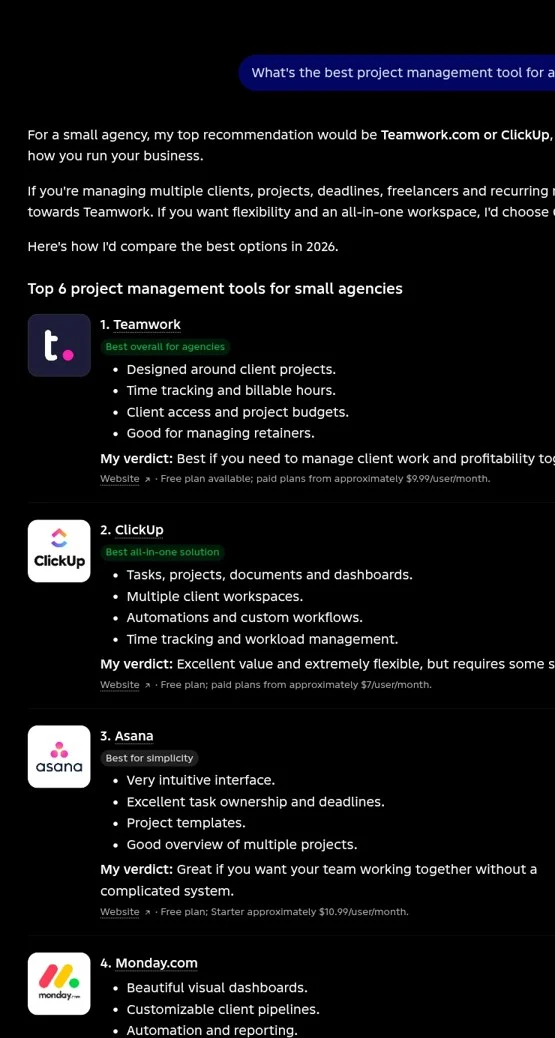
Caption: ChatGPT’s project management shortlist, requested with my connection routed through France. The core names matched the ones it gave me in Nigeria. Screenshot by author, 23 Nov 2026
What I asked, and the limits of a small test
The three questions were:
- “What’s the best way for a small business to accept online payments?”
- “Which e-commerce platform should I use to start an online store?”
- “What’s the best project management tool for a small agency?”
I used incognito windows, opened a fresh chat for every attempt and repeated each question in each location. I saved more than 30 answers in full, plus screenshots.
This was one person testing on one day, not a study. A VPN changes where a connection seems to originate, but it can’t reproduce everything about a real user in France, and AI assistants word their answers differently each time. Read what follows as patterns worth checking, not proof.
Local, half-local and global
Payments sat at the local end. From Lagos, ChatGPT’s recommendations were Nigerian providers every time, with fees in naira, Nigeria’s currency, and with the ways Nigerian customers pay: card, bank transfer and USSD (Unstructured Supplementary Service Data), the short codes people dial on a mobile phone to pay from a bank account. From Paris, both assistants turned European. Gemini’s two answers recommended Stripe, Mollie, PayPal, Square and GoCardless, quoted fees for European cards in euros, and suggested accepting Cartes Bancaires, a card network one answer listed among France’s “local favorites”. No answer from Paris, to any question, named a Nigerian company.
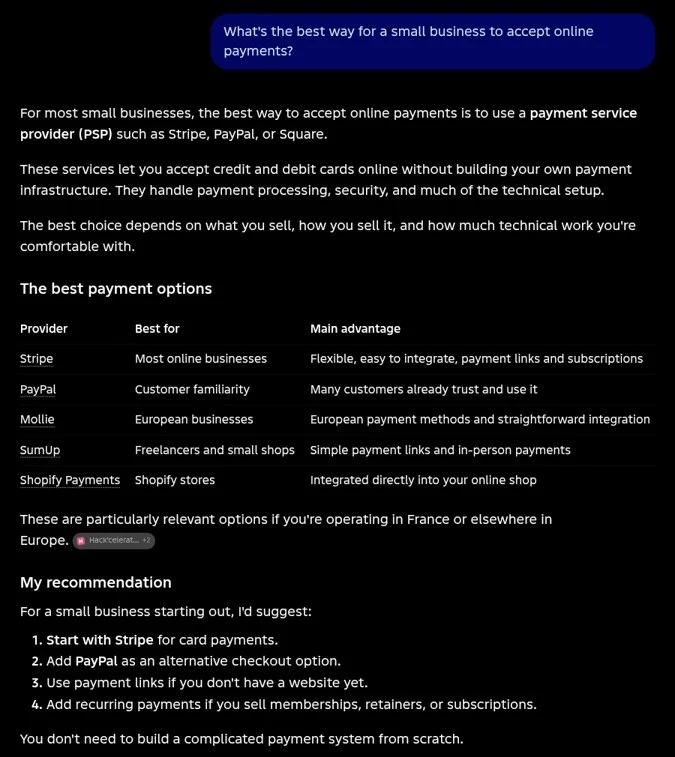
Caption: Requested over the VPN connection to France, ChatGPT’s payment shortlist turned European, adding Mollie and SumUp to Stripe and PayPal. Screenshot by author, 23 Nov 2026
Online stores sat in the middle. Shopify and WooCommerce appeared in every answer, from both cities and both assistants. What changed was everything around them: whether local platforms joined the list, and which currency the costs came in.
Project management was fully global. Every one of the ten answers to that question named Teamwork.com, ClickUp and Asana, and nine named monday.com. None referred to Nigeria or France. ChatGPT swapped its top two between the cities, but the names stayed the same.
One guide, two cities, one answer
The clearest clue to what drives these differences came from Gemini’s answers about online stores.
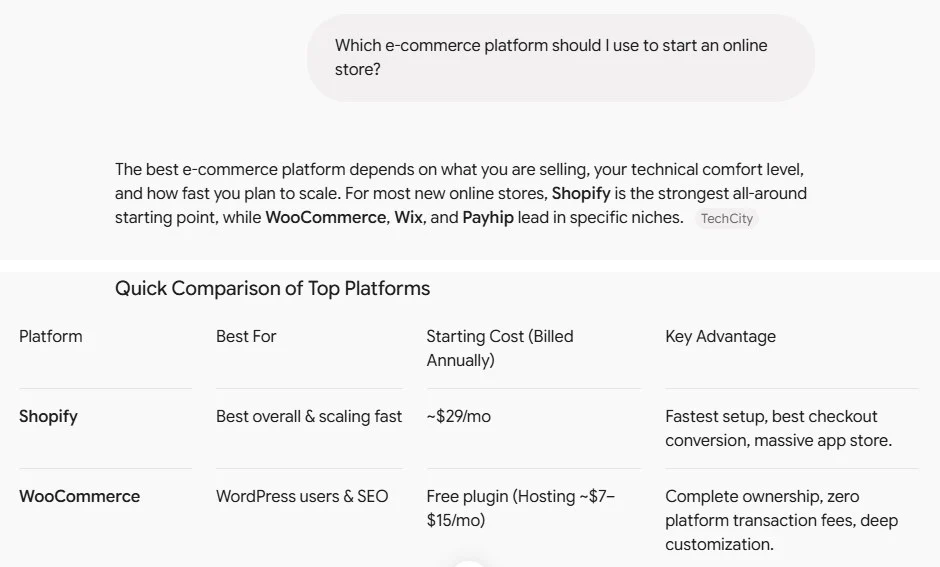
Caption: Gemini’s e-commerce recommendations from Nigeria: international platforms, priced in US dollars. A very similar list came back from France when Gemini cited the same general guide. Screenshot by author, 23 Nov 2026
From Lagos, one Gemini answer listed Shopify, Wix, WooCommerce, BigCommerce and Payhip, with costs in US dollars. From Paris, one listed Shopify, Wix, Squarespace, WooCommerce and BigCommerce, also in dollars. Four of the five platforms matched, and Shopify, Wix and BigCommerce were each put at about $29 a month in both. Both answers cited the same page: BestStorefront’s “Best Ecommerce Platforms for 2026: How to Choose”, a general guide whose title names no country.
Gemini’s second answer in each city looked different, and so did its sources. In Lagos, when it also drew on Nigerian guides from Webift and V3design, it added Bumpa, which it said was “built specifically for Nigerian merchants”, and Selar for digital products, and it mentioned billing in naira. In Paris, when its only source was a French-language ranking on L-Expert-Comptable.com, every price was in euros and PrestaShop got its own row as an option for “European stores wanting open-source” software.
Project management showed the same effect from the other side. All six of ChatGPT’s answers to that question, three from each city, cited the same agency software round-up from The Agency Shed. Judging by their titles, none of the sources behind the ten answers on project management was aimed at either country. Same reading list, same advice.
A few dozen answers can’t prove that sources caused these differences. But the match suggests a working theory: the user’s location helps decide what the assistant goes looking for, and the pages it finds decide what it says. When those pages are general, Lagos and Paris end up in the same place.
Paris didn’t always get the more local answer
It would be easy to assume that AI tools tailor advice more closely for European users than for African ones. On online stores, ChatGPT did the reverse in my test.
From Lagos, every ChatGPT answer included two platforms aimed at Nigerian sellers, Bumpa and Paystack Storefront, and the answers offered budget ranges in naira. Its sources included Webift’s “Best Ecommerce Platforms in Nigeria (2026) Compared”. The Paris answers leaned on the big international names. PrestaShop, which ChatGPT recommended for “businesses targeting France and other European markets”, made two of the three lists. Not one source behind those answers was a guide to France; they were general rankings, such as Hostinger’s “13 best ecommerce platforms in 2026: In-depth comparison”.
So Paris wasn’t automatically served a more tailored answer than Lagos. What seemed to matter was whether the assistant found a comparison written with that city’s buyers in mind.
Ask twice, get a different list
Gemini’s answers moved more from one attempt to the next than ChatGPT’s did. I asked Gemini the payments question four times from Lagos. Three of the four answers mixed the two worlds, ranking Nigerian and international providers in one table, with some fees in naira and others in dollars. The fourth kept to Nigerian providers, adding Monnify and Kora, and mentioned the international ones only in passing.
ChatGPT was steadier. Within each city, its lists barely moved between attempts: the same core payment providers, the same Nigerian store platforms in Lagos, and the same project management tool at the top.
Some variation is normal, because these tools generate each answer anew. But it means one response is a single draw from a range of possible answers, not a settled verdict.
How an assistant sees a market
Taken together, the test suggests that an AI assistant sees a market through the comparisons published about it. Between them, ChatGPT and Gemini cited at least eight different guides to payment gateways in Nigeria, and their payment answers were detailed and local. In the project management answers, no source was a guide to either country, and Lagos and Paris looked identical.
That has a practical side for small business owners anywhere:
- Tell the assistant where you and your customers are. Both assistants asked about this in follow-up questions, such as ChatGPT’s “Where is your business registered?” from Paris.
- Open the sources. They show whether an answer rests on a guide to your market or a general one.
- Ask more than once, and in more than one assistant, before shortlisting anything.
- Confirm fees and prices with the provider. One of ChatGPT’s Lagos answers said so itself, advising me to confirm rates, taxes and settlement terms before signing up.
For anyone who wants a market to appear as itself in these answers, the lesson is simple: the assistants can only reflect what has been written down.
The two agency owners got the same project management advice. That probably wasn’t because their needs are identical. More likely, as far as the assistants’ reading went, nothing told Lagos and Paris apart.
Lukman Yunusa is an SEO Strategist at OTH Agency LTD, working on SEO for OthFlow (othflow.com).