Standard Bank Group has expanded its partnership with Huawei to cover cloud, AI and data capabilities — including modernisation of its core banking systems — in an agreement announced at HUAWEI CONNECT 2026 in Shanghai.
The deal builds on a strategic partnership established in 2024. No contract value, timeline or implementation schedule was disclosed.
Core banking is the substantive part
The commitment that matters most is not the AI.
Jason Cao, chief executive of Huawei’s Digital Finance business unit, said Huawei will work with software partners to provide the technology foundation for modernising Standard Bank’s core banking systems, supporting migration from legacy infrastructure to cloud architecture.
Core banking is the system of record — accounts, balances, transactions. Replacing or migrating it is the highest-risk technology project a bank undertakes, and placing that work with a vendor is a considerably deeper commitment than deploying a chatbot.
Cao framed Standard Bank’s willingness to do so as validation: the bank’s trust in Huawei’s critical core banking infrastructure, he said, demonstrates the company’s capabilities and long-term commitment in financial services.
AI remains at the exploration stage
On AI, the language is deliberately provisional. The two will “continue to explore opportunities” in AI-enabled customer service, fraud detection, risk decision-making and intelligent operations.
Nothing has been committed or deployed. Leo Chen, Huawei’s Senior Vice-President and President of Enterprise Sales, said the company would continue investing in computing power, AI infrastructure, cloud, data and software engineering, and would “support core-system modernisation, strengthen AI infrastructure and scale AI applications.”
The cloud platform will be implemented in phases.
The inclusion argument
Funeka Montjane, Standard Bank Group Chief Executive of Personal and Private Banking, made the case on cost-to-serve.
“When technology lowers our cost to serve, it makes it commercially viable to reach communities that have historically been excluded from traditional financial services,” she said. “We believe technology can play a powerful role in expanding access to banking, helping more people save, invest and build a better future.”
That is the economic logic behind most African banking modernisation: the barrier to serving low-income customers is unit cost, and infrastructure that lowers it changes who can profitably be banked.
Standard Bank is Africa’s largest bank by assets, operating in 21 countries.
The question nobody addressed
The release notes that each of those 21 markets has distinct regulatory, infrastructure and customer requirements.
It does not say where core banking data will reside under the new architecture, how data residency obligations across 21 jurisdictions will be met, or what sovereignty provisions apply.
For a cloud migration of core banking systems across a continent where financial regulators are tightening data localisation rules, that is the operative question — and the announcement leaves it entirely open.
Who signed
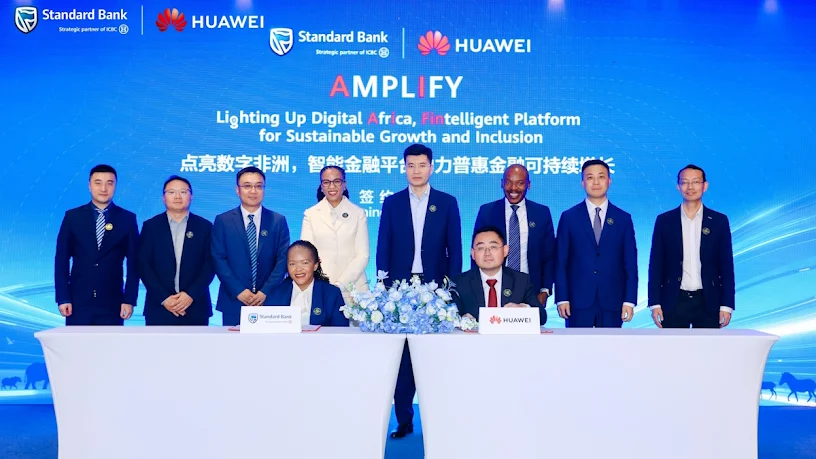
The agreement was signed by Tsebeletso Mashau, CIO of Africa Regions and Deputy Group CIO of Personal and Private Banking at Standard Bank, and Kui Zheng, Deputy General Manager of Huawei Enterprise South Africa.
“It is really about the possibilities that it unlocks for what we can do for our clients,” Mashau said, adding that the agreement “will not be remembered for the investment in technology, but it will be remembered for what it made possible for our clients and the future of banking in Africa.”
Khomotso Molabe, CIO of Personal and Private Banking and Deputy Group CIO, framed the objective as simplification: “By standardising and modernising our technology landscape across key areas, we are creating the foundation required to deliver greater agility, security, scalability and cost efficiency.”
Will Meng, chief executive of Huawei South Africa, said the company aims to be Standard Bank’s “most trusted delivery partner, most devoted innovation partner and most long-term strategic partner.”
Issued by Huawei Cloud