Egypt has begun what its Planning Minister described as intensive cooperation with the OECD to formulate a national artificial intelligence strategy — eighteen months after President Abdel Fattah El-Sisi launched one.
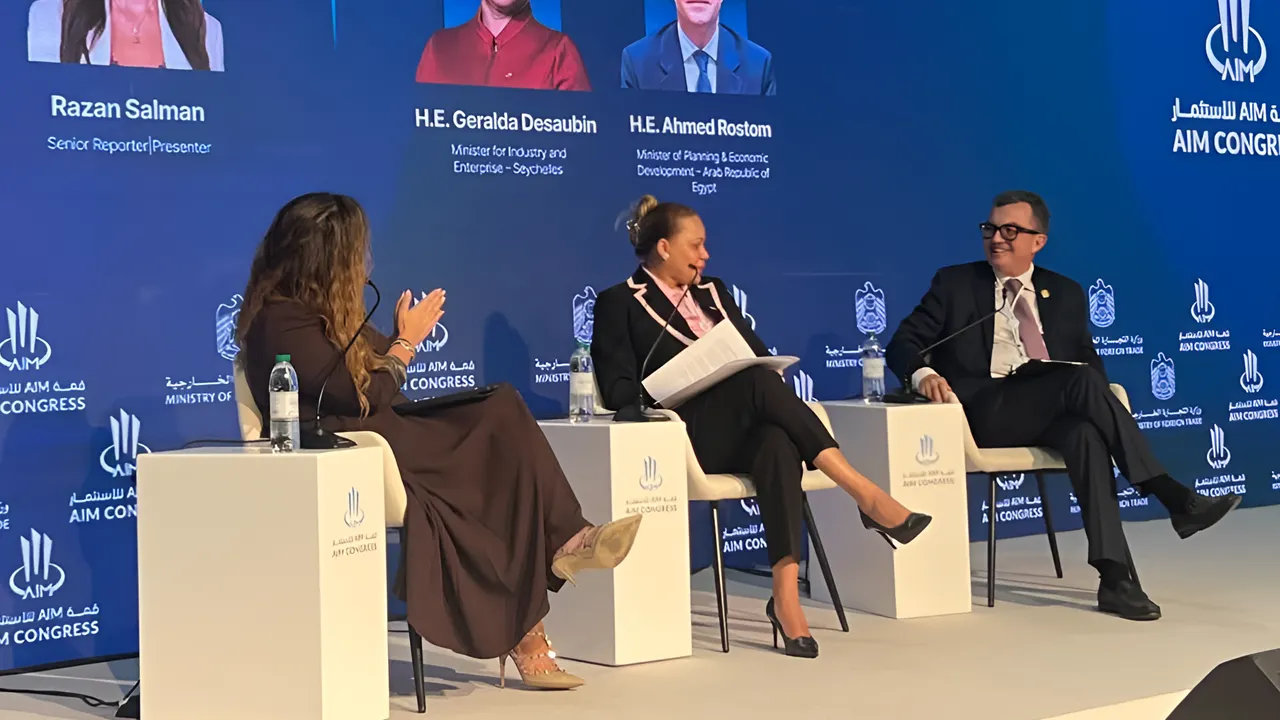
Ahmed Rostom, Minister of Planning and Economic Development, announced the work at the 15th AIM Congress in Dubai, saying the strategy will set a five-year vision for expanding responsible use of AI and emerging technologies, raising public awareness, and standardising government systems and regulations for secure data exchange.
It is not clear whether this enhances the existing National AI Strategy 2025-2030, replaces it, or looks ahead to a 2030-2035 period. Egypt is a Non-Member Partner of the OECD.
Two ministries, one strategy
The jurisdictional detail is worth registering. Egypt’s AI strategy has been owned throughout by the Ministry of Communications and Information Technology — through ITIDA, the Applied Innovation Centre, the Karnak national language model and the BelMasry translation platform launched last month. Communications Minister Raafat Hindi hosted the World Bank in July specifically to discuss the strategy’s rollout.
This announcement comes from a different ministry, at a congress abroad, framed around manufacturing and workforce rather than technology. Rostom spoke in a session titled “Quiet Reinvention of Global Manufacturing and the Art of Production at Scale,” addressing the Egyptian economy and its manufacturing sector before turning to AI.
Rostom took the planning portfolio in February 2026, succeeding Rania Al-Mashat, who had represented Egypt on AI governance internationally including at TICAD 9.
Workforce first
Rostom’s framing was explicitly about protecting workers rather than replacing them. AI integration in production, he said, must go hand in hand with reskilling, with the objective of empowering people to supervise and control AI systems rather than be substituted by them.
That responds to measurable public anxiety. A July poll by the Cabinet’s Information and Decision Support Centre found 56% of Egyptians believe wider AI adoption will eliminate jobs — a figure barely changed since 2023.
The measured risk may be lower than the perceived one. The International Labour Organization estimates 4.5% of existing jobs in low- and middle-income economies are potentially exposed to generative AI automation, against 14.2% in high-income economies, with 16.2% of jobs in lower-income economies more likely to be complemented than replaced. Displacement risk, on the ILO’s assessment, concentrates where automatable white-collar work concentrates.
But a government planning workforce transitions has to address the 56%, not the 4.5%. Rostom warned that failing to develop workforce capability alongside technological progress could turn the digital divide into a structural challenge for future employment, and called for greater investment in university science and technology programmes to widen access to AI knowledge, particularly among disadvantaged groups.
He also pressed for effective regulatory frameworks ensuring transparency and accountability, and stronger cybersecurity standards to address risks from increasingly autonomous interactions between algorithms.
What already exists
Egypt’s current strategy is not thin. Launched in January 2025 as the second phase of work begun in 2017, it rests on six pillars — governance, infrastructure, technology, data, ecosystem and talent — and targets an ICT contribution to GDP of 7.7% by 2030, $42.7 billion in AI-related economic value, more than 250 AI companies and 30,000 AI professionals.
Egypt established a National Council for Artificial Intelligence in 2019 and its first national strategy in 2021, work that lifted it 49 places on Oxford Insights’ Government AI Readiness Index between 2019 and 2023. It now ranks first in Africa and 51st globally, chairs the Arab Permanent Committee’s working groups on AI governance and quantum computing, and runs one of the continent’s few AI regulatory sandboxes through its Financial Regulatory Authority.
Why the OECD
The choice of partner carries some significance. South Africa’s Financial Sector Conduct Authority has noted that OECD AI principles carry no binding force on African states — they are a reference standard countries adopt voluntarily. Egypt working directly with the OECD on strategy formulation is a closer form of engagement than adoption of principles.
It also sits alongside a widening set of external partnerships: UNESCO on the teacher competency framework, the World Bank on strategy rollout, the UNDP on the AI-Share initiative, and commercial arrangements with NVIDIA, Cassava, Konecta and Deloitte.
The open question is what the OECD partnership adds that the existing strategy lacks. Rostom’s emphasis on workforce readiness, regulatory frameworks and standardised government systems suggests the gap may be implementation architecture rather than vision. Egypt has not been short of AI strategy documents. What it is now assembling — sandboxes, competency frameworks, coordination structures, ministerial training — is the machinery to execute one.