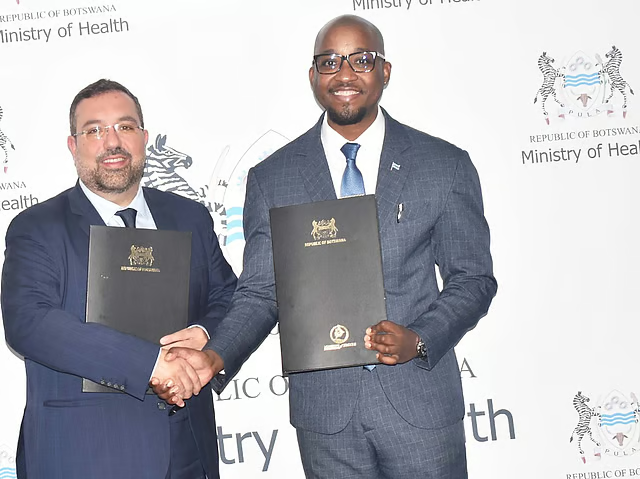
Abu Dhabi health technology group M42 has entered Africa through a ten-year strategic partnership with Botswana’s Ministry of Health, covering digital health transformation, a national genomics programme, precision medicine and local capability development.
The agreement, signed in Gaborone, is M42’s first health systems partnership on the continent. It was signed for Botswana by Acting Permanent Secretary Dr Tshepo Machacha, with Health Minister Dr Stephen Modise present alongside Kareem Shahin, chief executive of M42’s Digital Health Solutions platform and group chief digital officer. Financial terms were not disclosed.
Who M42 is
The announcement does not say, and it matters. M42 is a joint venture between G42 and Mubadala Health — placing this deal inside the same Emirati network that has been extending steadily across African technology infrastructure.
G42 is the partner behind the $1 billion geothermal-powered data centre at Olkaria in Kenya, announced during President William Ruto’s Washington visit and since stalled over grid capacity. Its subsidiary Presight has worked with Côte d’Ivoire on public sector digitalisation. Mubadala led Moove’s $250 million Series C this month. TAQA is supplying power to Morocco’s $1.2 billion Nexus AI Factory. AIQ has been in talks with Egypt’s petroleum ministry. MTN disclosed this week that its new Africa Data Hub vehicle has a UAE-backed partner it declined to name.
Botswana marks the extension of that footprint from compute and energy into national health systems.
Medicines first
The most immediate component is supply chain. M42 and Mubadala Bio will work with Botswana to strengthen the supply of medicines and medical equipment, aiming at a more reliable chain, better access to essential products and faster procurement.
“This agreement is about strengthening our health security, building resilience into our supply chains, and ensuring that no patient in Botswana is left without the medicines and medical products they need because of avoidable delays,” Modise said.
The timing is deliberate. Botswana’s Parliament approved a National Health Insurance Policy on 19 August, aimed at universal health coverage regardless of income or location. A functioning insurance scheme depends on medicines actually being available at the point of care.
AI, genomics and the data question
The longer-horizon work draws on M42’s capabilities in artificial intelligence, digital health, clinical care and genomics.
“This agreement marks our entry into Africa and presents an opportunity to deploy our full capabilities across digital health transformation, genomics, precision medicine and capacity development,” said Dimitris Moulavasilis, M42’s group chief executive.
Shahin said the company would work alongside Botswana’s health professionals to support a system where medicines are available, technologies work and care reaches communities across the country.
The genomics element is where the partnership carries implications beyond service delivery. A national genomics programme generates one of the most sensitive datasets a state holds, and African genomic data is scientifically valuable precisely because it is underrepresented in global reference datasets — which also makes it commercially valuable.
None of the material released addresses where that data will be stored, who will be able to use it for research or commercial purposes, or what rights Botswana retains over derivative work. Those questions have been live elsewhere on the continent: Rest of World reported in May that Ghana, Nigeria and Zambia had each rejected US-linked health data-sharing agreements.
The counterweight is that African-controlled genomic AI capacity is being built too. The South African Medical Research Council and University of Cape Town launched an AI for African Population Health Unit this month, explicitly to train models on African biomedical datasets under African institutional control. Botswana’s programme could complement that or sit outside it, depending on terms not yet public.
A small country, a long contract
Botswana has a population of roughly 2.6 million and one of the more stable health systems in southern Africa. Ten years is a long commitment for any government to make to a single foreign partner, and it spans at least two electoral cycles.
The upside is coherence. Health systems fail at integration more often than at any single component, and a decade-long partnership covering supply chain, digital infrastructure and clinical capability at once avoids the fragmentation that has undermined shorter interventions elsewhere.
The test will be what Botswana retains at the end of it — trained clinicians and technologists, systems it can operate independently, and control of the data generated along the way.