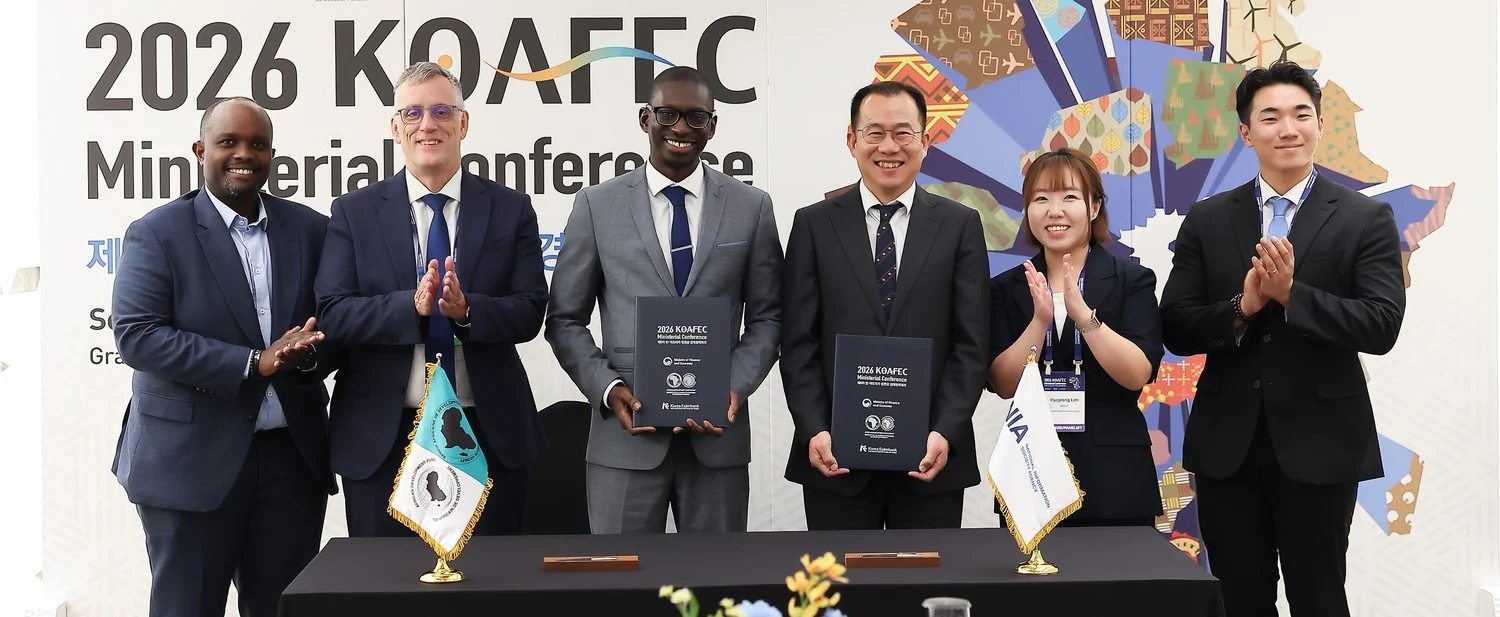
The African Development Bank and Korea’s National Information Society Agency signed a three-year letter of intent on AI and digital transformation cooperation in Seoul on 9 September, on the sidelines of the 8th Korea-Africa Economic Cooperation Ministerial Conference.
Ousmane Fall, the Bank’s Director of Industry and Trade Development, signed for the AfDB. Yoon-Seok Ko, NIA Vice-President, signed for the Korean agency.
Scope
Areas earmarked for cooperation:
- Data governance
- Creation of AI-ready datasets
- Digital public infrastructure
- Training and technical assistance for public sector managers and engineers
- Digital infrastructure rollout
The division of labour is explicit: NIA supplies technical expertise drawn from digital policy work with around 137 countries; the AfDB identifies country priorities and mobilises financing, including through the KOAFEC trust fund.
Korea joins India as a DPI exporter
The digital public infrastructure element is the most strategically distinctive part.
Morocco and India agreed a joint commission last month partly on the same basis, with India presenting its Aadhaar, UPI and DigiLocker stack — government-owned, open, interoperable rails rather than proprietary platforms.
Korea is now making a comparable offer through NIA. That gives African governments a second source for DPI expertise, and it differs in kind from US hyperscaler cloud contracts, Chinese infrastructure financing or Gulf sovereign capital.
The trust fund, accurately
Korean contributions to KOAFEC total $132.82 million as at 31 May 2026, making it the AfDB’s largest active bilateral fund. Of that, approximately $50 million has gone to technical assistance and project preparation — financing more than 40 investment operations and programmes worth over $6 billion, and mobilising at least $4 billion.
The fund has also supported more than 1,300 African startups and entrepreneurs, benefiting over 1,200 businesses and contributing to more than 5,000 jobs.
Korea joined the African Development Fund in 1980 and the Bank in 1982. KOAFEC launched in 2006 and is financed exclusively by Korea.
What the conference produced
The ministerial conference ran 8–11 September under the theme “Harnessing AI and Digital Infrastructure for Africa’s Transformation,” closing with a final declaration and an action plan committing to AI projects in several African countries — particularly in agriculture, water, health, governance and capacity building.
That is a partial answer to the question this conference posed. Korea’s distinctive contribution to African AI has been concessional lending tied to technical institution-building, of the kind behind the $170 million loan for a Tanzanian AI institute approved in August — its first AI project under the Economic Development Cooperation Fund. A letter of intent on datasets, data governance and public sector capability is consistent with that model rather than a departure from it.
The AfDB continues to anchor the economic case on its own projection that AI could add up to $1 trillion to African GDP by 2035, conditional on investment in digital infrastructure, affordable connectivity, reliable electricity, skills and enabling policy.