Morocco’s Ministry of Digital Transition and Administrative Reform has released two open-source AI tools for Moroccan Darija — the first concrete output from its partnership with French AI company Mistral, signed a year ago.
The tools:
- A language identification classifier that distinguishes between Arabic dialects, including Darija
- An automatic speech recognition model, built on Mistral’s Voxtral technology, that transcribes spoken Darija into text
Both are released openly, meaning any Moroccan developer, startup, researcher or government agency can build on them immediately rather than solving the dialect problem independently.
Why dialects are hard
Most large language models handle colloquial Arabic poorly. The overwhelming majority of Arabic text in existence is Modern Standard Arabic — the written, formal register — which makes dialects difficult to train for.
Darija is not MSA. It is a distinct spoken variety that most Moroccans use daily and that general-purpose models struggle to process.
Code-switching is the harder half
Voxtral handles conversations that shift between Arabic, French and English mid-sentence.
That is the technically demanding part and the practically necessary one. Moroccan speech routinely moves between the three languages within a single utterance, and a transcription model that breaks at the switch is not usable for customer support, public services or media captioning.
Target applications named by the ministry include public services, education, media, customer support, document digitisation and multilingual data processing.
A year from memorandum to model
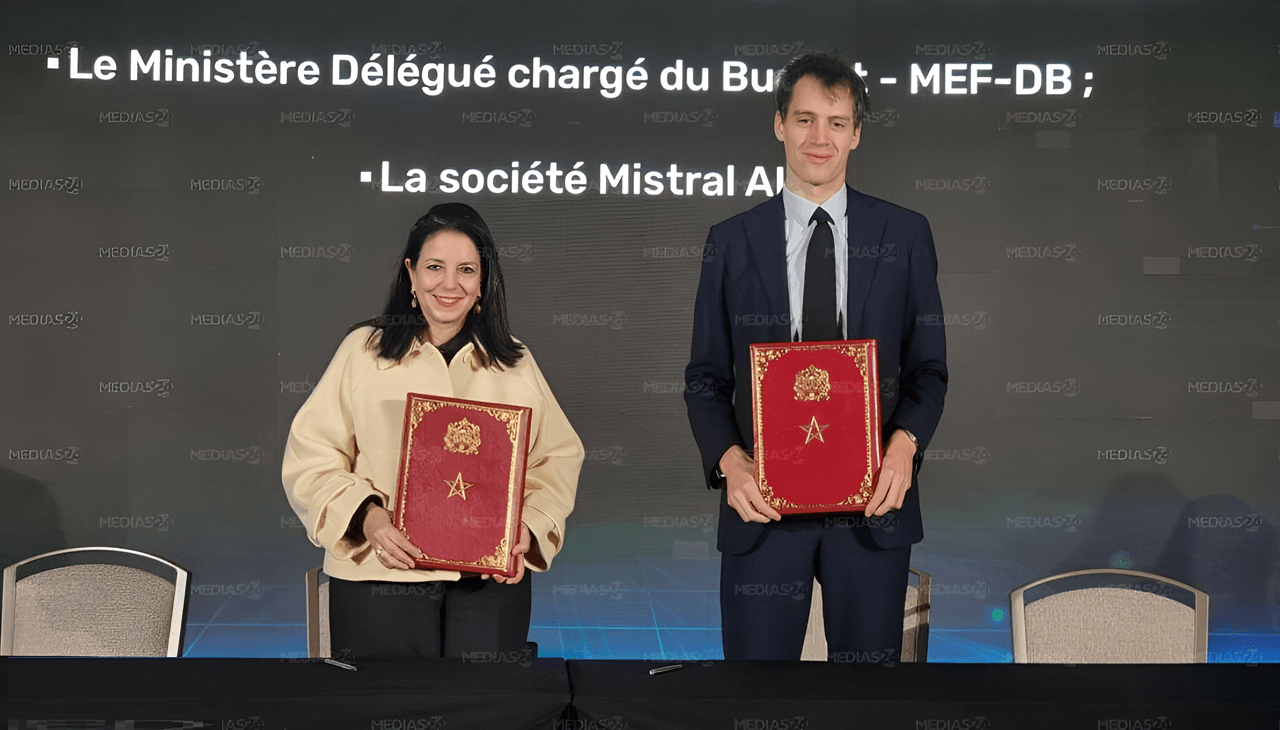
Minister Amal El Fallah Seghrouchni and Mistral co-founder and chief executive Arthur Mensch signed a memorandum in September 2025, covering education, applied research and knowledge sharing, with emphasis on ethical and inclusive use and data protection.
The Darija tools are the first output, released twelve months later. In a field where memoranda frequently produce nothing at all, that is a usable benchmark for others signing similar agreements.
The tools complement a wider suite of AI solutions the ministry develops and trains in-house to power its own AI marketplace and support public administrations. Further models and use cases are under development across generative AI, language processing, speech recognition and digital public services.
The release forms part of the AI Made in Morocco roadmap and the Maroc Digital 2030 strategy.
What hasn’t been published
No accuracy benchmarks, no detail on the volume or provenance of the Darija training data, no licence terms and no download location have been disclosed.
Those matter for an open release. “Open source” covers a range of licences with materially different permissions, and without benchmarks developers cannot judge whether the models are good enough to build on.