When African governments negotiate with credit rating agencies and investors, the quality of their own data shapes what borrowing costs them. That is the argument Amelia Marie Michele N. Irenge, a Congolese fellow in the African Young Women Leaders programme, makes from her posting to the Africa Credit Ratings Initiative in New York.
Digital data systems can consolidate debt levels, fiscal balances and growth trends into stronger analysis, she says, giving countries a more credible account of their own economies. “When countries are able to present clearer and more credible data, it influences how they are assessed in terms of risk.” Those assessments feed directly into borrowing costs and access to international capital markets.
Her second point is sharper. Delayed or incomplete information weakens any AI-supported analysis built on it, and externally developed tools carry assumptions calibrated for other settings. African institutions therefore need reliable data infrastructure, local analytical capacity and authority over how their economies are represented.
That is data sovereignty argued in basis points rather than principle — and it arrives as the African Union works to establish its own credit ratings agency, on the premise that existing agencies systematically misprice African risk.
Where the other fellows encounter it
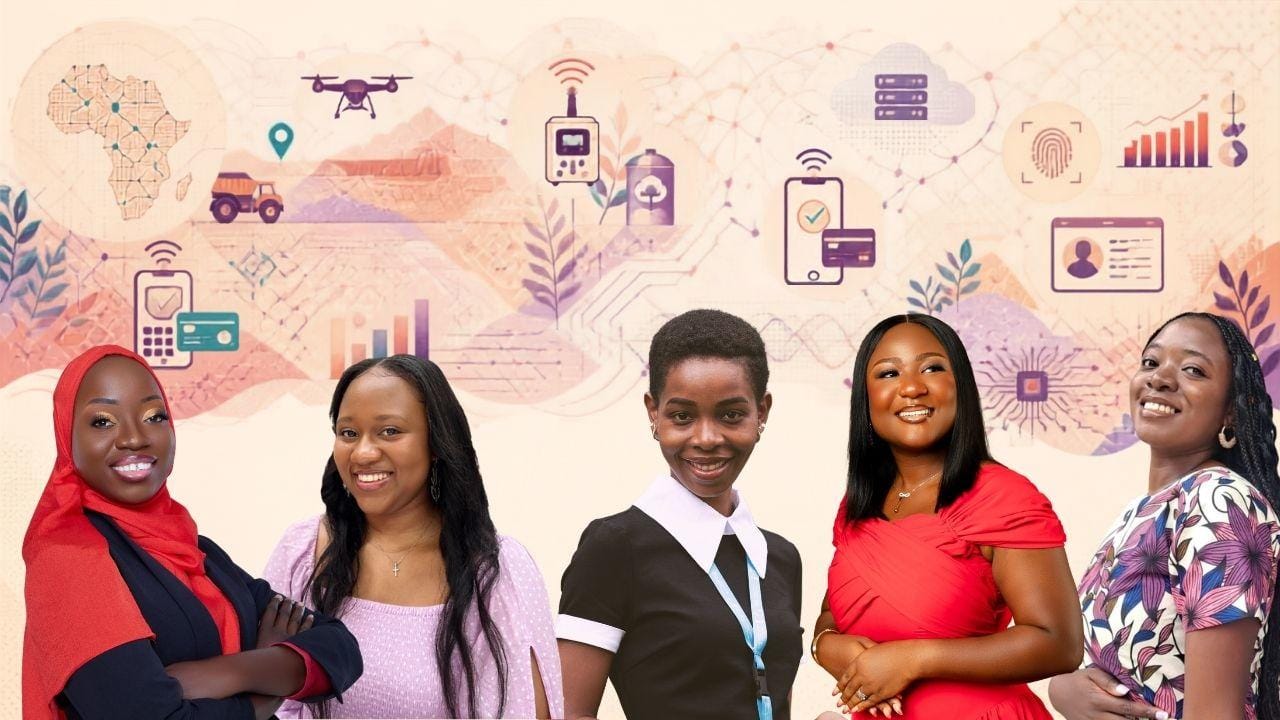
Irenge is one of five fellows in the programme’s fourth cohort whose work sits at the intersection of AI, data and public institutions, deployed across countries other than their own.
Diana Makafui Tuekpe, a Ghanaian fellow supporting inclusive digital transformation in Malawi, points to the country’s national birth registration campaign. A school-based model trains teachers as registration agents, bringing digital tools into schools, health facilities and trusted community spaces. The outcome is a child gaining legal identity, and with it stronger access to education, healthcare and protection.
Choolwe Jane Nsanzya, a Zambian fellow deployed to Nigeria, works with the Mine-Tech UniPod at Nasarawa State University, Keffi — a facility combining AI, drones, GIS, data analytics and advanced rock-evaluation equipment so students can develop and test locally grounded mining solutions. “When technological innovation is anchored locally, it can leave lasting, generational impact,” she says.
That facility belongs to the same UNDP UniPod network as the AI UniPod in Addis Ababa, which completed its first startup bootcamp last month, and the innovation hub launched at the University of Lagos in April. The model is consistent: university-hosted, equipment-heavy, aimed at converting research capacity into local enterprise.
In Botswana, Senegalese fellow Fatou Sarr works on AI-powered monitoring, reporting and verification systems for carbon markets — tracking greenhouse gas emissions from rural cookstoves to improve transparency, connect communities to carbon revenues and strengthen climate action. Her standard is exacting: “AI should expand people’s choices and capabilities.”
Immaculate Tushabe, a Ugandan gender fellow in Addis Ababa, sees the same questions at household level. Mobile platforms are helping women-led small businesses access financial services, receive payments and reach customers, and gender data can sharpen policy design. But access depends on connectivity, digital literacy, control over devices, training and trust. Women leaders bring necessary knowledge to those decisions because, as she puts it, “they understand the everyday realities behind the data.”
Context as a design requirement
The common thread across the five is that context is not a softening consideration but a technical constraint.
“For AI to be inclusive and ethical in Africa, it has to start with context,” Tuekpe argues — meaning systems capable of working offline and in low-resource environments, supported by data governance, policy frameworks and institutional capacity, and able to handle African languages, cultures and economies.
Nsanzya, whose background is in law and human rights, describes approaching digital transformation “through a protection-first lens,” with accountable rules and community-centred policy protecting rights while access expands. Irenge adds the corresponding design standard: “AI solutions should be designed to fit African realities,” backed by investment in African researchers, developers and public institutions.
Those are the same requirements running through the technical work iAfrica has covered this year — offline-capable health systems in Uganda, AI trained on African biomedical datasets at the SAMRC and UCT, language models built for Darija, Amazigh, Igbo and Hausa rather than translated into them.
The fellows’ distinctive contribution is where they sit. Not building the models, but inside the institutions that will procure, govern and be assessed by them.
“Africa has always innovated within constraints,” Tuekpe says. Tushabe’s observation is quieter and more pointed: “Young women leaders are already doing this, often quietly.”