African languages will not survive by being preserved in books, archives and cultural memory alone. They have to be used — in news media, science and public life — and built into the data and AI systems that will shape how information moves.
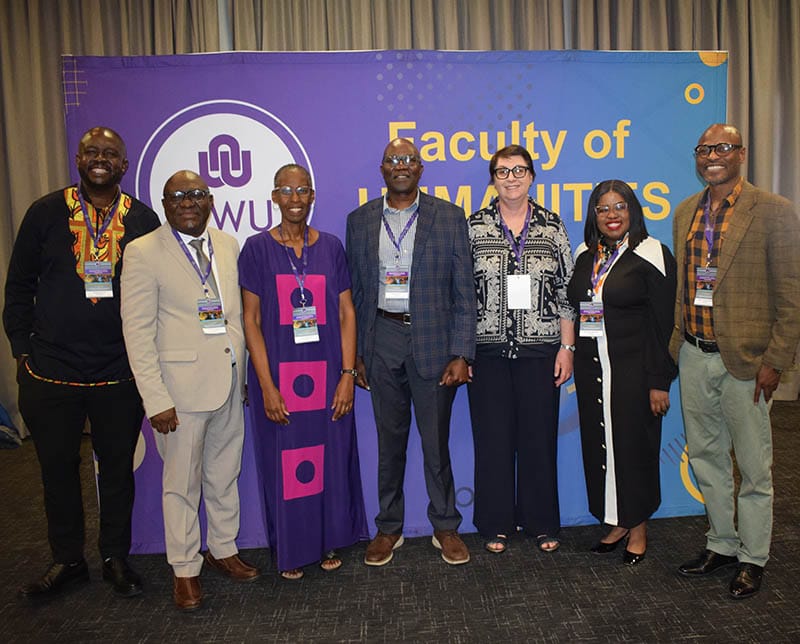
That was the central argument at North-West University’s Indigenous Language Media in Africa research entity as it marked ten years with a two-day symposium at the Birchwood Hotel and OR Tambo Conference Centre in Kempton Park on 25 and 26 August, held under the theme “Legends of the past, present and tomorrow.”
The keynote challenge
Professor Monica Chibita of Uganda Christian University used her address to reject the framing that has dominated much of the field.
“Indigenous language media do something more than preserve,” she said. “They allow people to participate in the present.”
Her argument, delivered under the title “Preservation and more: Indigenous language media, social change and the African Knowledge Society,” was that indigenous languages enable engagement with public policy, health, education, business and knowledge — and that their importance grows as algorithms and AI increasingly mediate how people communicate and access information.
She called for what she termed “dynamic preservation”: keeping languages alive by using them in investigative journalism, climate science, public health, entrepreneurship, coding, data journalism and artificial intelligence.
Looking to ILMA’s second decade, Chibita said African languages must be represented not only in content but “in the labs, in the code, in the data, in the standards and in the governance.”
NWU already has some of that
The clearest illustration of what Chibita described sits at the same university.
Dr Seani Rananga completed a PhD at NWU developing a multilingual AI framework capable of detecting misinformation across English, isiZulu and Sepedi — work backed by a Google PhD Fellowship and awarded Best Poster at the 2025 Deep Learning IndabaX. Her central finding was that machine translation quality directly determines how well AI performs on low-resource languages, meaning improvements upstream flow through to everything downstream.
That is African languages in the code, the data and the standards, produced at NWU rather than argued for in the abstract. NWU also became the first South African university to adopt an official AI policy in January.
The gap Chibita is pointing at remains substantial. African languages account for less than 0.1% of internet content. The GSMA estimates fewer than 2% of the continent’s languages receive meaningful support from modern AI platforms. Nine of South Africa’s eleven official languages qualify as low-resource for language modelling.
But the work is accelerating — the Gates-funded African Next Voices dataset recording 9,000 hours across 18 languages, Lelapa AI’s InkubaLM, LINGUA Africa’s 26 funded projects, and the GSMA’s five-government ATLAS Umoja initiative among them.
Language and power
Opening the symposium, Professor Dumi Moyo, executive dean of the Faculty of Humanities, said the anniversary recognised both ILMA’s first decade and a community of scholars who established indigenous language media as a field of academic inquiry.
Language remains closely tied to power across Africa, Moyo said, where colonial languages continue to dominate government, education, business and media. Indigenous language media therefore have a role in giving communities greater voice and recognition.
He credited ILMA’s work with contributing to the decolonisation of media studies and establishing indigenous languages as legitimate vehicles for knowledge production, and acknowledged ILMA director Professor Abiodun Salawu for moving the field from a peripheral concern to a recognised discipline.
Established in 2016, ILMA’s research has covered African-language print, broadcasting and digital media, alongside journalism, democracy, development, political economy and indigenous communication systems.
Goodwill messages came from Dr Keaobaka Seshoka, chief executive of the Pan South African Language Board; Reggy Moalusi, executive director of the South African National Editors’ Forum; and Professor Mirna Nel, deputy dean for research and innovation in the Faculty of Humanities.
The second decade
ILMA spent ten years establishing that African languages belong in modern communication. The task Chibita set for the next ten is different: ensuring they help shape the technologies, knowledge systems and platforms that will carry that communication.
Originally published by NWU News: news.nwu.ac.za/ilma-marks-10-years-taking-african-languages-ai-age