Kenya has signed a five-year framework with the Emerging Markets Working Group of Stanford University’s Hoover Institution to apply data and AI to policy and economic decision-making, with an El Niño early-warning system as the first deliverable.
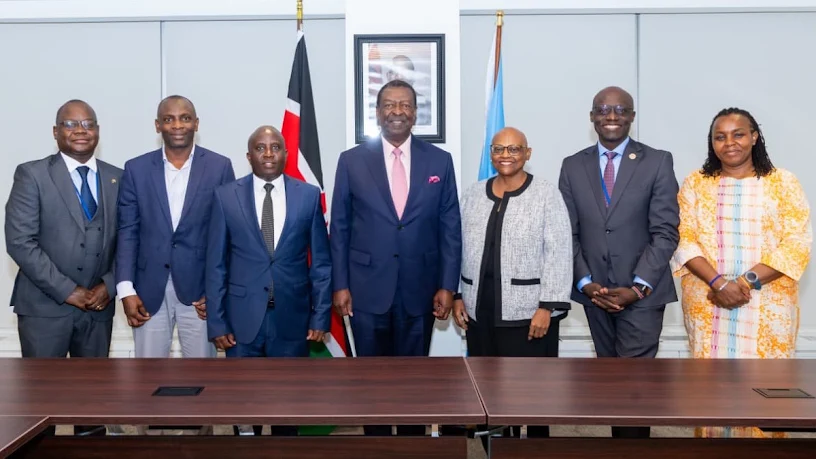
Prime Cabinet Secretary and Foreign Affairs Cabinet Secretary Dr Musalia Mudavadi signed for Kenya on the sidelines of the 81st United Nations General Assembly in New York. Dr Jendayi Frazer, co-director of the working group, signed for Hoover. Frazer served as US Assistant Secretary of State for African Affairs under President George W. Bush and previously as US Ambassador to South Africa.
What gets built first
The El Niño Impact Monitoring and Response System integrates climate, geospatial, water, agriculture and infrastructure data to generate county-level intelligence, with the aim of faster and better-coordinated responses.
It is a defined use case with an identifiable user. Kenya has faced severe flooding and displacement from past El Niño events, and responses have historically been slowed by fragmented information across ministries and counties.
Three further tools are planned:
- Digital Trade Readiness Index
- Public-Private Partnership Governance Tracker
- Sectoral Resilience Scorecard
All sit on a Growth, Resilience and Investment Platform, intended to improve investment readiness, policy coordination and development intelligence.
The stated objective
Principal Secretary for ICT and the Digital Economy John Tanui framed the ambition as moving from data to insight and from insight to action.
The aim is not to digitise existing processes, he said, but to build a government that can “anticipate challenges, allocate resources effectively and create new opportunities for citizens and businesses.”
“Beyond these tools, the strategic objective is to build lasting institutional capability in evidence generation, analytics, monitoring, evaluation and policy development,” Tanui said.
That last point matters more than the tools. Dashboards built by an external partner are easy to launch and hard to sustain once the partnership ends. Institutional capability is what remains.
The question the announcement leaves open
County-level intelligence combining climate, water, agricultural and infrastructure data is among the more sensitive datasets a government holds.
The announcement does not say where that data will be hosted, who will process it, or what access the Hoover Institution will have. Kenya’s own draft AI strategy is among four African national strategies that name dependence on US technology providers as a strategic and sovereignty risk, according to Rest of World reporting iAfrica covered in May.
That does not make the partnership unwise. It does make data governance the first thing worth asking about.
A foreign-ministry-led AI strategy
The agreement is the latest in a series of AI and data partnerships Kenya has signed as foreign policy rather than technology procurement. Mudavadi’s ministry has anchored the Kenya-France Africa Forward AI clusters programme, and Tanui has led talks with the US Embassy and American Chamber of Commerce on AI cooperation and data governance.
Kenya’s partnership map now spans Microsoft and AWS, OpenAI, France, the EU and Hoover — alongside a draft national AI policy still in consultation and an AI Bill before Parliament.
It arrives in a difficult month. Anthropic published a threat intelligence report this week naming a Kenyan actor that used its models to mass-produce political content ahead of the 2027 election. Kenya’s draft policy proposes a Kenya AI Safety Institute that would be positioned to examine exactly such cases. It does not yet exist.