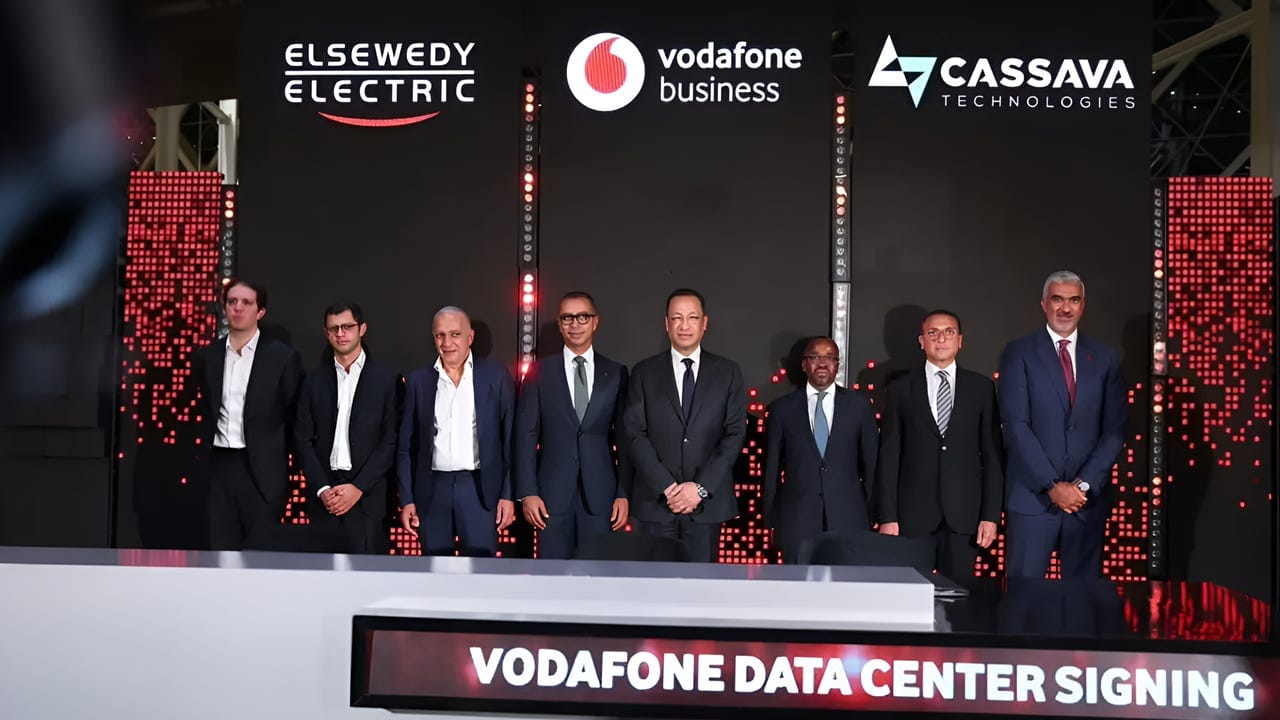
Vodafone Egypt and Cassava Technologies have launched Egypt’s first AI factory, offering government entities and businesses GPU-as-a-Service on NVIDIA hardware with data hosted and processed inside the country.
The facility forms part of Vodafone Egypt’s plan to invest more than EGP 20 billion ($300 million) in the current fiscal year, building on more than EGP 125 billion ($2.45 billion) across 28 years in the market. The partnership includes access to NVIDIA training and enablement programmes intended to help organisations build AI capability rather than simply rent compute.
Egypt is buying from everyone
The launch reads differently in light of what Communications Minister Raafat Hindi said days earlier: that Egypt is actively courting multiple global infrastructure partners rather than backing a single national champion.
That is a deliberate posture, and it explains a run of announcements. Konecta opened its first global generative AI centre of excellence in New Cairo last month as part of a $100 million investment. Deloitte committed a further $80 million to its Egyptian technology hub, now over 900 staff. NVIDIA backed the SIGNALS accelerator with RiseUp, A15 and BitRoot. The World Bank pledged support for the second National AI Strategy. Hassan Allam and A15’s $400 million data centre was licensed in June.
Multi-sourcing is a hedge. A country that hosts Cassava, Konecta, Deloitte, NVIDIA and Huawei simultaneously is harder to leverage than one that has committed to a single provider — and Egypt’s own National AI Strategy 2025-2030 targets 250 AI companies by 2030, which requires a plural supplier base rather than an exclusive one.
Cassava moves north
For Cassava, this is its first significant push into North Africa.
The UK-headquartered group operates across Africa, the Middle East, Latin America and the United States through Cassava AI, Liquid Intelligent Technologies and Africa Data Centres, serving customers in 94 countries. Its Africa Data Centres subsidiary runs the continent’s largest carrier-neutral network, connected by more than 100,000 kilometres of cross-border fibre and serving over 50 telecoms carriers and cloud providers, with established positions in Johannesburg, Cape Town and Nairobi.
It is backed by NVIDIA, Google and the US International Development Finance Corporation, and is three years into a $700 million African data centre rollout with NVIDIA covering South Africa, Egypt, Kenya, Morocco and Nigeria. The Egyptian AI factory builds on a separate Vodafone and Elsewedy Electric partnership.
Cassava’s positioning has been consistent: infrastructure backbone rather than reseller. Group executive Angus Hay told Enlit Africa in May that the company sees renewable energy as “the new oil” for African AI infrastructure. The Egypt facility extends that argument into a market with different power economics from southern Africa.
What sovereignty means here, and what it does not
The data residency claim is concrete. Processing inside Egypt satisfies local regulatory requirements, and the companies argue it improves cybersecurity and gives organisations greater control over data protection.
That matters commercially. Egypt’s financial and government sectors face residency obligations, and Nigerian and South African regulators have moved the same way — which is why OADC, UniCloud and Atlancis have all built local AI compute propositions this year.
But sovereignty in this configuration is jurisdictional rather than structural. The facility runs NVIDIA silicon, operated by a UK-headquartered company with US development finance backing. Data stays in Egypt. The supply chain does not become Egyptian.
That is the same qualification Rachel Adams of the Global Center on AI Governance offered in reporting iAfrica covered in May: digital sovereignty “cannot mean total independence from global AI supply chains,” but can mean stronger control over sensitive data, better procurement terms and clearer accountability from foreign providers.
On that definition, the Vodafone-Cassava facility delivers. Egypt’s four-way position — first in Africa on the Government AI Readiness Index, second on outsourcing AI readiness, and among the countries whose draft AI strategy names dependence on US technology firms as a strategic risk — is a country buying capability while trying not to be captured by it.