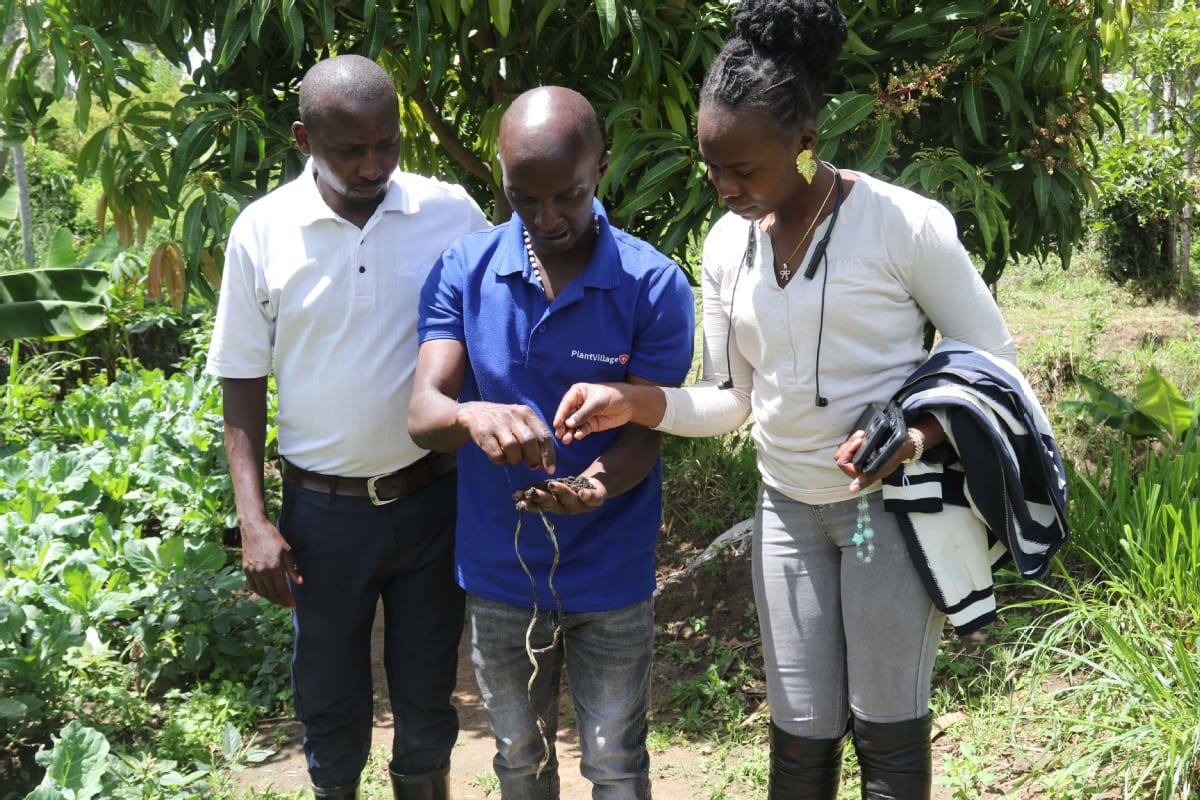
In Matungulu ward in Kenya’s Machakos County, farmer John Wambua photographs his maize leaves with a smartphone and receives a diagnosis within 20 seconds — a fall armyworm infestation, with recommended solutions to address it.
“This app has greatly helped me and many farmers around this area,” Wambua said, adding that the tool diagnoses problems, provides instant responses, tailored recommendations and expected outcomes. He no longer calls an agronomist to test his soil pH, cutting costs in the process. The app also provides weather forecasts. “When the rains started, many farmers did not plant because they assumed it was not yet the onset of rainy season. I planted because the app had predicted the rains had begun. That is why the size of my maize crop is bigger than the rest in the village,” he said.
Wambua and his neighbor Cynthia Ayekoh, a farmer from nearby Kangundo, both use PlantVillage+, an AI-powered crop diagnostics app introduced in the area about three years ago. Ayekoh said the app has helped her detect pests and diseases early, before they spread to worrying levels, and has helped avoid the misdiagnosis that previously led farmers to spray the wrong chemicals and damage their crops. “I no longer have to go looking for an agronomist. I just use the app and get a solution right away, which is also cheaper for me,” she said. She hopes the company will introduce an offline version and local language options to increase accessibility for farmers with limited formal education.
Across Kenya and the wider continent, AI is being quietly adopted in agriculture — the dominant economic sector in many African countries. In addition to PlantVillage+, tools such as Virtual Agronomist have been used by Kenyan smallholder farmers to get real-time advice on pest control, fertilizer usage and crop disease detection.
PlantVillage+ is accessible through the Google Play Store and is available in more than 40 countries worldwide, with a strong presence in Africa. The platform has between 400,000 and 500,000 users each month, according to brand manager Mercyline Tata. Musau Mutisya, a sales representative based in Machakos County, said he is currently working with more than 400 farmers in the county. The company is also developing software for commercial farms to manage activities such as spotting infestations, determining when to apply fertilizer and identifying when crops are ready for harvesting.
Raphael Ntonja, a machine learning engineer at PlantVillage+, said the company trains its AI model using crop images showing different diseases. “We photograph various crops and diseases, collect the data and label the diseases on the leaves before training the model,” he said. “After training, we evaluate the model ourselves before deploying it for farmers to use.” Ntonja said AI has the potential to transform agriculture and strengthen food security by decentralizing expertise. “The knowledge that farmers previously needed to get from an expert can now be accessed through AI. No matter where a farmer is, including in the most remote areas, they can get help through a phone.”
Harun Katusya, a data scientist and chief executive of Africa’s Premier AI Conference 2026, said AI is poised to transform African agriculture from reactive, survival-based farming into predictive, precision-driven agribusiness. Over the next decade, he said, AI will guide farmers on when to plant, irrigate, fertilize and harvest using data from satellites, sensors and weather systems. Mobile-based AI tools, including WhatsApp bots, could give smallholder farmers access to real-time agronomic advice, addressing the chronic shortage of agricultural extension officers. “AI is not just about producing more food; it is about producing smarter, preserving more and improving distribution,” Katusya said.
Joseph Gitonga, principal lead for AI and agriculture transformation at Kenya’s Strathmore Agri-Food Innovation Center, said AI delivers the greatest value when it augments existing human systems rather than replacing them. “Diagnostic and advisory AI tools are currently the most practical applications because they provide measurable and immediate outcomes,” he said at a Strathmore webinar in March.
Elizabeth Wamicha, an AI and digital innovation researcher and adviser at Nairobi-based digital innovation firm Qhala, said trust in AI systems depends on transparency about how farmer data is collected, stored and used. “Farmer data literacy is critical so producers understand the value and risks associated with sharing their information. Farmers should be treated as knowledge contributors rather than passive data sources. AI development must shift from data extraction toward farmer empowerment and cocreation,” she said.