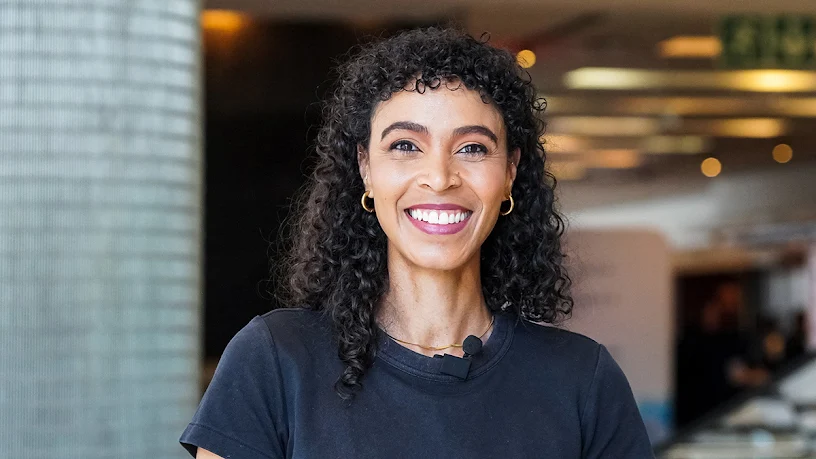
Lelapa AI is adding text-to-speech to its product line and preparing to take its language technology outside Africa, chief executive and co-founder Pelonomi Moiloa has told ITWeb TV — a move that would make the Johannesburg lab an exporter of AI methodology rather than a recipient of it.
The company’s live API, Vulavula — “to talk” in xiTsonga — currently converts multilingual contact centre conversations into structured text for analytics, quality assurance and compliance, built for telecoms and financial services.
“We want to add text-to-speech after that and have voice generation, so that you can plug it into anything, and have devices speak vernacular — that would be cool,” Moiloa said. “We’ve done it for three languages now, and we would like to roll that out against all the languages that we offer.”
Beyond the continent
The more consequential ambition is geographic. “We do believe that we built a technology that’s beneficial for a majority world, smaller models, less data, and that’s what we’ve set out to achieve.”
That is a different proposition from every other African language-AI company in the field. Intron, Spitch, Botlhale, Untapped AI and Veta Origin are all building for African languages and African markets. Lelapa is arguing that the constraint it solved for — building capable models where data is scarce and compute is expensive — describes most of the world’s languages, not just Africa’s.
The efficiency claim behind it is specific. Through its machine translation models, Lelapa has used 60% less compute and 60% less data than would normally be required to adapt a model to a new language. Its InkubaLM small language model was subsequently compressed by a further 75% without performance loss through the Buzuzu-Mavi Challenge, run with Zindi, which drew 490 participants from 61 countries.
“This showcases opportunities to the rest of the world that creating technologies for different languages doesn’t have to be tricky,” Moiloa said.
A crowded voice market
The text-to-speech addition arrives into a field that has moved quickly. Intron released Sahara v2.5 last month with voice generation in Igbo and Hausa and code-switching across around 20 African languages. Spitch supplies Yoruba, Hausa, Igbo, English and Amharic speech models through Cencori’s developer gateway. Botlhale AI covers eleven South African languages for contact centres.
Lelapa’s three languages put it behind on coverage. Its argument has never been breadth, though — it is that models built on less data and less compute reach places where heavier systems cannot go, which matters where roughly 70% of users are on entry-level smartphones.
The problem it solves for enterprises
Moiloa describes Lelapa’s role as an infrastructure layer between institutions and the people who deal with them.
“Their internal systems are functioning in business language in the South African context, which is English. But there are Zulu, Xhosa, Swati, Sotho, Tsonga and Afrikaans-speaking people communicating with this institution that speaks English. We provide the language infrastructure layer between the people and that institution.”
In a contact centre, that means transcribing and translating local-language audio so it becomes searchable and analysable by systems that only read English — or enabling a WhatsApp bot that engages customers in vernacular.
What has changed in four years
Moiloa’s observations on the shift since Lelapa launched in December 2022 are worth noting.
“When we first started Lelapa, we never used the word AI — we were always talking about machine learning, and that has since changed.” Models have improved on local languages where data exists, and hyperscalers have become more literate about the problem.
What has not changed is the gap between capability and value. “The true value isn’t necessarily in the models themselves, but where they provide value, and that has been the tricky part,” she said. “People still don’t fully understand how to turn this cool, amazing thing into things that increase revenue, that lower their opex lines.”
That echoes findings across your coverage this year — PwC putting daily AI agent use among African workers at 17% despite 64% overall adoption, and MIT’s finding that generative AI pilots fail on implementation rather than technology.
Unusual institutional reach
Lelapa’s founding team extends well beyond the company. Alongside Moiloa and Jade Abbott, it includes professors Vukosi Marivate, Benjamin Rosman and George Konidaris.
Rosman now chairs the expert panel rebuilding South Africa’s national AI policy, withdrawn in April over fabricated citations, with a redraft due at Cabinet in November. Marivate also sits on that panel, and separately holds a seat on the UN’s first Global Scientific Panel on Artificial Intelligence.
Two founders of one startup shaping national AI policy while a third co-founded the Deep Learning Indaba and Masakhane is a concentration of influence unusual for a company of Lelapa’s size — and it means the arguments Moiloa makes about efficient, locally-grounded AI are being made simultaneously in the market and in the policy process.
On revenue, Moiloa was direct. “We just want to grow, make money, sustain ourselves, make sure we can continue doing this mission and vision we’ve set out. At the end of the day, we want to be this bridge between digital products and services.”
Based on an ITWeb TV interview. Original: itweb.co.za/article/itweb-tv-lelapa-ai-eyes-faster-ambitious-growth/VgZeyvJlpbXMdjX9