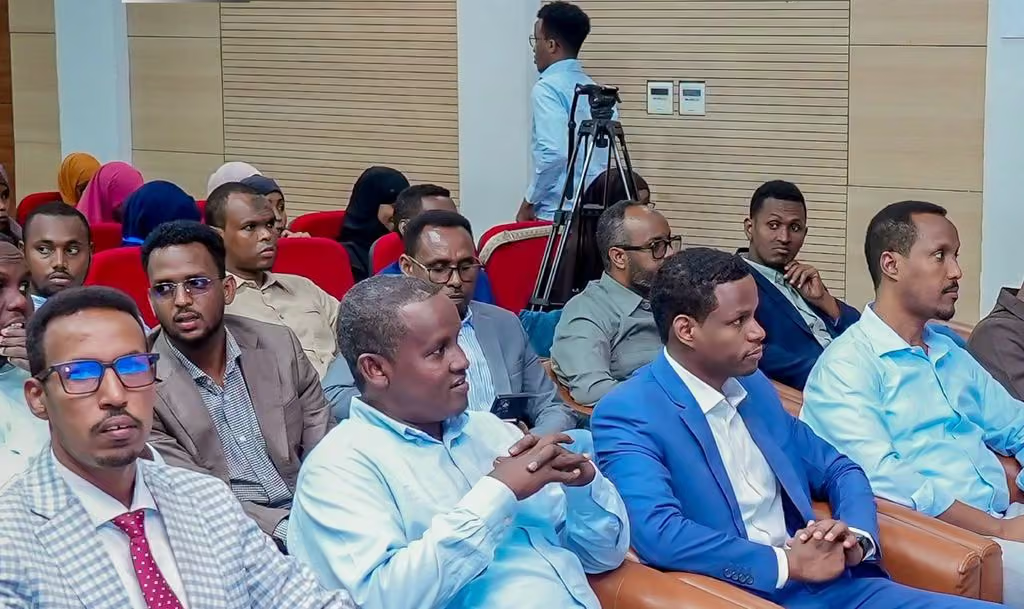
More than 160 final-year ICT students from 22 Mogadishu universities have begun the third edition of the Bile Initiative, a Somali-run programme designed to move graduates from academic study into technology employment — with artificial intelligence among its four training tracks.
The 2026 edition was launched in Mogadishu on Thursday. It is implemented by Tabaarak ICT Solutions and SomaliREN, Somalia’s national research and education network, with support from the Hormuud Salaam Foundation. Training covers software development, artificial intelligence, cloud computing and software analysis.
Women make up 43% of this year’s participants — a figure well above what most African technology skills programmes achieve, and one that stands out given Somalia’s broader gender indicators.
“The Bile Initiative connects students graduating in 2026 from ICT programmes at universities with the job market,” said Gure Abdi Anshur, chief executive of Tabaarak ICT Solutions. The aim, he said, is to give students the preparation they need to enter employment. SomaliREN chief technology officer Mohamed Ali Ahmed said the initiative plays an important role in developing the skills of Somali university students.
The programme has supported more than 300 students since it began.
Locally funded, locally run
What separates the Bile Initiative from most African AI skills programmes is the absence of an international partner.
The comparable initiatives iAfrica has covered this year run on foreign capital and foreign curricula: Meta’s AI Academy with 3MTT in Nigeria, Google’s reopened Hustle Academy across three markets, the EAC and Germany’s AI4EAC Challenge, the Mastercard Foundation’s EdTech Fellowship in Kenya, Tech4Dev’s Women Techsters programme in Ghana, and Tomorrow Foundation’s rollout of an Arizona State University curriculum in Nigeria.
The Bile Initiative is funded by the philanthropic arm of Hormuud, Somalia’s largest telecommunications operator, and delivered by two Somali organisations. That matters for durability. Programmes dependent on external funding cycles end when the funding does; ones anchored to a domestic commercial sponsor with a direct interest in the local talent pool have a different survival profile.
It is not Somalia’s only route into these conversations. Hormuud Telecom signed a memorandum with GIZ last year covering digital literacy and AI training for youth employment. Somalia participated in the first AI4EAC Challenge alongside seven other East African states, and presented a national AI adoption plan at the East Africa Science and Technology Commission summit in April, where officials described AI systems already deployed in national media operations for translation and content generation. The National Communications Authority signed an AI and space technology cooperation agreement with Saudi Arabia in 2025.
The gap it is aimed at
The initiative targets the transition point that international research keeps identifying as the weak link. The International Labour Organization reported this month that global youth unemployment rose to 12.4% in 2025, driven partly by the disappearance of the middle-skilled roles that traditionally provided a first step into work. The IFC estimates more than 230 million jobs in sub-Saharan Africa will require digital skills by 2030.
For Somalia, where the technology sector is small and formal graduate employment scarcer still, 160 students across 22 universities is a modest number in absolute terms. It is a significant one relative to the size of the country’s ICT graduate cohort — and it is being done without waiting for anyone else to fund it.