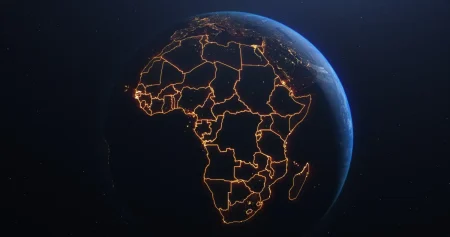
South Africa does not appear on the World Bank’s global map of economies with a national AI strategy — a direct consequence of the collapse of the country’s draft AI policy in April, and the clearest international cost yet of that failure.
The exclusion appears in World Development Report 2026: The Promise of Artificial Intelligence, the Bank’s flagship annual publication released Tuesday. A note beneath the report’s map of national AI strategies states that South Africa “is not included as an economy with a strategy” because of the withdrawal of the draft national AI policy in April 2026.
The Bank counted more than 80 countries with published national AI strategies as of June 2026, defining a strategy as a standalone, government-led framework setting out a country’s vision and action plan for AI. Its central observation is that the countries with the most to gain from the technology may be the least prepared for it: of 25 low-income countries, only Rwanda had published a dedicated AI strategy, against more than half of high-income economies.
South Africa — an upper-middle-income economy with the most developed technology sector on the continent — now sits outside that group entirely. Rwanda, one of the poorest countries in the Bank’s sample, is inside it.
How it happened
Communications minister Solly Malatsi withdrew the draft national AI policy on 26 April after internal checks confirmed its reference list contained fictitious sources. The 86-page document, gazetted on 10 April with 67 references, included citations to academic journal articles that did not exist — most plausibly generated by an AI tool and published without verification.
Malatsi said at the time that the failure was not merely technical and had compromised the policy’s integrity and credibility. He subsequently appointed an independent expert panel chaired by Wits University AI researcher Prof Benjamin Rosman to rebuild the document.
Not corrected soon
The World Bank’s map reflects the position as at June 2026, but South Africa’s absence is unlikely to be corrected quickly. The Department of Communications and Digital Technologies has told parliament that the panel’s consolidated report is expected in August, with a revised draft going to cabinet in November and public consultation targeted for January 2027.
South Africa will not have a published national AI policy before next year — nearly three years after the National AI Summit that began the process in April 2024.
The acknowledgements problem
There is an additional awkwardness in the report itself. The communications department and the Department of Science, Technology and Innovation both appear in the World Development Report’s acknowledgements as organisations that provided input, as do communications regulator Icasa and the South African Revenue Service.
South African institutions, in other words, contributed to a report that excludes South Africa from its map of countries with AI strategies.
Load shedding as cautionary example
South Africa fares poorly elsewhere in the report. In its chapter on AI and the environment, the World Bank identifies Brazil and Malaysia as emerging destinations for hyperscale data centre operations while citing South Africa’s history of chronic load shedding as an illustration of how grid constraints deter large-scale AI investment.
That framing sits uncomfortably against domestic momentum. Cape Town approved two hyperscale data centres last week drawing a combined 174MW — among the largest new loads to reach an African grid — and Microsoft has committed more than R26 billion to South African data centre capacity. The World Bank’s assessment suggests international capital allocators may still be pricing in a grid risk the local market considers substantially reduced.
The report’s prescription for governments centres on reliable electricity, broadband connectivity and foundational literacy — the complements the private sector will not fund on its own, and without which AI tools deliver little. It is a list on which South Africa’s position is contested rather than settled, and one the country will now be assessed against without a published national strategy to point to.