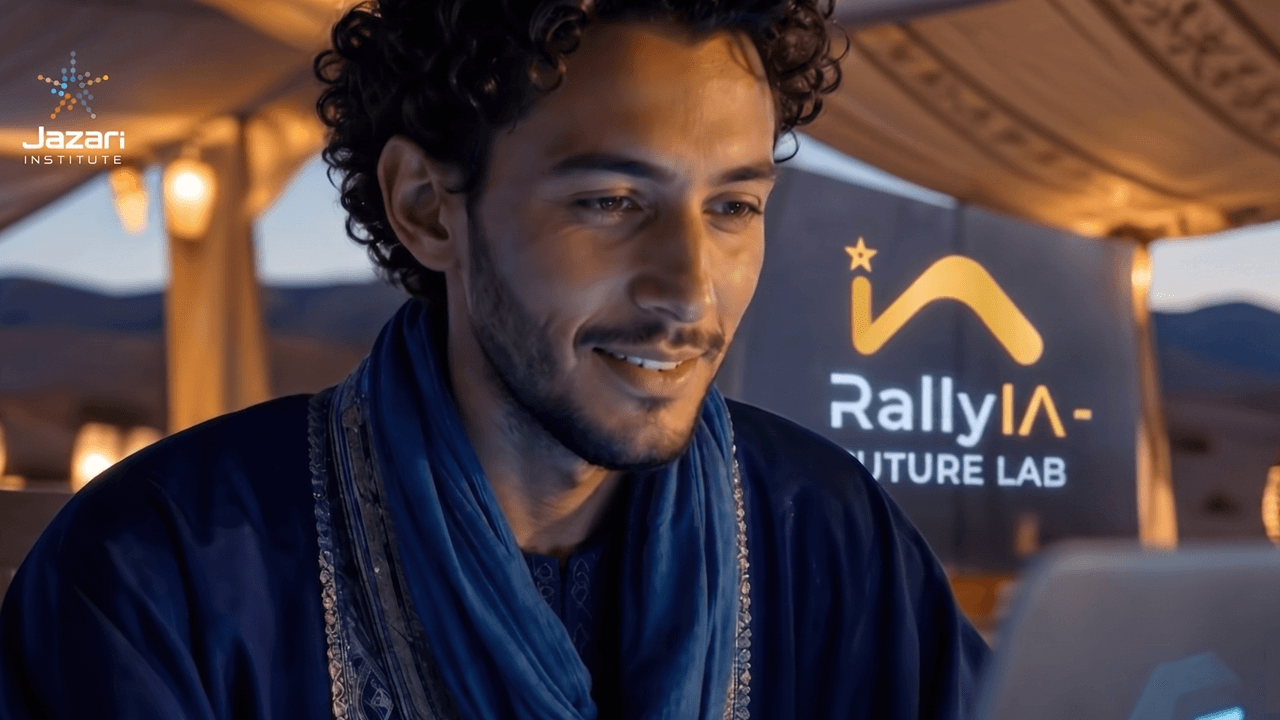
Morocco’s Ministry of Digital Transition and Administrative Reform has launched the Rally AI Future Lab, a national initiative organized by the Jazari Institute that brings together 1,000 researchers, engineers, students, entrepreneurs and developers for a five-day intensive programme.
The inaugural lab runs from June 16 to 20 in the city of Merzouga, in the Drâa-Tafilalet region. Held under the High Patronage of King Mohammed VI, the programme forms part of Morocco’s broader “AI Made in Morocco” strategy and is designed to build technological sovereignty by developing locally designed AI solutions tailored to the real needs of citizens, government and the national economy. The initiative has an ambition to reach 5,000 participants across multiple cohorts throughout the Kingdom’s 12 regions.
The launch follows the January debut of AI Made in Morocco, a national artificial intelligence initiative targeting a 100 billion dirham ($10 billion) contribution to GDP and the creation of 50,000 AI-related jobs. The Rally AI Future Lab is intended to build domestic AI capability from the ground up — developing talent, prototyping solutions and creating a pipeline from idea to operational product. By launching the programme in Merzouga, in eastern Morocco, rather than Rabat or Casablanca, the government is signalling that the effort is national in scope and intended to reach the whole country.
Around 1,000 participants will take part in the intensive five-day programme, which combines training, experimentation, prototyping and mentoring. The programme targets the creation of high-impact AI projects across four priority areas — modernization of public services, administrative efficiency, digital inclusion and economic competitiveness — with a focus on applied, citizen-facing solutions rather than purely academic outputs. The phased expansion model, aiming for 5,000 participants across several cohorts, is designed to build a sustained national innovation initiative rather than a one-off event.
The lab builds directly on the success of the RamadanIA Hackathon, which was deployed across all 12 regions of Morocco and mobilized more than 700 participants and around 50 mentors. The national final in Rabat brought together nearly 170 selected talents, with several teams distinguishing themselves through the maturity of their AI solutions.
The initiative sits within the broader AI Made in Morocco strategy, which aims to use AI as a lever for technological sovereignty, economic competitiveness and public sector transformation by uniting public, private, academic and international ecosystems around solutions designed in Morocco and adapted to local needs. The ministry describes its goal as installing a sustainable architecture of innovation, with an emphasis on the gradual, structured transition from ideas to operational solutions at national scale.
The Rally AI Future Lab connects to a wider architecture Morocco is building across all 12 of its regions. Last year, Digital Transition Minister Amal El Fallah Seghrouchni announced plans to expand the Al Jazari Institute nationwide, creating a network of centres of excellence specifically in Morocco’s less developed and less populated regions. The inaugural Al Jazari Institute is located in the Guelmim-Oued Noun region in the southwest, and a memorandum of understanding has been signed to establish a second institute in Nador, in the northeast Rif region, marking the start of a national rollout. The institutes are mandated to deliver four functions: training and skills development, applied research and co-innovation, shared digital platforms and data infrastructure, and incubation and acceleration of AI solutions.