Egypt has become one of the first countries in the world to launch a nationally contextualized AI competency framework for teachers, developed with UNESCO and tailored to the Egyptian education system’s priorities, needs and constraints.
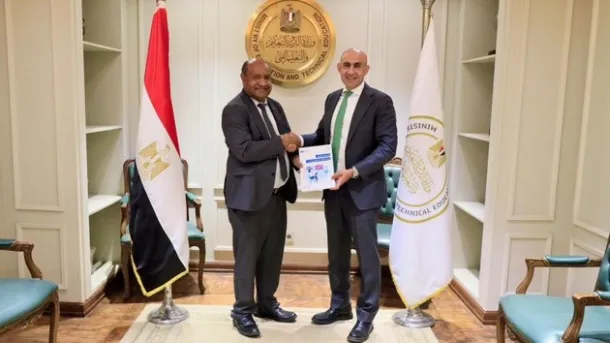
The framework was launched by Egypt’s Minister of Education and Technical Education, Mohamed Abdel Latif, and UNESCO Cairo Office Officer-in-Charge Robert Parua. It is designed to equip teachers with the knowledge, skills and ethical understanding to use AI responsibly and effectively in classrooms — from lesson design and personalized learning support to critical evaluation of AI-generated content.
Development ran through a highly participatory process. A National Consultation and Validation Workshop held in Cairo in October 2025 brought together more than 120 representatives from government institutions, universities, teacher training bodies, civil society, development partners and the private sector to adapt UNESCO’s global AI competency framework to Egyptian conditions. Surveys, focus groups and interviews with national and international experts fed into the final text, which the partners say is aligned with Sustainable Development Goal 4 and the 2030 education agenda.
The framework was produced within the UNESCO-Huawei “Technology-Enabled Open Schools for All” project — the same UNESCO-Huawei partnership that has been backing digital learning capacity across several African education systems. The Ministry of Communications and Information Technology also participated in the multi-stakeholder process, with strengthening of digital infrastructure, connectivity, policy and AI ethics called out by the parties as complementary work streams.
Abdel Latif framed the launch as a bet on the professional cornerstone of the system. “The teacher remains the cornerstone of every reform,” he said, positioning the framework as giving educators the digital capabilities and ethical awareness to use AI purposefully in classrooms. He characterised the Ministry-UNESCO partnership as “a national model of constructive international cooperation.”
UNESCO used the launch to reiterate the principle that has anchored its AI-in-education work since the 2019 Beijing Consensus on Artificial Intelligence and Education: that technology should support and empower teachers rather than replace them. That principle threads through the 2021 UNESCO Recommendation on the Ethics of AI and the 2025 Santiago Consensus on Teachers, which together shape UNESCO’s institutional approach to human-centred, ethical AI in education. The Egyptian framework operationalises those instruments at the national level, translating global guidance into a working reference for teacher training, professional development, educational planning and curriculum reform.
UNESCO also used the launch to acknowledge broader progress from Egypt’s education ministry over the past two years, including work on classroom overcrowding, attendance rates, teacher professional development and teacher shortages — reforms that the organisation argued provide a stronger foundation for the framework’s rollout than would have existed even a couple of years ago.
The next phase is where the framework moves from document to delivery. Egypt and UNESCO have committed to implementing an accompanying action plan including online and face-to-face training programmes, the preparation of AI master trainers, the development of Arabic learning resources for AI concepts, and the establishment of teacher training hubs designed for interactive and technology-enabled professional development. Whether the framework meaningfully lifts teacher confidence and classroom practice — rather than joining the long list of well-designed frameworks that stall at the implementation gate — will depend on execution.
The launch also connects to a classroom-side complement iAfrica has already reported on. At the Egypt International Regional AI Summit in February, the government unveiled Sia, a personal AI tutor supporting secondary school students and teachers in Arabic language and Egyptian history. The competency framework’s teacher-side upskilling and Sia’s student-side tool converge on the same premise: that AI in Egyptian classrooms works when educators are trained to use it critically and locally-built tools are trained on Egyptian curricula and Arabic-language material. Egypt’s second National AI Strategy 2025-2030 explicitly targets a national AI talent pool of 30,000 people; the teacher-framework launch is one of the earlier institutional pipes into that pool.
The wider regional context is that Egypt now sits inside a small but expanding set of African countries formalising nationally contextualized AI policy — from the Six Francophone West African countries who adopted a shared governance framework earlier this month, to Mozambique’s UNESCO-supported national AI strategy last year, to Djibouti’s ongoing national AI strategy development. Egypt’s teacher-competency framework is the first in the region to translate the general policy-level UNESCO instruments into a working operational framework for the teaching profession itself.