Standard Bank Namibia says it intends to be at the forefront of AI adoption in the country, with applications spanning financial inclusion, healthcare insight and business growth — though it has not named a single system, use case or timeline.
Chief Technology Officer Allvan Farmer framed the ambition around local problem-solving. “Artificial intelligence gives us an opportunity to solve uniquely African problems with uniquely African solutions.”
He drew on the mobile money precedent. “Just as Africa pioneered new approaches to financial inclusion through mobile technology, we believe AI can help address some of Namibia’s most important challenges, from expanding access to financial services to unlocking new insights in areas such as healthcare, economic development and business growth.”
The analogy has a limit
That comparison has become standard — AWS sub-Saharan Africa head Jyoti Ball made the same case in September — and it carries a gap worth naming.
Mobile money leapfrogged branch banking because the infrastructure it depended on, mobile networks, already existed. Africa skipped bank branches by running services over telecoms it had built. AI’s equivalent dependency is compute, and that has not been built. The continent holds roughly 409 megawatts of data centre capacity, under 1% of the global total.
Pretoria-based AI academic Kennedy Chengeta drew the line precisely in reporting iAfrica covered this month: “You cannot leapfrog a foundry with a language model. What you can leapfrog is the systems layer above production.”
For a bank, the systems layer is where the opportunity actually sits — credit decisioning, fraud detection, customer service — and none of it requires Namibia to host compute. It does require the bank to say what it is building.
What the group does elsewhere
Standard Bank has been more specific in other markets. The group has published an AI governance framework, partnered with Microsoft on AI capability, and deployed systems across its South African operations.
Namibian peers are also further along in disclosure. The Bank of Namibia won the Central Banking AI Initiative Award in March for deployed machine-learning systems, and NIPAM began structured AI training for civil servants in May.
Standard Bank Namibia has committed to continued investment in local technology talent as it expands adoption.
The skills half
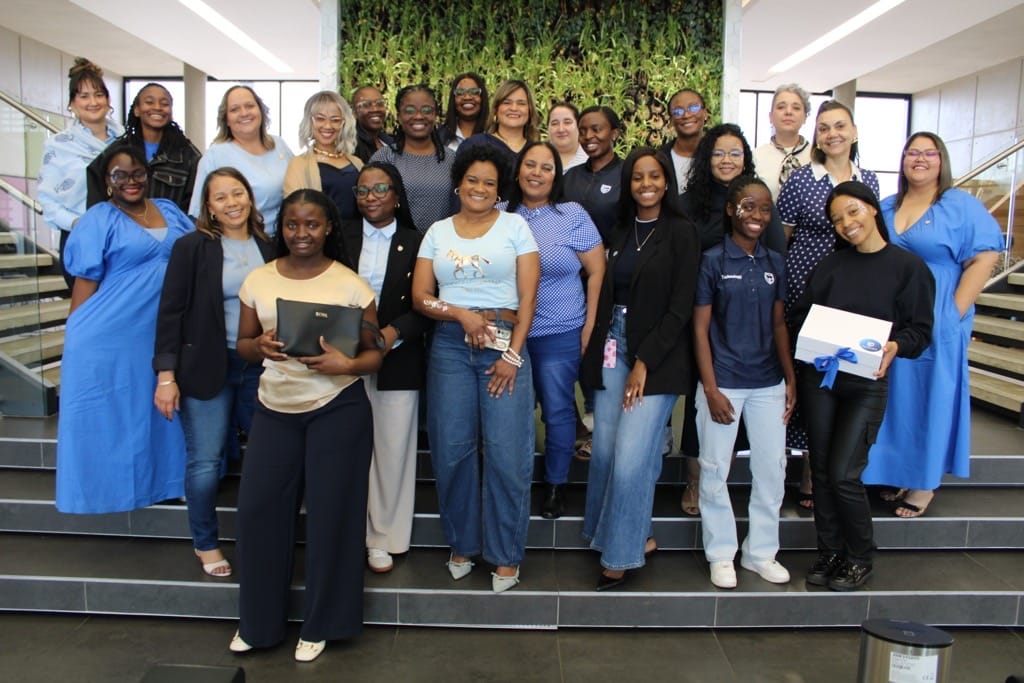
The announcement accompanied an engagement bringing together women from the bank’s technology and digital teams to discuss careers, innovation, leadership and barriers in technology fields.
“To realise this potential, we need diverse voices, perspectives and skills contributing to the development of these technologies,” Farmer said. “Creating opportunities for women to grow and lead in technology is not only about representation, but about driving better innovation.”
Business Analyst Natasha du Plessis said the session allowed women across different technology roles to exchange experience and build networks. “While our roles, backgrounds and responsibilities may differ, we are united by a shared passion for technology, innovation and progress.”
Namibia’s ICT Minister Emma Theofelus holds one of eight African seats on the AI for Good Global Commission, and the country has drafted an AI Bill alongside data protection and cybercrime legislation.