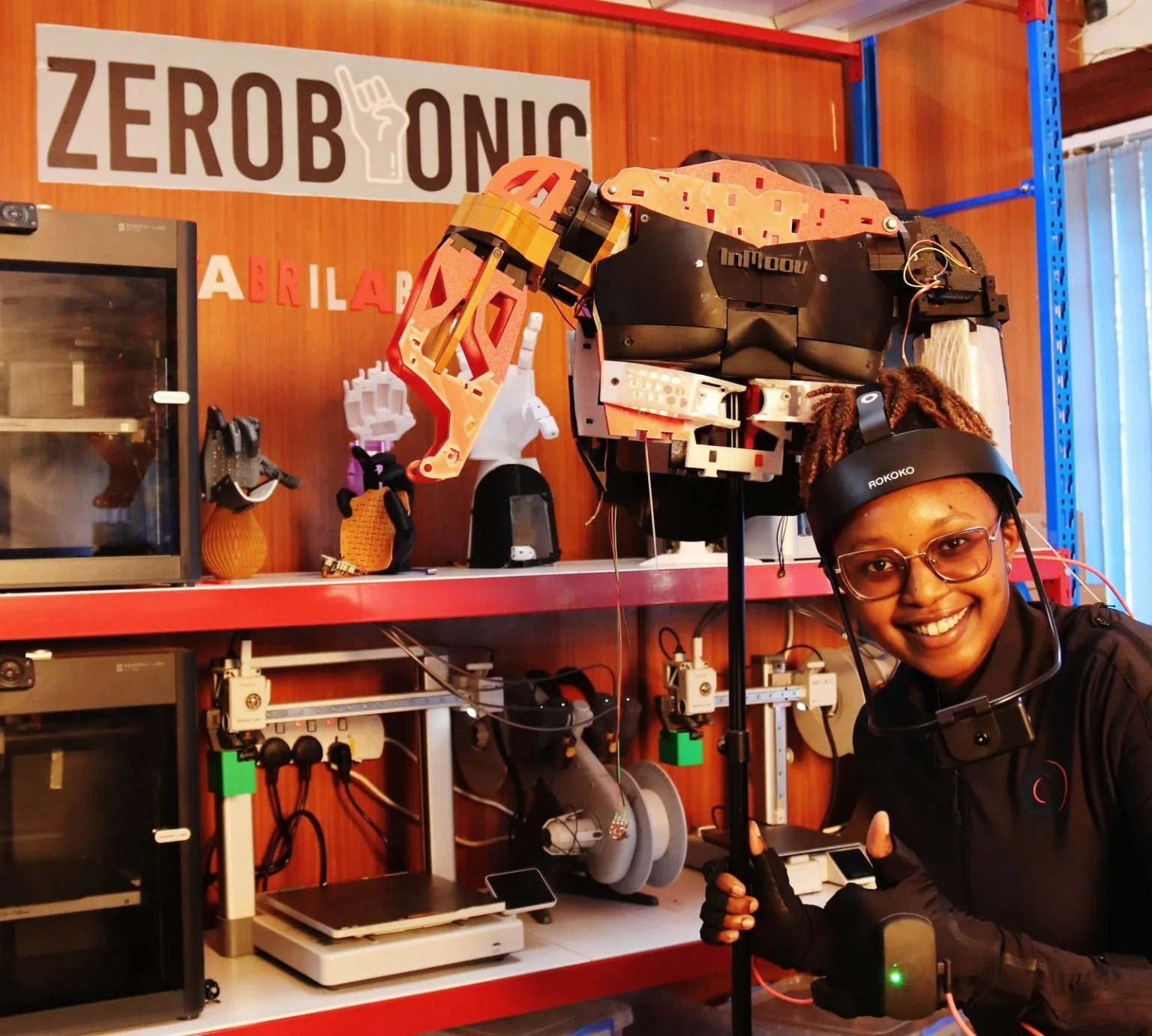
Kenyan computer scientist Norah Kimathi has built a robotic system that translates a teacher’s spoken words into sign language in real time — and, alongside it, a database of African sign languages to train the models that make it work.
Kimathi, 22, co-founded ZeroBionic in 2023 and completed her BSc in Computer Science at Strathmore University in July 2026.
How it works
The system captures a teacher’s speech, processes it through an AI engine, and renders it as sign language through a multi-jointed robotic arm — removing the requirement for a dedicated human interpreter in every classroom.
Two design decisions matter more than the robot itself.
It runs offline. The system is engineered for low-connectivity and offline environments rather than assuming continuous high-speed internet. That is the difference between a tool that works in a rural Kenyan classroom and one that works in a demonstration. The same principle is visible across the better African AI projects this year — Tether’s offline translation models, Uganda’s offline-capable health supply chain framework, and the 2G-based waste system that won Yango’s technical prize.
The hardware is made locally. ZeroBionic 3D-prints its components using recycled regional plastic waste, cutting production costs and addressing a waste stream at the same time. Most African AI is software running on imported hardware; this is neither.
The dataset may be the bigger contribution
Off-the-shelf AI models are trained predominantly on Western sign language data and routinely fail on regional dialects. Kenyan Sign Language is not American Sign Language, and neither is Tanzanian or South African Sign Language.
ZeroBionic is building a dedicated digital database of African sign languages to train models on localised gesture nuance.
That infrastructure barely exists. Arusha Technical College in Tanzania received LINGUA Africa funding this year to create the first open datasets for Tanzanian Sign Language, one of only a handful of such efforts across the continent. A usable African sign language corpus would serve every project working in this space — not only Kimathi’s.
The question the design raises
Sign languages are not gestures alone. Grammar is carried in facial expression, head position, body orientation and the scale and speed of movement. Kenyan Sign Language, like others, uses non-manual markers to signal negation, questions and intensity.
Whether a multi-jointed robotic arm conveys that is the technical question this approach invites, and it has not been addressed publicly. It is also the question a Deaf advisory group would raise first — which is why it matters that the announcement says nothing about whether Deaf Kenyans shaped the design.
UNDP’s HAIDI Innovation Track in Kenya makes exactly that a funding condition, requiring innovators to work directly with disability communities on testing and validation rather than designing for them at a distance.
Two directions, one gap
ZeroBionic is one of two African sign language AI projects to surface this month, running in opposite directions.
University of KwaZulu-Natal graduate Akhil Hansrajh has built a system that converts South African Sign Language into spoken English, prompted by watching his parents struggle to communicate at a social grant office. ZeroBionic converts speech into signed output.
Both are early stage. Both are motivated by a specific observed failure. Between them they describe the two halves of a conversation that currently requires a human interpreter neither country has enough of.
Kenya’s iHUB and Mastercard Foundation EdTech Fellowship selected Signvrse for sign language translation work earlier this year, alongside DEAFHEALTH and Deaf Outreach Program.
Background
Kimathi served as a team leader at the Global Give Back Circle in 2020, working on educational empowerment initiatives in East Africa, and interned as an IoT engineer at Strathmore University’s @iLabAfrica research centre in 2025, working on embedded systems and hardware-software integration.
ZeroBionic has not disclosed deployment figures, partner schools, accuracy data or funding.