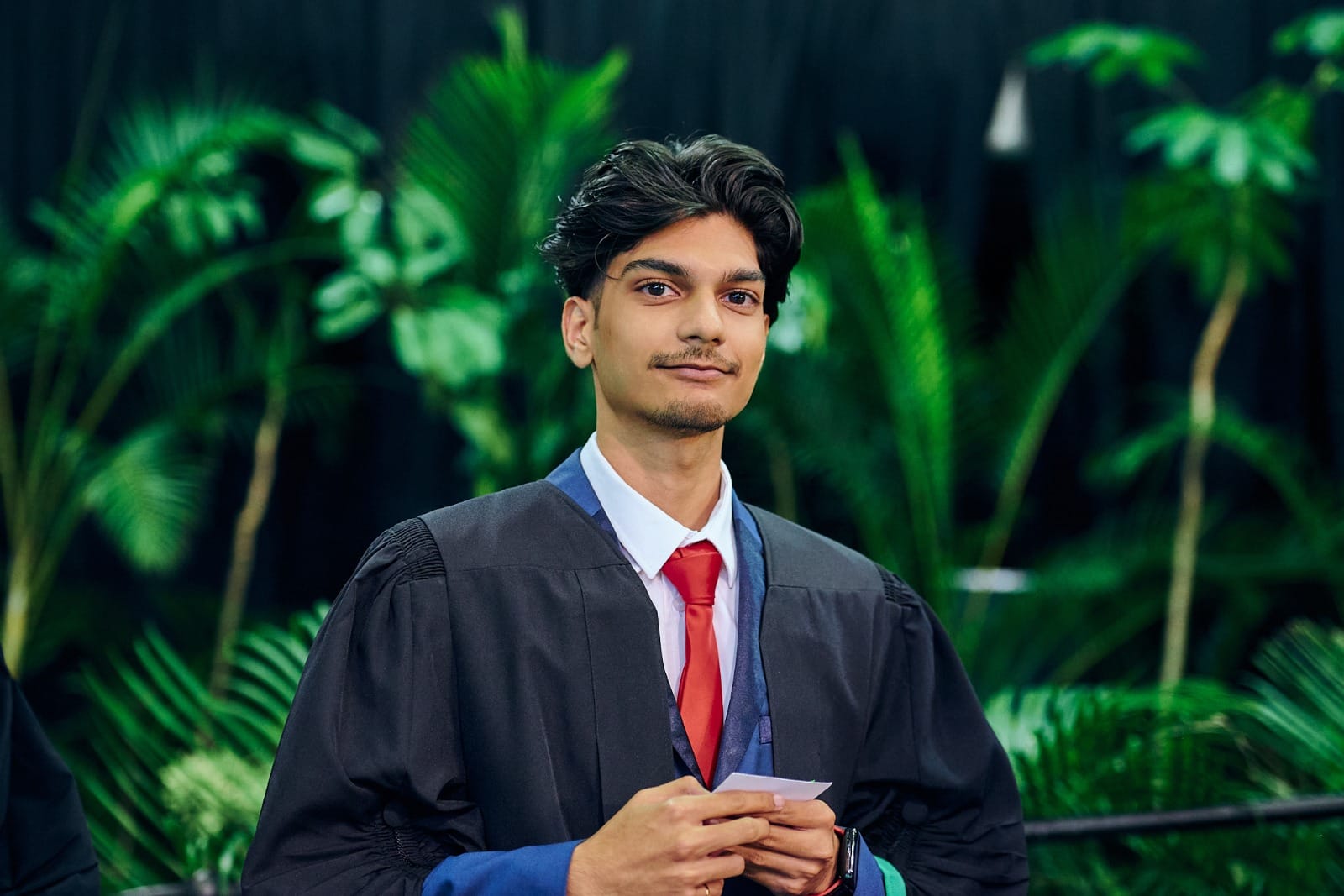
A University of KwaZulu-Natal graduate has built an AI system that translates South African Sign Language into spoken English in real time, prompted by watching his parents struggle to communicate at a social grant office.
Akhil Hansrajh, whose parents are both hard of hearing, told VOC News the project came from a gap in his own ability to help.
“My dad taught my sister and I to sign when we were young, but I only really learned the alphabet, so I could never interpret a whole conversation,” he said.
An experience involving his parents and the South African Social Security Agency showed him how those barriers play out in accessing public services.
How it works
A camera tracks hands, arms and face. An AI model identifies the sign and converts it into spoken English.
“A deaf person can sign to a teller who’s never learned sign language before and the teller hears the signs in real English,” Hansrajh said.
The design choice matters. The interpreter runs on the Deaf person’s side and requires nothing of the counter staff — no training, no new equipment, no scheduled interpreter. That is the difference between a system that works at an unannounced visit to a SASSA office and one that works only where someone has prepared for it.
Where it stands
The system has been tested by Hansrajh’s parents. He is candid that more data from Deaf signers is needed to improve accuracy.
Next steps are recognising full sentences rather than individual signs, and adding speech recognition so hearing people’s responses can be converted to text — closing the loop in both directions.
No timeline, funding, vocabulary size or accuracy figure has been disclosed.
The access problem it addresses
South African Sign Language became the country’s 12th official language in 2023, which makes access to public services in SASL a constitutional question rather than a courtesy.
Delivery has not followed. Qualified SASL interpreters are scarce, and the gap is most acute in exactly the settings where the stakes are highest: clinics, police stations, courts and social grant offices.
Hansrajh’s system is one of a small number of African projects working on this. Kenya’s Signvrse, selected for the iHUB and Mastercard Foundation EdTech Fellowship this year, builds sign language translation, and Tanzania’s Arusha Technical College received LINGUA Africa funding to create open datasets for Tanzanian Sign Language. That funding gap is the recurring obstacle — sign language recognition needs large volumes of video data from native signers, and almost none exists for African sign languages.
The question worth putting to any assistive AI project is whether the community it serves shaped the design. UNDP’s HAIDI programme in Kenya makes that a funding condition, requiring innovators to work directly with disability communities on testing and validation. Hansrajh’s motivation is personal and his first testers are Deaf. Whether DeafSA or comparable organisations have been involved is the detail that would indicate how far the project can travel.
Based on reporting by VOC News.