
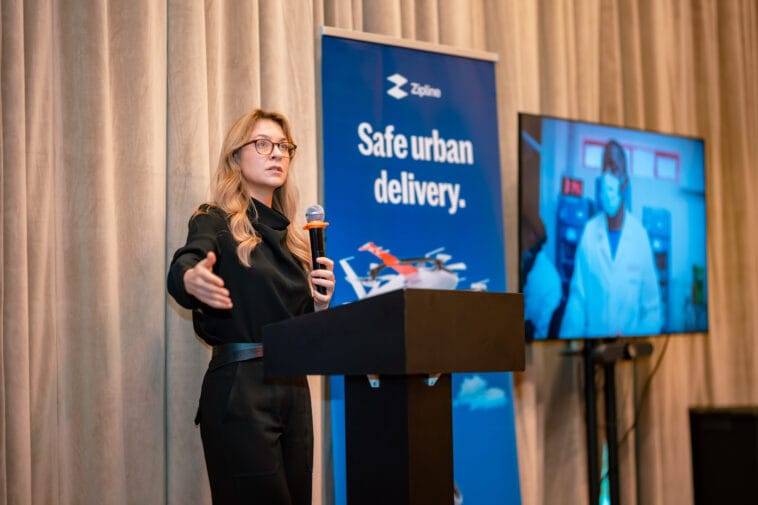
Côte d’Ivoire has approved an eight-year public-private partnership with Zipline to expand its autonomous medical delivery network from one distribution centre in Daloa to ten nationwide — one of Africa’s largest deployments of AI and robotics in healthcare.
Once complete, the network is projected to serve more than 2,200 health facilities and over 12 million people.
How it’s paid for
The financing structure is the most consequential element.
The US government provides upfront infrastructure funding to Zipline, supported in part by a $150 million State Department pay-for-performance award. The government of Côte d’Ivoire has committed to paying for ongoing operations.
That division matters. Donor-funded health technology across the continent has a long record of working well until the funding cycle ends. An eight-year arrangement in which the host government carries recurring costs is designed to outlast the grant — and it puts operational control with the ministry rather than the donor.
Zipline Africa chief executive Caitlin Burton framed it as “commercial diplomacy” in practice: “U.S. catalytic public funding and AI and robotics innovation combined with strong Ivorian government leadership and domestic investment.”
The value of the Ivorian operational commitment, the rollout timeline and the portion of the $150 million allocated here were not disclosed.
What Daloa delivered
Since launching in 2023, Zipline has made more than 3.55 million medical product deliveries to over 220 health facilities across five regions — including approximately 2 million vaccine doses and 20,500 units of blood products.
The company estimates 2,058 equivalent lives saved and projects a return on investment of roughly 300% for the expansion. Both are Zipline’s own modelled figures, and neither methodology has been published.
“Since Zipline began operating in Daloa, we have seen shorter delivery times, improved availability of vital products and stronger support for our health facilities,” said Pierre N’Gou Dimba, Minister of Health, Public Hygiene and Universal Health Coverage. “By expanding to 10 distribution centres, Côte d’Ivoire is taking a proven model nationwide.”
Where the AI actually sits
Each distribution centre combines warehousing, cold storage, inventory management, autonomous drone delivery and digital tracking.
The AI substance is in the logistics layer rather than the flight. Facilities order on demand instead of relying on scheduled road deliveries or holding large stock. The ministry gets real-time visibility into orders, inventory and deliveries, allowing it to anticipate demand, reduce stockouts and expiries, protect the cold chain and respond faster in emergencies.
Demand forecasting across 2,200 facilities is a data problem, and it is where the system either works or does not. The drones are the visible part; the inventory model is the one that determines whether a rural clinic has what it needs.
The practical case is seasonal. Rainy season road access is a recurring constraint on medical supply in much of West Africa, and autonomous delivery is one of few interventions that does not depend on the road being passable.
Local operation as the stated objective
“Côte d’Ivoire is not simply adding delivery capacity; it is building an autonomous logistics backbone operated by Ivorian talent,” said Xavier Greusard, Zipline’s vice president for Africa go-to-market, citing local training across pharmacy, aviation operations, maintenance, logistics, engineering and data management.
That commitment is testable. Hundreds of skilled jobs are projected, and whether Ivorians run the network by year eight is a measurable outcome rather than a framing device.
The expansion aligns with Côte d’Ivoire’s Vision 2030 agenda and its Couverture Maladie Universelle programme, and joins a widening national AI build-out — the Ivoire Tech Next 15 and Scale Up programmes opened this year, alongside a $95 million UAE commitment covering a modular data centre, sovereign cloud and an AI centre of excellence.
Zipline has completed more than 2.5 million commercial deliveries since 2016, serves over 5,000 hospitals and health facilities, and has flown more than 150 million autonomous commercial miles. It now completes a delivery somewhere in the world every 20 seconds.