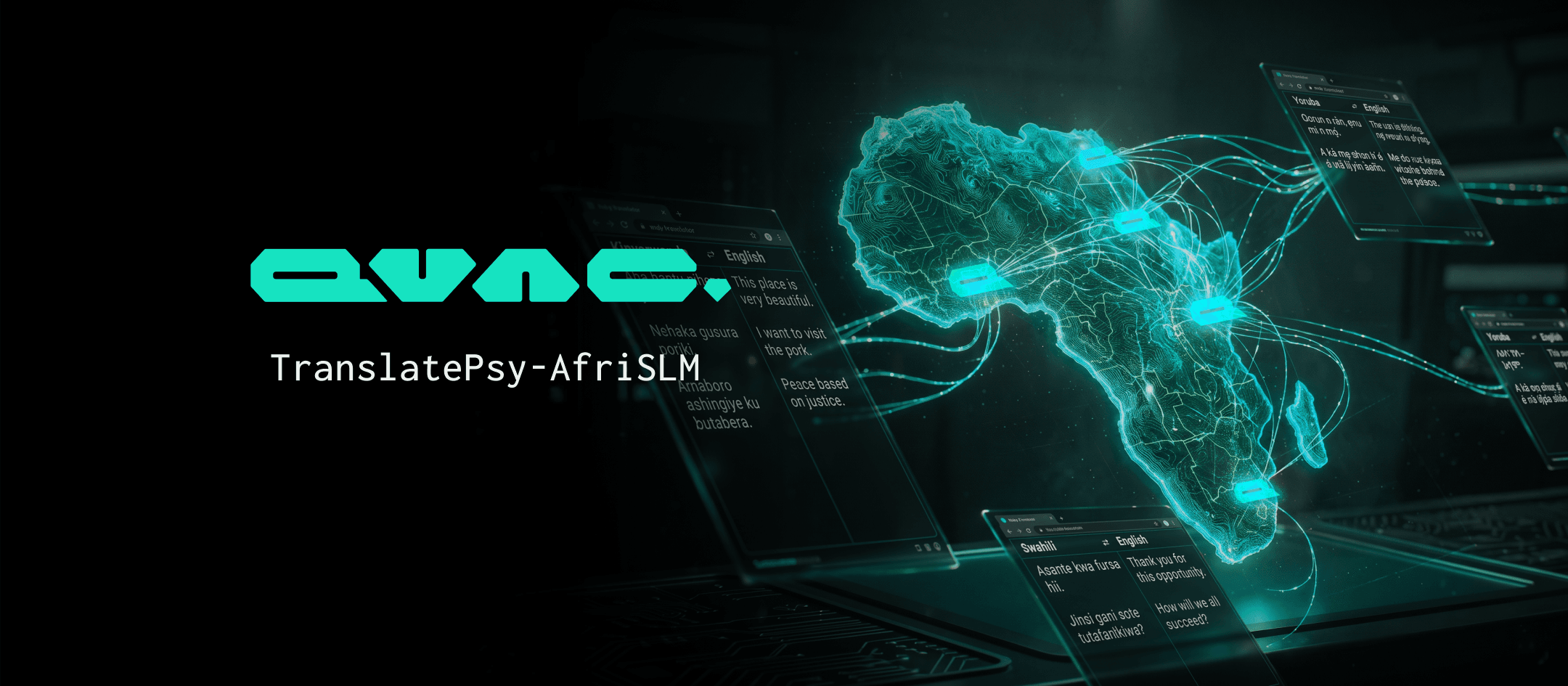
Tether AI Research has released open-source translation models covering 19 African languages that run entirely on smartphones and laptops without an internet connection — and, unusually for a corporate AI announcement, the underlying research has been accepted for presentation at EMNLP 2026, the leading peer-reviewed conference in natural language processing.
The release comprises QVAC TranslatePsy-AfriSLM, supporting 19 African languages, and TranslatePsy-AfriNano, supporting eight, alongside a parallel European release covering nine languages. All are downloadable from Hugging Face, with AfriSLM available in 0.8-billion, 2-billion and 4-billion parameter versions.
The claim, and why it can be checked
Tether says its smallest AfriSLM model — 800 million parameters — outperformed Qwen3.5-122B-A10B, TranslateGemma-27B and NLLB-3.3B across the FLORES-200, BOUQuET and SMOL translation benchmarks.
Those are models between roughly four and 150 times larger. The claim would normally warrant heavy scepticism. Two things temper that: the research has passed EMNLP peer review, and the weights are public, so any researcher can reproduce the benchmarks.
The methodological contribution is a quality-estimation filtering technique that removes up to 96% of low-quality open-source training data. Better data rather than more parameters is the stated route to the performance gain — an argument with a direct African precedent. Lelapa AI’s InkubaLM was built on the same premise, using 60% less compute and 60% less data than conventional adaptation requires, and was subsequently compressed a further 75% without performance loss through the Buzuzu-Mavi Challenge.
What is covered
AfriSLM supports Hausa, Amharic, Yoruba, Lingala, Swahili, Igbo, Zulu, Somali, Oromo, Malagasy, Kinyarwanda, Xhosa, Afrikaans, Wolof, Luganda, Nyanja, Shona, Tswana and Southern Sotho — spanning West, East, Central and Southern Africa and, on Tether’s estimate, roughly half the continent’s population.
The European models, TranslatePsy-EuroNano, support 90 translation directions across nine languages using English as a pivot. The smallest deployment requires 36MB of storage against 633MB for an equivalent Firefox offline configuration, a 94% reduction, while the highest-quality European model retained 98.4% of Meta’s NLLB-200 translation quality into English.
Offline is the point
Processing locally means the models work without connectivity and keep user data on the device rather than sending it to third-party servers.
That addresses a constraint documented repeatedly across your coverage. Only about a third of Africans have regular internet access and roughly 70% use entry-level smartphones. The World Bank’s World Development Report 2026 concluded that applications must work on basic devices and weak networks to reach populations outside well-connected urban centres. Uganda’s health ministry built its AI medical supply chain framework on the premise that connectivity cannot be assumed.
The privacy dimension matters too. Intron offers offline deployment and zero-retention cloud options specifically because Nigerian hospitals have limited appetite for sending patient consultations offshore under the Data Protection Act 2023.
Tether identifies healthcare as the highest-impact application, pairing AfriSLM with QVAC MedPsy, a small medical foundation model, to deliver health education in local languages. The announcement is appropriately careful here, noting such systems “would require appropriate safeguards and clear boundaries between health education and clinical care.”
Other applications named include agricultural extension advice, humanitarian and disaster response in low-connectivity settings, and NGO field work across multiple language communities.
Who Tether is
Tether AI Research is a division of Tether, the company behind USDT, the world’s largest stablecoin by market capitalisation. The connection is not obvious from the branding and is worth stating.
Tether’s regulatory history is part of the public record, including 2021 settlements with the US Commodity Futures Trading Commission and the New York Attorney General over misrepresentations concerning its reserves. The company has since diversified into AI, bitcoin mining, agriculture and other sectors.
That context does not diminish the technical work, which rests on peer review and published weights rather than corporate assertion. But readers assessing where African language AI capability is coming from should know.
Chief executive Paolo Ardoino framed the release through the company’s financial-inclusion argument. “Four billion people were left behind by the traditional financial system, and the most powerful technology of our age has repeated that failure,” he said. “Language should not determine who can benefit from artificial intelligence.”
Tether also says it operates solar-powered kiosks across sub-Saharan Africa where residents charge phones, swap batteries and access digital financial services, and suggests these could become local-language content access points. No figures on the number or location of those kiosks were provided.
Where it sits
African language AI has become one of the continent’s most active research areas, and the open-weight, small-model approach is now well populated.
Lelapa AI’s InkubaLM covers five languages on modest hardware, with its founders now extending into voice generation and beyond Africa. Intron’s Sahara v2.5 handles code-switching across around 20 languages. Nigeria’s state-backed N-ATLAS anchors the GSMA’s five-government ATLAS Umoja initiative. LINGUA Africa is funding 26 projects across more than 50 languages, drawn from over 800 applications. Google’s WAXAL dataset covers 21 sub-Saharan languages; the Gates-backed African Next Voices recorded 9,000 hours across 18.
What distinguishes this release is the combination: 19 languages, fully offline, open weights, and a peer-reviewed benchmark claim. Whether the performance holds up under independent testing is now a question anyone can answer, which is more than can usually be said.