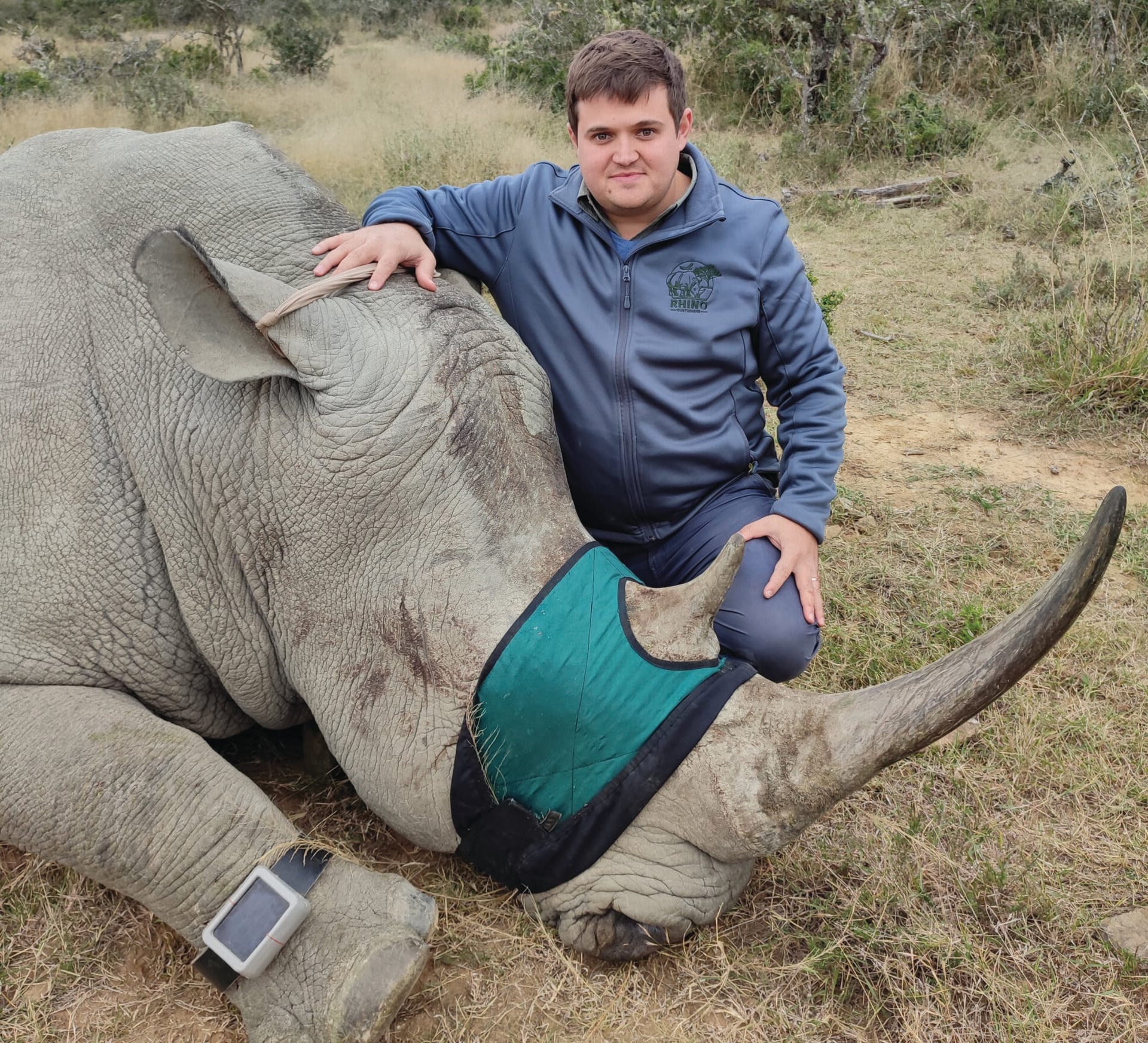
An AI-enabled tracking collar built by a South African company is now deployed on close to 2,000 animals across more than 60 of the country’s largest reserves — operational scale that puts it well ahead of most African AI deployments, which rarely graduate from pilot.
Rouxcel Technology’s RhinoWatch is a solar-aided GPS foot collar with onboard abnormal behaviour detection. Founder Dr S.P le Roux established the company in 2018 to solve a specific gap in anti-poaching response.
“If we rewind 10 years back, most reserves had anti-poaching units, people willing to respond with force,” le Roux said. “What they did not have is the when and the where of the poaching incident, and this is what I set out to try and provide.”
Designed to stay quiet
The system’s design principle is restraint. “As long as the rhino is healthy, and everything is fine, we don’t really want to know about him, except for the odd location ping and to see that there’s sufficient movement,” le Roux said. “But the moment there’s a potential threat, we want to know as soon as possible.”
The collar issues grey, amber or red alerts depending on the severity of the detected abnormality and how closely it resembles a poaching incident. A red alert typically triggers deployment of a thermal drone to assess the situation before a response team commits.
That tiered approach matters operationally. Anti-poaching units have finite capacity, and a system generating constant alerts becomes noise. The technology has since been adapted for pangolins and elephants, both heavily targeted.
The numbers behind it
South Africa’s Department of Forestry, Fisheries and the Environment recorded 352 rhinos poached between January and December 2025 — 266 on state properties and 86 on privately owned parks, reserves or farms. That represents a 16% decline on 2024, when 420 were killed, and the department attributed the drop to anti-poaching and anti-trafficking efforts.
The figures remain severe. More than 12,000 rhinos have been lost to poaching since 2008, and illegal wildlife trafficking is estimated at $20 billion globally.
Where AI helps, and where it doesn’t
Le Roux is measured about what the technology contributes. “The important thing it does for conservation is the same that it does for everyone else — making sense of a lot of data and pointing out what is relevant and important.” He notes AI is also being applied to drone imagery for population counts.
That caution is echoed more sharply in research. AI in nature conservation featured among the top 10 emerging issues in South African biodiversity in the 2026 horizon scan, discussed in an article published in The Conversation in June. Alongside opportunities in tracking animals and insects at scale, monitoring land use and processing far larger volumes of data, the authors flagged risks in how models are trained and the prospect of taxonomic expertise declining if AI displaces human involvement.
Jeran Cloete, a PhD candidate in conservation ecology and entomology and co-author of the piece, put the limitation directly.
“These AI systems, and anything you do on a tech or information level in conservation, are purely a research exercise if there isn’t focused effort to actually translate it to people,” he told Forbes Africa. “It doesn’t translate to actual impact on biodiversity unless you can cause it to change people’s behavior.”
That is the harder test, and it applies to detection systems generally. A collar that identifies a poaching incident in progress is only useful if a response team reaches the animal in time — which depends on rangers, vehicles, funding and coordination rather than on the model.
Beyond South Africa
Le Roux said Namibia, Zimbabwe, the Democratic Republic of the Congo and Kenya have shown interest. “We’ve deployed the technology in more than 60 of South Africa’s biggest reserves,” he said, adding that close to 2,000 deployments suggests operators see value in the system.
Rouxcel joins a small set of AI conservation tools now working on African reserves. Nightjar’s TrailGuard, developed with technology originally built for industrial risk monitoring by Insight Terra, was prototyped in South African parks. In Kenya’s Aberdare National Park, Rhino Ark is piloting an Austrian-built system using machine learning and ultrasound to deter hyenas from black rhino calves.
Article rewritten by AI – Originally written By Nicole Pillay, Forbes Africa.