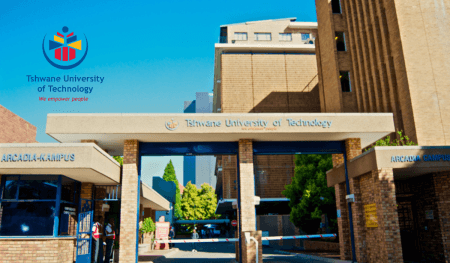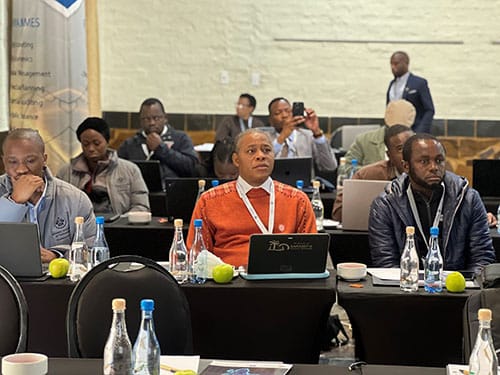
Researchers from across the continent gathered at Tshwane University of Technology for the UNESCO Chair on African Integration and Innovation Research Seminar, where the ethical use of artificial intelligence in academic publishing shared the programme with research on economic resilience, export diversification and AI-driven credit risk modelling.
Hosted by TUT’s Department of Economics and supported by a grant from the African Union Development Agency, the seminar was designed to strengthen research capacity, exchange findings and identify publication opportunities.
AI and the publication problem
Professor Paul-Francois Muzindutsi, an NRF-rated finance expert from the University of KwaZulu-Natal, delivered a guest lecture titled “Writing for Publication in the Age of Artificial Intelligence.” He examined AI’s growing role in research and publication, addressing methodology, data analysis and writing structure — and emphasised the importance of using AI ethically and responsibly in academic work.
That subject carries particular weight in South Africa this year. In April, the government gazetted an 86-page draft National AI Policy containing 67 references, several of them citations to academic journal articles that did not exist. Communications Minister Solly Malatsi withdrew the document on 26 April, saying the failure was not merely technical and had compromised the policy’s integrity and credibility. An expert panel chaired by Wits AI researcher Professor Benjamin Rosman is rebuilding it, and the World Bank subsequently excluded South Africa from its global map of countries with a national AI strategy.
The episode made concrete what Muzindutsi’s lecture addresses in principle: that generative systems produce plausible-looking references, and that verification is the researcher’s responsibility rather than the tool’s.
African universities have been building norms around this through the year. Makerere University held a webinar in June on adopting AI in research management, where participants raised questions on ethical use in academic writing, disclosure of AI-assisted editing and data privacy. South African institutions including UCT, Stellenbosch and the University of the Free State have moved away from AI detection software toward disclosure requirements and AI literacy, partly because detection tools show documented bias against second-language English writers.
Deep learning applied to credit risk
Dr Oluwatoyin Akinbowale, a postdoctoral fellow specialising in managerial accounting, finance and cyberfraud mitigation, presented findings from her study “Evaluating the Loan Default Rate Using Deep Learning AI Techniques,” investigating the use of AI to predict loan default patterns.
That research sits in a category attracting both commercial and regulatory attention. Nigerian fintech Mathesis Analytics raised strategic investment this month to scale AI credit decisioning, having supported more than 8 million loans. Nigeria’s Artificial Intelligence Control and Regulation Bill, before the National Assembly, names credit scoring as a high-impact decision requiring disclosure of automated involvement and a route to challenge outcomes. Academic work on default prediction feeds directly into a field where explainability is becoming a legal requirement rather than a technical preference.
The wider programme
Professor Mulatu Zerihun, NRF C2-rated researcher, UNESCO Chair and Head of the Department of Economics, presented a paper on alternative thinking in economics, encouraging researchers to embrace diverse perspectives. “Diverse thinking strengthens research by encouraging new perspectives and innovative solutions,” he said. “Research is not a one-size-fits-all endeavour.” He argued that understanding historical context is essential to developing solutions for present challenges.
Dr Kazeem Isah — ranked among the top 5% of economists in Nigeria and top 10% in Africa by the Research Papers in Economics network — presented research on how climate variability affects sectors of South Africa’s economy, and whether strong environmental, social and governance conditions contribute to economic resilience.
Dr Olivier Ogbonna, lecturer at the University of Nigeria, Nsukka, presented “Moderating Effects of Exports Diversification on Economic Policy Uncertainty and Exports Nexus in Africa,” examining how trade disputes, conflict and policy uncertainty affect export performance across the continent.
The seminar closed with a session led by Dr Mukhethwa Londani, senior biostatistician and statistical analyst at TUT, introducing researchers to QuestionPro, an online survey platform. Understanding such tools is critical, he said, because they bridge raw human sentiment and actionable, data-driven strategy, shaping how research data is gathered, protected and visualised.
Postdoctoral fellows in the department also presented work for peer feedback.
Rewritten from and article originally By Reatlegile Ratlagane.