Russia is seeking closer AI cooperation with Ethiopia, with research and development, human capital development and technology transfer identified as priority areas — the second Russian approach to an African national AI programme to surface this year.
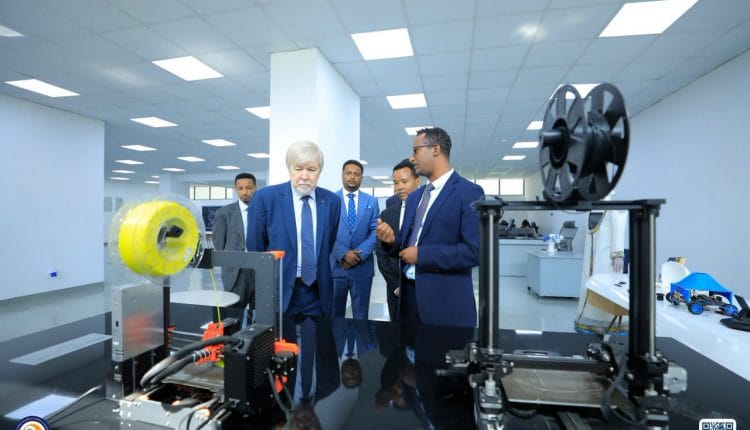
Russian Ambassador Evgeny Terekhin made the remarks during a visit to the Ethiopian Artificial Intelligence Institute, where he toured the facility and reviewed its work. Institute Director General Dr Worku Gachena briefed him on the institute’s activities within Ethiopia’s digital transformation programme, saying its research and development work is enabling progress across priority social and economic sectors.
Terekhin pointed to longstanding bilateral relations and said the two countries would strengthen cooperation across the three named areas. No agreement was signed and no projects, funding or timelines were disclosed.
The institute framed the partnership as aligned with the broader BRICS agenda of harnessing AI for shared development — a relevant framing given Ethiopia joined the bloc in 2024.
A second approach
The visit follows a similar overture in North Africa. In May, Algeria’s Minister of the Knowledge Economy, Startups and Micro-Enterprises, Noureddine Ouadah, told the African Initiative on the sidelines of the KazanForum that Algeria was willing to develop AI cooperation with Russia — including joint startup funding and research partnerships between Algerian and Russian universities, aimed at building AI companies positioned for both African and European markets.
Ouadah framed that as continuous with an older relationship, noting the Soviet teachers and researchers who worked in Algeria through the 1960s and 1970s. Ethiopia has a comparable history of Soviet-era educational and technical ties.
Two approaches do not make a strategy, but the categories are consistent: research partnerships, university links and technology transfer rather than infrastructure or capital.
Where Russia sits in the contest
Russia is the least-documented of the powers courting African AI programmes. The Lawyers Hub and Agence Française de Développement report launched at the Africa Forward Summit in May identified three blocs shaping the global contest: the United States pushing market-led governance and the export of its AI stack, China taking an infrastructure-first approach through Huawei, Alibaba Cloud and the Digital Silk Road, and the European Union positioning its rights-based regulatory model. Russia did not feature.
That reflects capability. Russia’s National AI Strategy 2030 earmarks around $1.2 billion, weighted toward defence applications — an order of magnitude below Chinese state AI funding and far below US private investment. Russia is not in a position to fund data centres or supply GPUs at the scale Chinese and American players have committed across the continent.
What it can offer is the category it named in Addis Ababa: research collaboration, scholarships and university partnerships. That is cheaper, slower and harder to measure than a data centre — but it also sits closer to what the World Bank told Ethiopia it actually needs. Its World Development Report 2026, published this month, urged the country to build adoption and adaptation capacity rather than pursue frontier ambitions, identifying skills and local data as binding constraints.
Ethiopia’s crowded partnership map
The Russian approach joins a long list. Ethiopia’s AI Institute is building a financial intelligence system to detect money laundering under a 52-week contract. The UK’s £4.6 million EthiopiAI programme funds responsible AI research. The AI UniPod runs with UNDP and Addis Ababa University under the Timbuktoo Initiative, completing its first startup bootcamp this month. Ethiopia has pursued AI cooperation with India on agriculture and health. Prime Minister Abiy Ahmed serves as African Union Champion for AI and Digital Health.
Zambian officials set explicit sovereignty conditions when opening AI talks with China this month, with SMART Zambia’s Percy Chinyama warning against adopting models built for mature environments without regard to local circumstances. Ethiopian officials made no equivalent qualification in the readout of the Russian visit.
Whether this produces anything beyond an ambassadorial visit will depend on what follows. For now it is a signal — and signals from Moscow on African AI have been rare enough to be worth recording.