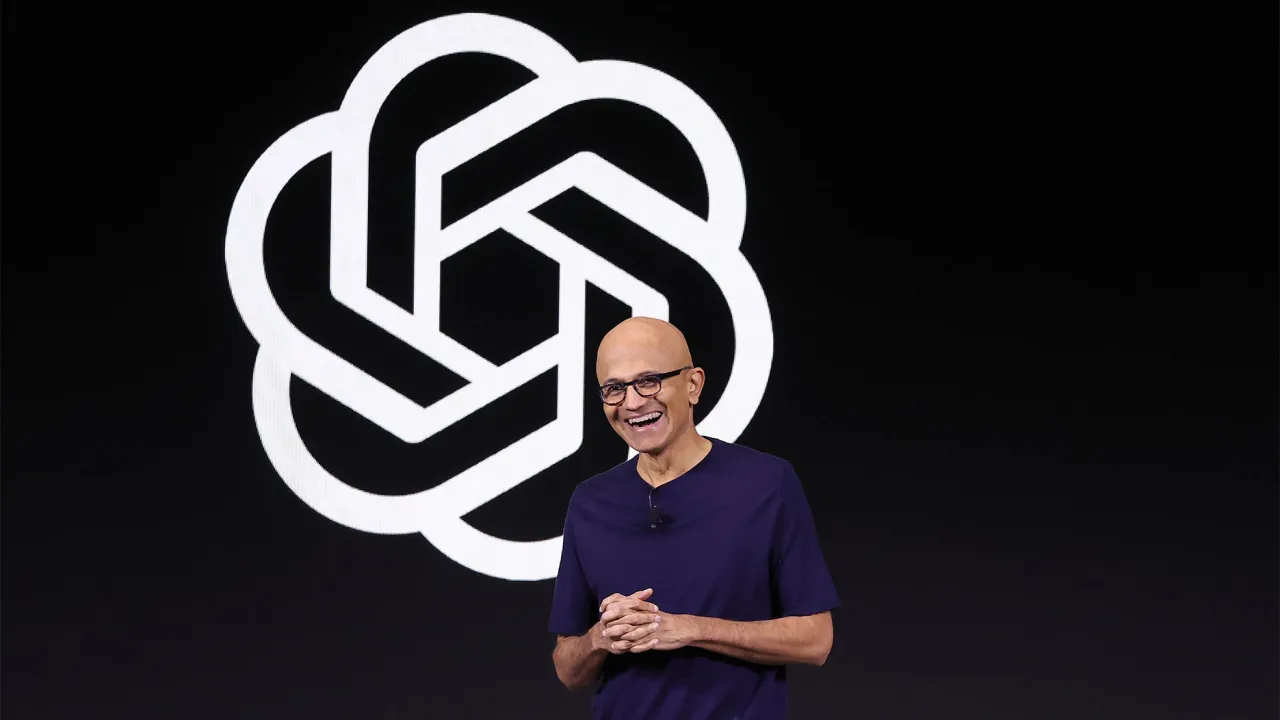
Microsoft chief executive Satya Nadella has doubled down on his warning to businesses using AI, telling CNN’s Fareed Zakaria on Sunday that companies which rely wholly on proprietary AI labs for their AI needs will ultimately not survive — an argument that lands directly on the same fault line African governments and CIOs have been publicly identifying since the start of the year.
Pressed on what constitutes over-sharing with an AI model provider, Nadella said enterprises need to be wary of everything they hand over — from data to prompts. His prescription is a setup in which every time a company uses a model, all of the metadata around that use is retained by the company itself, so it can eventually train its own weights or run its own open model. Weights are a model’s trained parameters — essentially its brain — and Nadella’s core proposition is that the company that does not hold onto its own usage data has, in his framing, “outsourced your thinking.”
Firms that don’t take this control, Nadella argued, “will not remain a firm.”
The specific technical architecture Nadella wants enterprises to adopt is what has become known as an AI gateway — an infrastructure layer that keeps prompts, context and memory separate from the underlying model itself. That separation, in his framing, lets a company use multiple models for what each does best, while ensuring that any one model can be swapped out or fail without the enterprise losing continuity. Nadella was blunt about coding harnesses in particular — the built-in coding-agent tools like Anthropic’s Claude Code and OpenAI’s ChatGPT Codex — and urged companies to stop relying on them as the interface between developer and model.
The self-interest is visible. Microsoft is an investor in both Anthropic and OpenAI, and enterprise coding agents from both companies are earning the model makers substantial revenue. But Microsoft’s cloud business is also now selling the alternative infrastructure Nadella is recommending — AI gateways, orchestration layers, and multi-model architectures — meaning the CEO’s warning against sole reliance on proprietary labs coincides commercially with a Microsoft product line.
Nadella’s underlying thesis, self-interest notwithstanding, is not a fringe view. Enterprises are increasingly turning to open-weight models — those whose parameters are publicly available — that they can fine-tune and run on their own hardware, which in turn drives demand for orchestration tools that can manage multiple models and for coding agents that aren’t locked to a single provider. His deeper concern goes further: once a firm has outsourced its thinking to a model provider, there is nothing structurally stopping that provider from eventually offering a competing service of its own — a risk that grows as enterprises grant AI agents access to the operational innards of the business.
That risk has been a live concern in the startup community for years. When OpenAI’s Sam Altman offered to invest in every Y Combinator startup in the latest cohort through AI credits in May, seed investor Jason Calacanis publicly warned founders that accepting the credits carried a non-zero chance the model maker would study exactly what they were building and copy it into a free offering, calling it the classic platform playbook. Nadella has now brought the same warning to enterprises.
The African relevance of the argument is unusually direct. The Rest of World investigation iAfrica covered in May documented that Nigeria, Egypt, Kenya and South Africa have each drafted national AI strategies naming dependence on Google, Microsoft, NVIDIA and Meta as a strategic and sovereignty risk — the same category of dependence Nadella is now telling enterprises to actively engineer against. In parallel, South African CIOs have been calling for locally built models and multi-model architectures. Dawood Patel of Helm made essentially the same vendor-lock-in argument on the enterprise side in June, warning that companies building complex systems on top of closed platforms end up with intellectual property “trapped inside that ecosystem” — and that what starts as a technology decision eventually becomes a CFO conversation because migrating away requires writing off years of integration and dataset investment.
Nadella’s remarks close a small but real gap between how African governments and CIOs have been framing AI dependence and how the CEO of one of the four US Big Tech companies named in those national strategies now describes the same problem to Western enterprises. It is possible to hold both readings simultaneously: Microsoft’s warning is genuine and commercially self-serving, and its recommendations are useful precisely because Microsoft has spent the past decade building the infrastructure that would let a customer follow them.
One caveat sits at the end of Nadella’s argument, and it will not read well to iAfrica’s audience given the site’s coverage of digital rights and data sovereignty. Asked how everyday people could protect themselves against the same over-sharing dynamic, Nadella shrugged, saying that individuals should expect to hand over their data as the price of a free service, along the lines of the older advertising business model. The concern about outsourcing thinking, in other words, applies to firms — not to consumers.