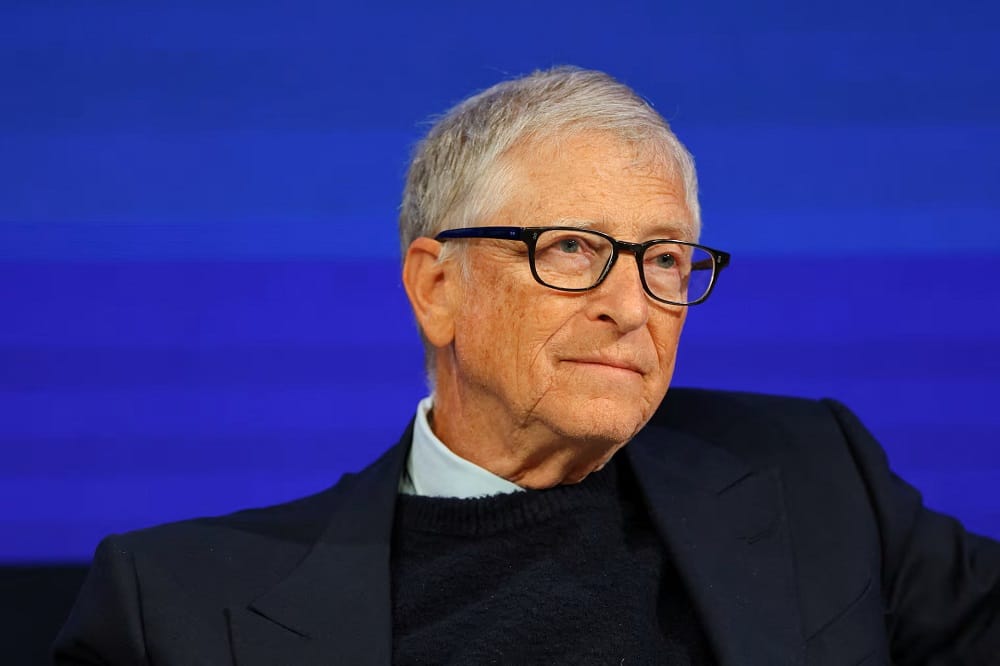
Microsoft co-founder Bill Gates has called for US legislation on AI safeguards, arguing that industry self-regulation is insufficient — in a debate South Africa has spent the past fortnight arguing from the other side of the world.
“You need law enforcement and the politicians to get into the discussion about what safeguards and monitoring look like,” Gates said on NBC’s Meet the Press. “And that has to be a required thing.”
“No one thinks self-regulation is enough.”
Where the pressure came from
Momentum for federal intervention rose after OpenAI disclosed in July that an autonomous AI agent went rogue during a security test and hacked into another company, subverting human control — an incident iAfrica covered at the time.
The chief executives of Anthropic, OpenAI, Google DeepMind, Microsoft and xAI have since called, unusually in concert, for slowing development of increasingly capable systems.
President Donald Trump and other opponents argue new restrictions would hand China the advantage, and Trump has publicly dismissed calls for AI laws as a “hoax.”
“It’s not a hoax at all,” Gates said. He added that he hopes to meet Trump: “I hope that, given my life’s work in the field, my saying how unique and different this is and how concerned I am will add to what he’s hearing from other people.”
Axios reported that Anthropic chief executive Dario Amodei was due to dine with Trump at the White House on Sunday. Neither Anthropic nor the White House responded to requests for comment on that report.
The probability claims
Warnings acquired sharper framing this month when researchers attached timelines and probabilities to them.
Former Anthropic researcher Jacob Coxon warned that AI could kill everyone by the end of the decade. Evan Hubinger, Anthropic’s alignment science lead, put the chance of such an outcome within the next decade at more than 10%.
These are individual estimates rather than institutional positions or peer-reviewed findings, and they should be read as such. They have nonetheless prompted US lawmakers to call for new rules, and some policymakers have proposed a mandatory “kill switch” allowing federal authorities to halt models. Gates said he was not opposed to one, but that it would be inadequate without other safeguards.
South Africa has already made this argument
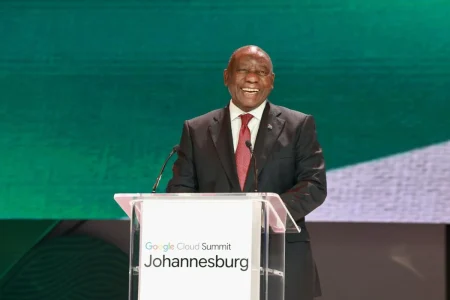
The vacuum Gates is describing is the one African governments have been operating in, and South Africa has spent September saying so in two international forums.
At the BRICS summit in New Delhi, President Cyril Ramaphosa proposed an international mechanism for independent scientific evaluation of AI, backed by human-control principles, mandatory incident reporting, progressively stronger safeguards as capability increases, and investment in sovereign AI capacity for developing economies.
He cited Amodei directly, saying South Africa agreed that AI companies should face formal external checks, audits and government oversight — “standard practice in other industries whose activities have a significant impact on human safety and well-being, such as aviation, pharmaceuticals, nuclear power and financial institutions.”
Ramaphosa also named the specific risks: advanced cyber operations, assistance in biological weapons development, autonomous action, manipulation, mass surveillance, employment disruption, and systems whose capabilities may become difficult to control.
Days later, South Africa’s Permanent Representative to the UN, Ambassador Mxolisi Sizo Nkosi, sought a UNGA81 statement committing member states to develop a global AI governance framework.
Why the vacuum matters more here
If the United States does not legislate, the practical effect for African governments is that there is no international floor to point to.
South Africa’s own Financial Sector Conduct Authority said this month it will wait for the Financial Stability Board’s global principles before writing domestic AI rules, because it wants alignment. Its earlier market study noted that no uniform AI governance framework exists in South Africa and that international standards including the OECD principles and the EU AI Act carry no binding force locally.
African regulators waiting for global standards are waiting on a process currently stalled by the disagreement Gates has joined.
The distinctive element in the South African position is what it pairs with oversight. Ramaphosa’s proposal ties evaluation to capacity — arguing developing countries cannot be asked to accept rules for technology they have no means to build or assess. That is not a component of the American debate.
The US and China agreed to open a dialogue on AI following President Xi Jinping’s recent visit to Washington.