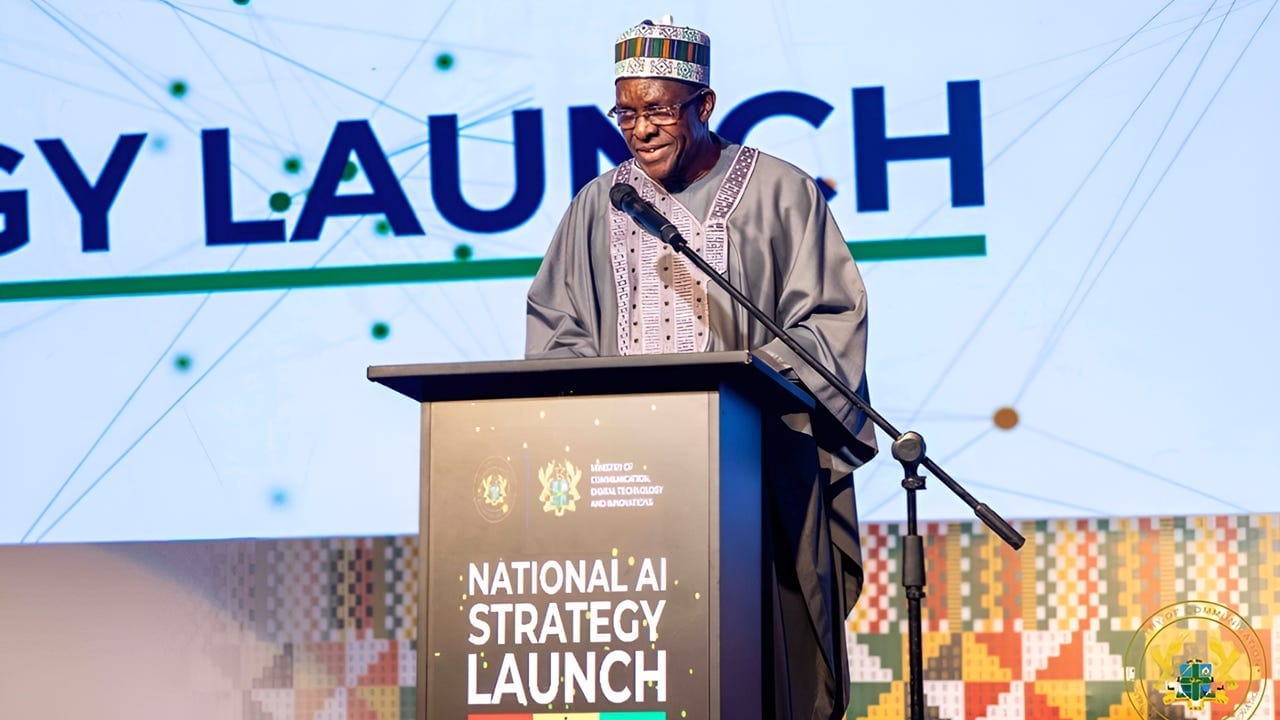
Ghana has launched its first National Artificial Intelligence Strategy, setting out an ambition to become a leading African AI hub by 2035 with a targeted $45 billion contribution to gross domestic product and $18 billion in total local and foreign private sector investment.
President John Dramani Mahama launched the strategy April 24 in Accra, joined by Communications, Digital Technology and Innovations Minister Samuel Nartey George and Speaker of Parliament Alban Sumana Kingsford Bagbin. The strategy was developed by the ministry with support from GIZ FAIR Forward, the British Foreign, Commonwealth and Development Office, UNDP, UNESCO and the Kwame Nkrumah University of Science and Technology’s Responsible AI Lab.
The strategy spans 2025-2035 and is built around eight pillars: expanding AI education and training, empowering youth for AI jobs, deepening digital infrastructure and inclusion, facilitating data access and governance, coordinating a robust AI ecosystem, accelerating AI adoption across sectors, investing in applied AI research, and promoting AI adoption in the public sector.
A National AI Fund will be established with an initial 5 billion Ghanaian cedis ($450 million) over five years to 2030, scaling to a 15 billion cedi ($1.4 billion) fund from 2030 to 2035. AI is targeted to contribute 200 billion cedis to GDP by 2030 and 500 billion cedis by 2035.
Every government ministry will designate an AI focal person to drive implementation across the public service, following a Cabinet AI Bootcamp held under the chief of staff’s leadership. A Responsible AI Authority will be established within the first year of implementation, modeled on Singapore’s National AI Office, Egypt’s National AI Council and the United Kingdom’s Office for AI.
Among the strategy’s distinctive proposals is GhanaChat, a large language model to be trained on data from government agencies for internal public sector use, designed to boost civil servant productivity while preventing the transmission of confidential information to overseas platforms. The strategy also sets a target of curating 1 trillion tokens of Ghanaian datasets by 2030, with grants proposed for dataset creation and annotation across health, agriculture and education.
Longer-term commercial targets include the creation of 10 Ghanaian AI unicorns and a privately funded Ghanaian artificial general intelligence lab competing globally — ambitions that frame the strategy as an economic competitiveness agenda rather than a digital governance exercise alone.
The launch follows Ghana’s Cabinet approval earlier this month of a $250 million national AI computing center to support research, development and deployment across agriculture, healthcare, education and financial services. Ghana currently ranks third in Africa for AI readiness and sits at the geographic and institutional center of the African Continental Free Trade Area.