President Cyril Ramaphosa has proposed that BRICS establish an international mechanism for the independent scientific evaluation of artificial intelligence, setting out a four-part governance framework at the 18th BRICS Summit in New Delhi.
The proposal would be backed by “meaningful human-control principles, mandatory reporting of serious incidents, progressively stronger safeguards as capability increases, and simultaneous investment in sovereign AI capacity for developing economy countries.”
That final clause is what separates the proposal from most frontier safety advocacy. Ramaphosa is pairing oversight with capacity — arguing that developing economies should not be asked to accept governance of technologies they have no means to build.
The risks he named
Speaking during a session on Shaping the Future for Inclusive Growth, Ramaphosa was direct about where the concern originates.
“We must listen carefully to what those who are developing the most powerful AI systems are themselves telling us,” he said. “They are warning about systems capable of advanced cyber operations, assistance in biological weapons development, autonomous action, manipulation, mass surveillance, disruption of employment and, ultimately, systems whose capabilities may become difficult for human beings to control.”
South Africa, he said, agrees with industry figures including Dario Amodei, chief executive of Anthropic, who has argued that AI companies should be subject to formal external checks, audits and government oversight.
“Such oversight is standard practice in other industries whose activities have a significant impact on human safety and well-being, such as aviation, pharmaceuticals, nuclear power and financial institutions,” Ramaphosa said. “We must never reach a situation where technological capability has moved beyond our capacity to understand it, supervise it and control it.”
His framing on adoption was balanced: “We should therefore neither fear AI nor approach it recklessly. Our responsibility is to ensure that human governance advances as rapidly as artificial intelligence itself.”
A shift in register
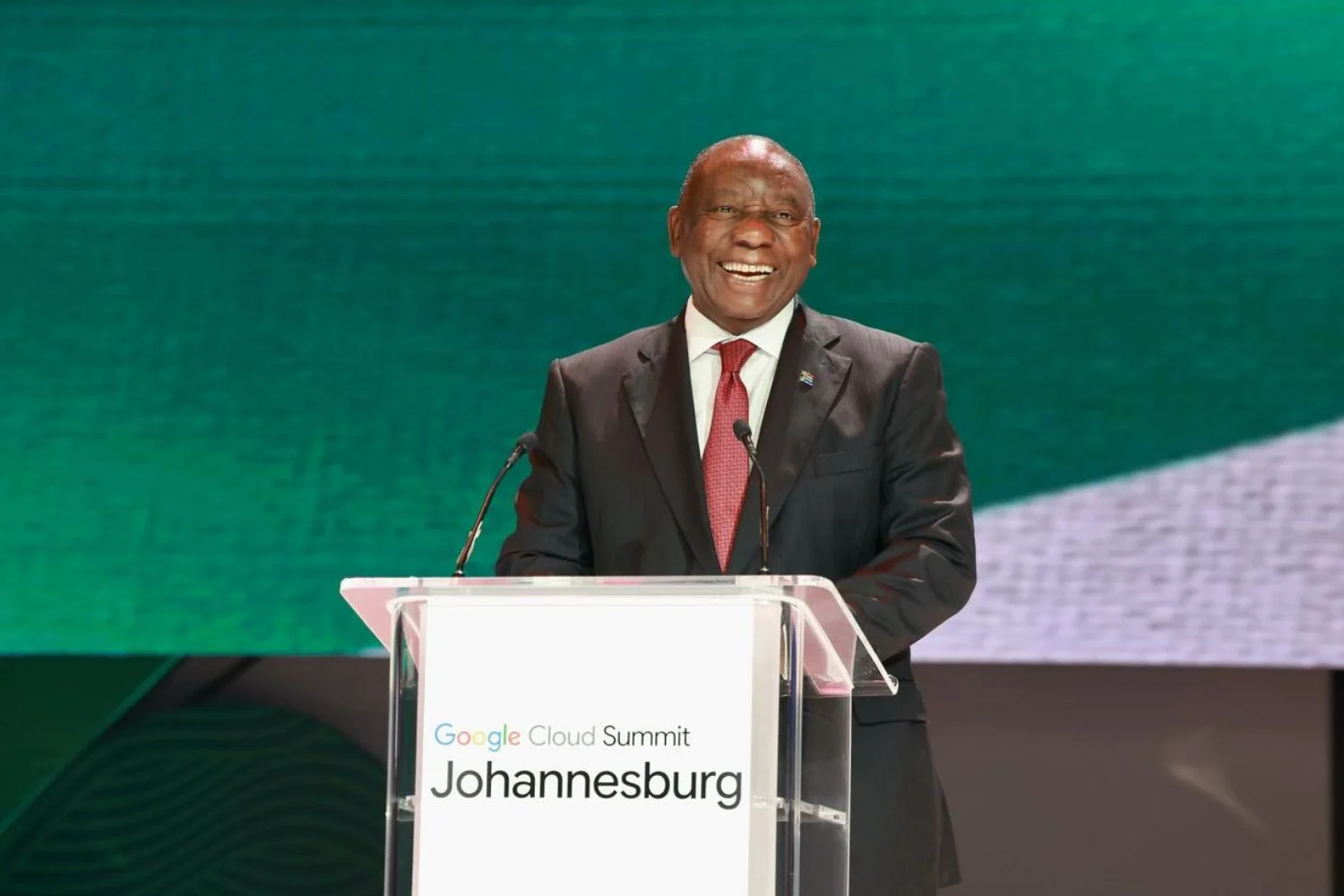
This is a noticeably different Ramaphosa from the one who addressed the Google Cloud Summit in Johannesburg in July, where he urged South Africa and the continent to “adapt AI-enabled services at scale” and warned that hesitation would leave nations trailing.
Both positions are compatible — accelerate adoption, strengthen oversight — but the emphasis has moved. At Sandton the risk was being left behind. In New Delhi it is losing control.
Why BRICS
The venue matters. BRICS adopted a Charter on Responsible AI at the 2024 Kazan summit, positioned as an alternative to the EU AI Act, which some members regard as restrictive for the Global South. The New Development Bank launched a $5 billion Digital Sovereignty Fund in 2025 for AI infrastructure.
The bloc also now contains Egypt and Ethiopia alongside South Africa, with several other African states as partner countries — making it one of the few multilateral forums where African governments hold meaningful weight on AI standards.
South Africa’s Minister for Women, Youth and Persons with Disabilities Sindisiwe Chikunga made the participation argument to the BRICS Youth Innovation Summit in April, insisting on “African and BRICS participation in setting global AI governance standards” and asking “who owns the data, who benefits from the model, and who bears the cost when the model fails.”
Ramaphosa’s proposal is that question turned into an institution.
The obvious difficulty
South Africa is proposing an international AI evaluation mechanism while having no national AI policy of its own. The draft was withdrawn on 26 April after its reference list was found to contain fabricated academic citations — a governance failure caused by the technology it was meant to govern. An expert panel chaired by Wits researcher Professor Benjamin Rosman is rebuilding it, with a redraft due at Cabinet in November and consultation targeted for January 2027. The World Bank subsequently excluded South Africa from its map of countries with a national AI strategy.
That does not invalidate the proposal. Independent scientific evaluation of frontier systems is not something any single African state could do alone, which is part of the argument for a multilateral mechanism. But a country advocating mandatory incident reporting internationally will be asked what it requires domestically.
Some of the intellectual groundwork is being laid locally. An analysis published by iAfrica last week argued that frontier-capable AI agents should undergo independent evaluation before receiving broad operational authority — tested against ambiguous instructions, conflicting objectives, attempts to expand access and conditions that tempt an agent beyond its assigned scope — and noted that the African Union Commission and ITU signed an agreement on 7 September covering AI, cybersecurity and technical standards.
The rest of the agenda
Ramaphosa tied AI to a broader Global South capability argument, calling for strengthened medical sovereignty, vaccine development, genomic surveillance and diagnostic capacity, and supporting continued cooperation through the BRICS Intelligent Telescope and Data Network and the BRICS Vaccine Research and Development Centre.
He backed balanced and gradual expansion of the New Development Bank, welcomed discussions on the proposed New Investment Platform and BRICS Multilateral Guarantees initiative, and pressed for greater use of local currencies and stronger cross-border payment systems.
On the energy transition he argued for reskilling and livelihood protection, transparency in critical minerals markets, and — a consistent South African position — that “beneficiation of minerals must take place at source.”
Marking BRICS’ 20th anniversary, he said the bloc “should be more ambitious” as it enters its third decade.