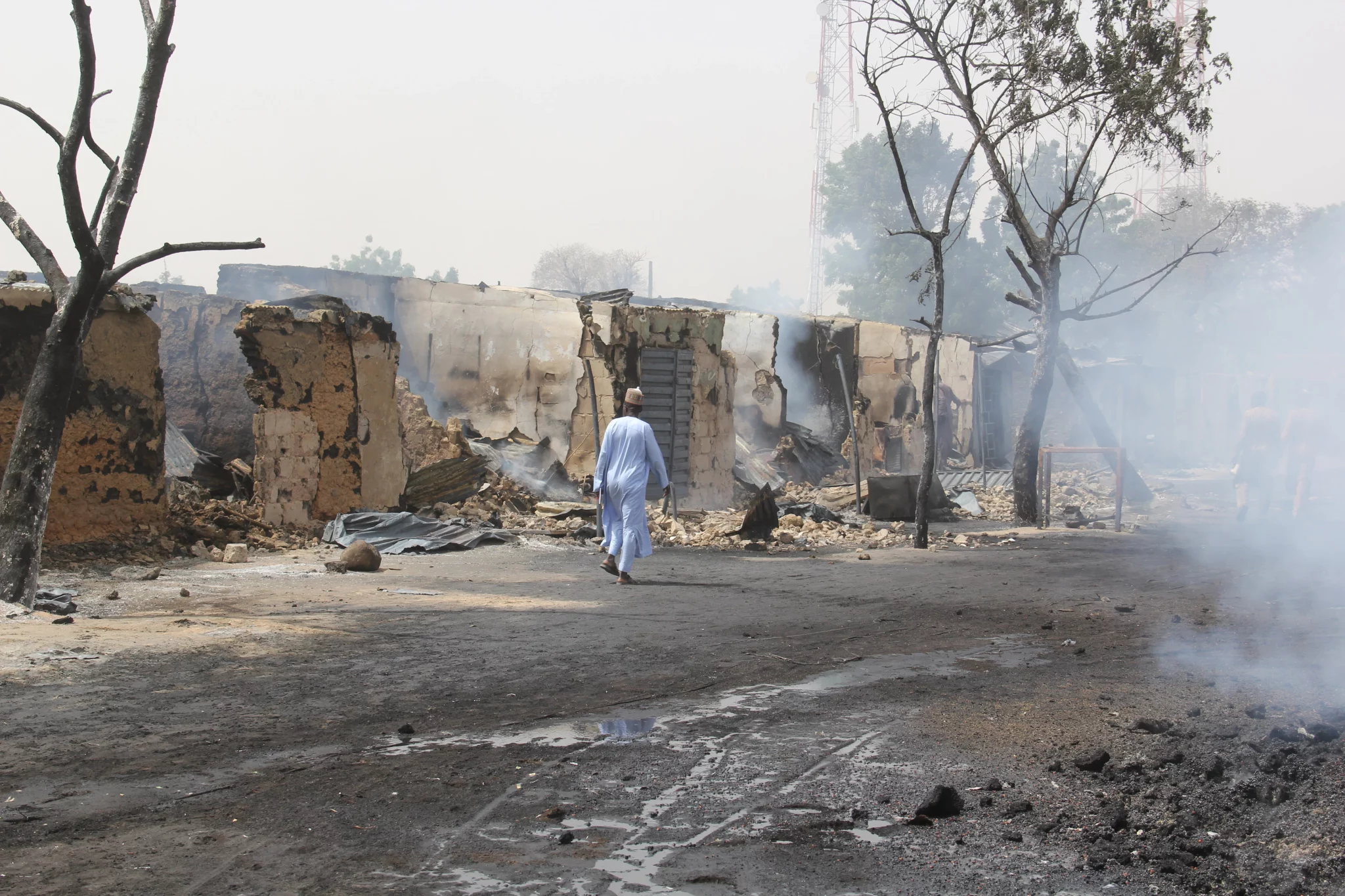
Around military bases in northeastern Nigeria, deep trenches serve as a low-tech defence against Islamic State West Africa Province. Motorcycles cannot easily cross them, and those minutes matter.
ISWAP commanders asked a commercial AI model how to get across.
That detail, from University of Cambridge fieldwork, is the smallest and most illustrative example in research that documents something more consequential than tactical improvisation: the deliberate construction of AI capability inside an insurgent organisation, with outside sponsorship.
Cells, not curiosity
Researcher Antonia Juelich interviewed 27 former Boko Haram and ISWAP members in northeastern Nigeria, including senior commanders and technical operators. iAfrica reported the headline findings in July. The structural detail is new.
Former commanders described specialised AI cells of five to 20 trusted operatives, with access tightly controlled and designated prompt engineers trained to work around model safety filters, query systems and synthesise results for battlefield commanders.
The capability did not emerge organically. According to the research, technology transfer began around 2023 when central Islamic State cadres supplied ISWAP with hardware, encrypted satellite links and paid software subscriptions, alongside instruction in jailbreaking — techniques for circumventing the guardrails intended to prevent models generating dangerous content.
That reframes the story. This is not fighters discovering a consumer product. It is a transnational organisation identifying commercial AI as a capability worth investing in, and equipping an affiliate to use it.
Both factions systematically queried off-the-shelf platforms including ChatGPT, Claude, Gemini, Grok, Meta AI and DeepSeek. Documented uses extend beyond the trench problem to troubleshooting captured government weaponry, refining attack logistics, engineering explosives and improving operational security.
‘Uplift’
The Cambridge researchers use a specific term for the effect: uplift — improving an existing actor’s capability without a comparable increase in resources.
The danger is not that AI turns recruits into strategists. It is that an organisation which has fought guerrilla warfare across borders for fifteen years becomes incrementally better at what it already does. Faster attacks, better precision, improved operational security.
Boko Haram was lethal long before any of this. Since intensifying its insurgency in 2009, the group and its offshoots have killed tens of thousands and displaced millions across the Lake Chad Basin. It bombed the UN headquarters in Abuja in 2011 and abducted 276 schoolgirls from Chibok in 2014; more than 80 remain in captivity, according to Amnesty International. The wider conflict has claimed roughly 43,000 lives, displaced 3.1 million people and pushed over four million into severe food insecurity, on figures cited in the study.
The asymmetry
The sharpest argument in Ndege’s analysis concerns adoption speed rather than capability.
For a commander to adopt a new model requires a smartphone or laptop, connectivity and perhaps a subscription. The group experiments. If it works, more fighters use it.
For a government security agency: budget approval, procurement, data protection, personnel training, inter-agency access decisions, legal questions on surveillance and privacy, and doctrine on when AI-generated intelligence can be trusted.
Most of those constraints are necessary. Governments should be more careful than terrorists. But they produce a mismatch. The Nigerian military has vastly more money, weapons, intelligence and personnel than Boko Haram, and Kenya’s forces capabilities Al-Shabaab cannot match. Neither can iterate as quickly.
The question is not whether African states can outspend militant groups. It is whether they can outlearn them.
The East African question
Al-Shabaab presents a structurally similar risk. Emerging from the Islamic Courts Union in the mid-2000s, it has survived sustained offensives by Somali forces, the United States, Kenya, Ethiopia and successive African Union missions. It killed 67 at Nairobi’s Westgate mall in 2013, 148 at Garissa University College in 2015, and 21 at the DusitD2 complex in 2019.
The evidence base differs sharply, and the piece is careful about this. Documentation of operational AI use is robust for Boko Haram and ISWAP, resting on direct testimony about structured cells and specific applications. For Al-Shabaab it is not. Assuming replication would be premature.
What holds regardless is the barrier to entry. No proprietary hardware, no specialised network. The same models used by developers in Lagos, students in Nairobi and executives in Johannesburg are available to anyone with a browser.
A moving target
The activity Juelich documented reflects 2024 capabilities. Current multimodal systems analyse satellite imagery, process large datasets, synthesise real-time audio and video and execute complex reasoning.
A counterterrorism posture built around what generative AI could do two years ago is already obsolete.
Nigeria’s own state-side AI investment has been substantial — a $190 million agreement with UK-based MARSS Group for AI-driven command, control and intelligence infrastructure, signed this year. Whether procurement of that kind can keep pace with an adversary that adopts by subscription is the open question.
The risk the research identifies is not spectacular. It is that commercial AI grants experienced insurgencies a quiet, incremental edge — while state responses remain slowed by procurement cycles, fragmented intelligence sharing and shortages of technical expertise.
Rewritten using AI based on original work By Adonijah Ndege.