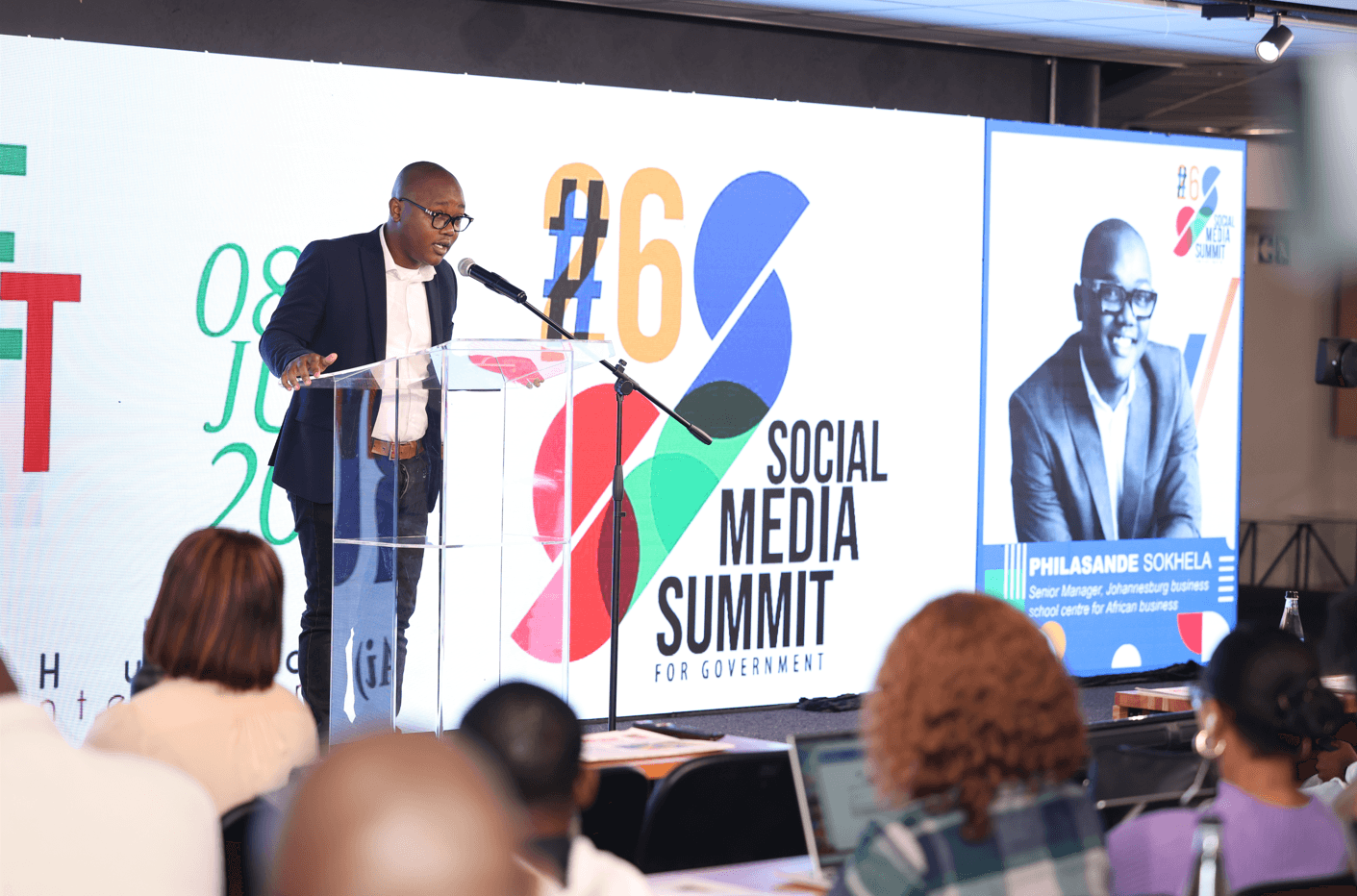
The University of Johannesburg played host this week to the fourth Social Media Summit for Government, a two-day gathering of government communicators, policymakers and digital leaders working through what artificial intelligence means for citizen engagement and the future of public-sector communication.
Held at the Johannesburg Business School on July 8 and 9 under the theme “Artificial Intelligence + Human Intelligence,” the event was organized by pan-African reputation advisory Decode in partnership with JBS, and endorsed by the Public Relations Institute of Southern Africa.
Delivering the keynote, Communications and Digital Technologies Minister Solly Malatsi argued that South Africa’s digital state must be built around accessibility, not around expecting citizens to adapt to systems that were never designed for them. “We shouldn’t be asking citizens to be digitally literate in an environment that was deliberately made to be ineligible,” he said, calling for a “one trusted point of entry” into public services underpinned by digital identity, data exchange and secure transactions working together.
Malatsi flagged the challenges facing South Africans without access to data or communication infrastructure, and called for partnerships, accountability and responsible self-regulation from technology companies to ensure digital services reach everyone. Social listening, misinformation and the responsibility of platform operators, he said, all sit at the centre of that agenda.
The most pointed warning of the summit came from Dr Caroline Azionya, president-elect of PRISA, who focused on the “weaponization” of public relations and communication through AI-generated synthetic media. Azionya pointed to the affordability of large language models, the proliferation of unethical operators, and the difficulty of detecting deepfakes — citing a 2025 study in which she said only 1% of people correctly identified them. She emphasized the importance of human oversight, professional accreditation and government accountability, and previewed the Africa Declaration on ethical communication, which she said is set to be formally launched next week.
“As a responsible and ethical communicator, you need to ensure that when you are communicating, you create value and do not bring harm to a society,” Azionya said. “Accredited systems can regulate who can practise the occupation. This means you can always go back to the source and trace people.”
The AI-as-tool-not-threat theme ran through much of the programme. Philasande Sokhela, senior manager at the JBS Centre for African Business, framed AI as an extension of human intelligence rather than a substitute for it, and pressed the audience on Africa’s positioning in the global AI economy. “The question we should be asking ourselves is: is Africa a mine, a market or a maker in the digital economy? Africa should lead parts of the AI revolution,” he said. “No matter how advanced technology becomes, society will always depend on something more important: trust. That is why human intelligence will remain our greatest competitive advantage.”
Decode founder and chief executive Lorato Tshenkeng picked up the same thread, warning of the potential for displacement as generative AI produces increasingly human-like content, and pressing for ethical decision-making in how the technology is deployed. Alistair King, vice chairperson of the WireCar Philipstown Foundation, offered a working example, showing how the foundation has used AI tools to build a short film, a mobile game and an e-commerce platform around a Northern Cape wire car race in an effort to lift the local community.
A panel on AI and human intelligence as “the new engine of public trust,” chaired by UJ strategic communications lecturer Professor Mandla Radebe, brought together Sasria stakeholder management executive Muzi Dladla, JBS Centre for Public Policy director Professor Busani Ngcaweni, and CSIR senior engineer Dr Chris Mahlathi. Discussion centred on the intersection of social behaviour and AI, and on the continuing weight of human judgment in AI applications.
The programme also featured Umkho AI founder and chief executive Botshelo Baloyi on AI for the public sector; a fireside chat on tech, truth and transparency between Kavisha Pillay of Campaign On Digital Ethics and Sipho Mthombeni, government affairs and public policy manager at Google South Africa; and an international keynote from Professor Martin Emmer of Freie Universität Berlin and the Weizenbaum Digital Science Center on the consequences of the AI revolution for political social media engagement. Rogerwilco senior brand strategist Mongezi Mtati addressed the attention economy, alongside sessions on how social media has disrupted mainstream newsrooms and a panel on crisis communication in an AI-accelerated environment.
Closing the summit, Tshenkeng returned to the theme of collaboration and announced that the inaugural Social Media for Government Awards would take place in 2027.