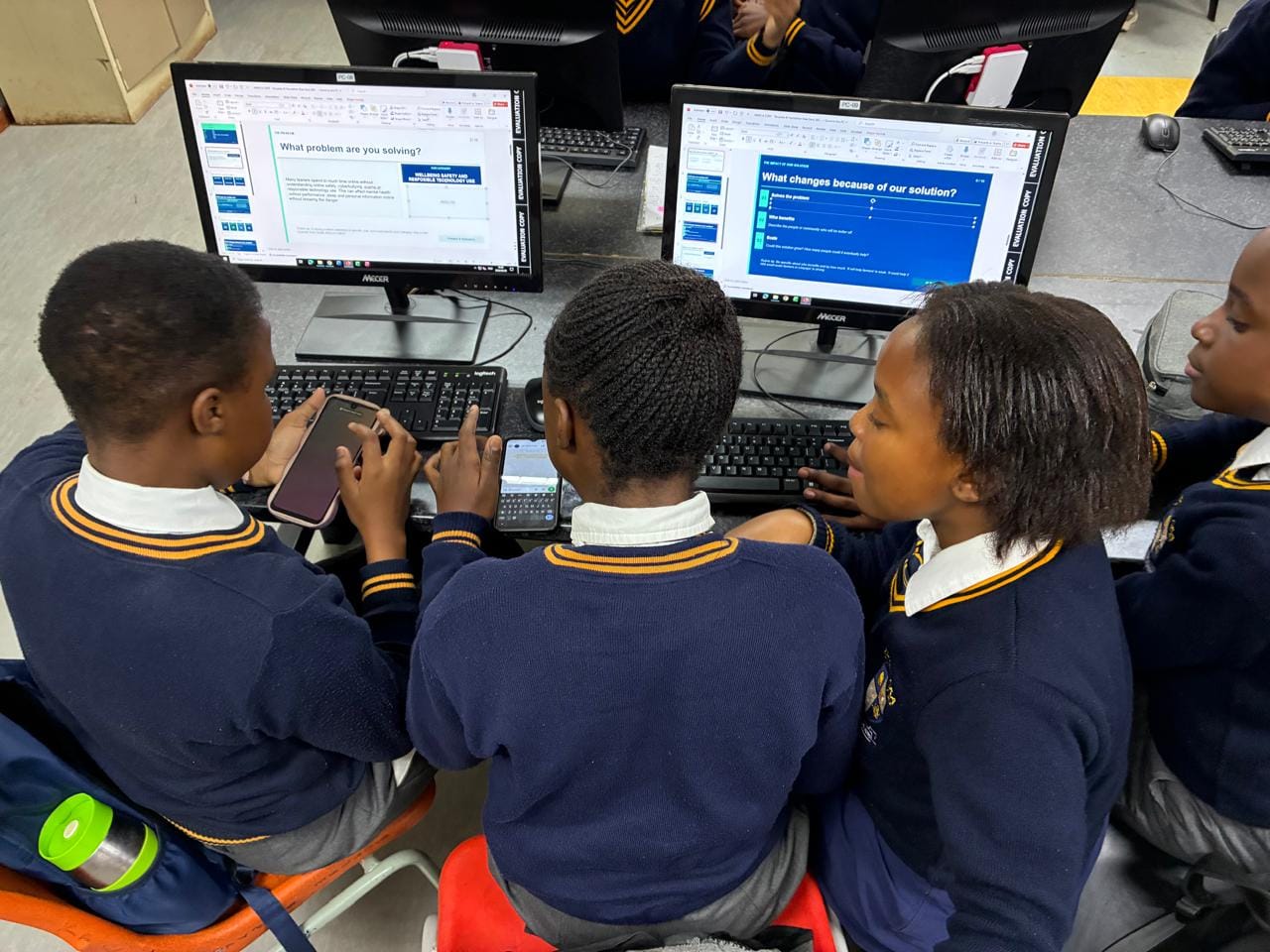
The AI Hackathon for Southern African schools this year added AI to its judging panel for the first time. Presented by the Independent Examinations Board (IEB) and education technology company TechWays, the event gives learners across South Africa insight into use cases for AI and how it can be applied in their communities.
Thousands of learners get hands-on with AI
Now in its third year, the 2026 Hackathon engaged thousands of learners from over 100 schools. With two age streams, Grade 6–8 and Grade 9+, teams competed at their schools to design AI-enabled solutions that address some of society’s biggest issues.
Says TechWays founder and CEO, Joanne Brink: “Amidst concerns about teen digital engagement, social media and AI consumerism, the Hackathon engages teens as AI innovators, encouraging them to consider how AI can benefit society and be used positively.”
AI is already part of everyday learning. Research from Common Sense Media shows 70% of teenagers have used generative AI tools, while only 37% of parents believe they are doing so. The OECD reports that nearly half (48%) of South African teachers already use AI in their work.
AI plus humans
The AI grader, called RubrIQ, is a joint project by Melio AI and TechWays. It was included in the judges’ panel for the first time to support the expert judges and teachers through the selection stages.
“The grader is an exciting development that removes selection bias from the early competition stages, helping to level the competitive playing field,” comments Brink.
“Educators shouldn’t have to choose between quality feedback and scalability,” she says. “Graders like RubrIQ combine AI and human expertise to help schools assess complex projects like these faster, more consistently, and with greater insight, and reduce the admin burden on teachers, school administrators and leadership teams.”
Thanks to the success of this and other pilots. RubricIQ is being evaluated by Carnegie Mellon University as part of its research into how AI graders perform against human graders and where the strengths and opportunities for improvement are.
Hackathon judging and results
Five AI judges graded entries, selected a shortlist of 20 across each category and provided detailed feedback to every team. The results were then interrogated and validated by expert judges Greg Desilla – COO at Melio AI, Junaid Desai – Solutions Architect at e4, Glenda Miles – Elevate Education Industry Advisor at Microsoft, Doug McCusker – Principal Engineer in the Group Engineering Team at Investec, Steffy Naicker – Group Transformation Manager, Learning & Development and ESG at iOCO, and Mubeen Suleman – Services Ops Support Manager at Lenovo Southern Africa.
Cash and technology prizes were awarded to the top three teams in each stream. A Foundations Cup award recognised a team from an underserved or inclusive education context.
The winners of the 2026 IEB-TechWays National AI Hackathon are:
Grade 9+:
Winner: TrustTrade AI – Hatfield Christian School. TrustTrade AI analyses transaction data and conversation behaviour to generate real-time risk scores.
Runner up: AquaGuard – Midstream College. AquaGuard uses AI to monitor irrigation systems and spot sensor anomalies to detect leaks and predict water needs.
Runner up: PlateSmart SA – Kearsney College. PlateSmart creates affordable meal plans based on location and household size, using sensor and citizen data to map risks.
Grade 6–8:
Winner: Scam Scanner – St Mary’s Diocesan School for Girls (DSG). Scam Scanner uses AI to check site history, security and reviews to allow online shoppers to check if a shopping site is safe, and suggest better alternatives.
Runner up: Green Flow – Bridge House School. Green Flow uses computer vision to classify water quality in real time, to sort wastewater and redirect it for reuse or sewer disposal.
Runner up: Nomvula – King David Linksfield. Nomvula uses AI to help cross-border traders match goods to the relevant customs duties and exemptions before it reaches a border.
Foundations Cup:
Winner: FoodBridge – Ribane Lake School of Specialisation. FoodBridge uses AI to analyse demand patterns across SADC produce markets to help farmers and suppliers get their goods to markets where there is demand.
Driving multi-faceted skills development
IEB CEO Confidence Dikgole says the Hackathon offers learners a unique opportunity. “Not only do participants enhance their understanding of AI, they also develop critical thinking, innovation, entrepreneurship, ethical technology use, and collaboration skills.”
Participants loved the event. “This has been an amazing day,” said one of the teachers. “I was comparing it to four years ago and how much AI has evolved and the reality of what Grade 7 students can create. This is preparing them for their future.”
Says one of the learners: “I totally enjoyed it, it’s like the best thing I’ve ever participated in. I’ve learnt so much, I had a lot of fun, and working with AI is very helpful for me to see how powerful AI can be as a helping tool. Overall I just want to say: Thank you so much for this excellent, perfect, exciting competition and I am DEFINITELY participating again next year!”
“It was a great, helpful and encouraging experience. I look forward to participating again in the future,” says another learner.
“The Hackathon builds on our ongoing rural youth funding partnership with TechWays, and gives us an opportunity to open up more opportunities for youths through bursaries,” comments iOCO’s Steffy Naicker.
“Lenovo was delighted to help empower up-and-coming tech talent with the tools they need to keep building, creating and innovating beyond the Hackathon,” says Lenovo’s Mubeen Suleman.
Lenovo was the official Technology Prize sponsor in the Grade 6–8, Grade 9–12 and Foundations Cup categories. The event was also supported by RGB Gaming and Canva.