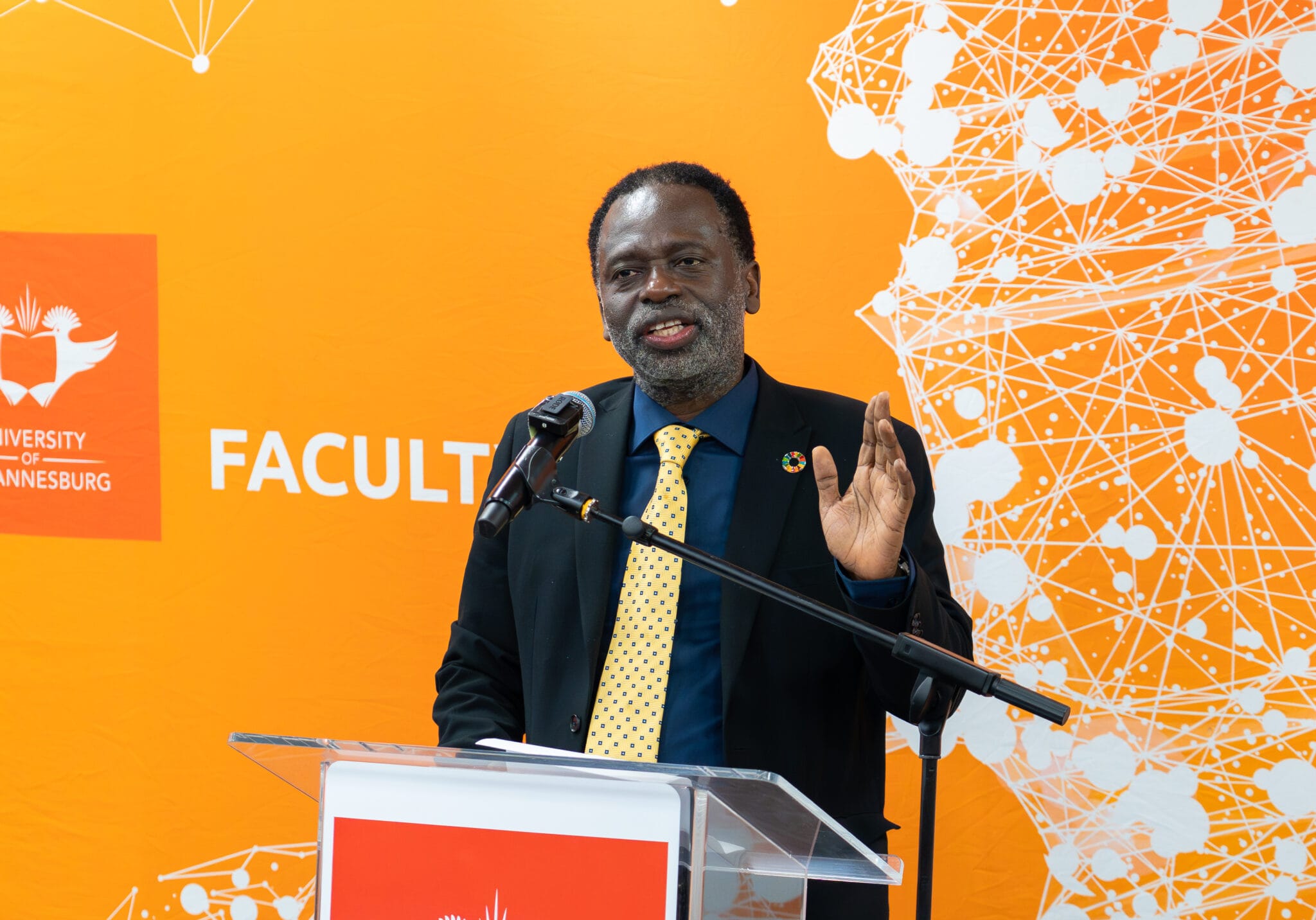
United Nations Under-Secretary-General and Rector of the United Nations University Professor Tshilidzi Marwala warned against relying on probabilistic AI systems in criminal justice on the second day of the University of Johannesburg’s inaugural AI and the Law Conference, telling delegates that lawyers and policymakers cannot afford to confuse the technical accuracy of a model’s output with the truth of what it says.
“Accuracy is not truth,” Marwala said in his keynote address, delivered in the Kruger National Park as the reserve marks a century of protection in 2026. “The same way we have long understood that correlation is not causation, we must recognize that accuracy is not truth.”
He proposed three interconnected lenses through which society should approach AI: law, which determines liability and how rights are protected; governance, which shapes the systems of oversight, data, algorithms and computing infrastructure; and balance, which forces societies to confront the trade-offs between technological progress and its risks. “Law alone arrives too late,” he said. “Governance alone lacks teeth. And balance alone is just honesty about trade-offs, with no mechanisms to enforce the choices we have made.”
Marwala reserved some of his sharpest concerns for the criminal justice system, where predictive policing and risk-scoring systems already influence decisions on bail, sentencing and parole. Given that AI systems are fundamentally based on statistical models, he questioned whether probabilistic technologies should be trusted in matters that demand proof beyond reasonable doubt. He also cautioned that AI systems can generate responses that appear convincing and accurate while being factually incorrect — a limitation, he argued, that lawyers and regulators must understand technically before they can regulate meaningfully.
The address landed sharply on the question of who should write the rules. “If we let the companies write the rules for the very tools meant to close the justice gaps, we risk the same digital divide simply reappearing inside the solution,” Marwala warned.
UJ vice-chancellor and principal Professor Letlhokwa George Mpedi followed with a keynote that pulled the arguments firmly into an African frame, warning that the continent cannot simply import AI governance frameworks developed for other jurisdictions and expect them to answer to Africa’s distinctive social, cultural and economic realities. “AI models are mirrors. They reflect whatever they were fed,” Mpedi said. “And if the data feeding those mirrors is overwhelmingly Western, then Africa is letting someone else’s mirror define its own reflection.”
Building on themes he has advanced elsewhere — including a widely circulated Business Day opinion piece co-authored with Sol Plaatje University chancellor Thebe Ikalafeng in June — Mpedi argued for an “AI equivalent of geographical indication” to protect African cultural provenance from being absorbed and monetized abroad, invoking South Africa’s protection of Rooibos as a precedent. He also flagged the linguistic dimension of the problem: Africa is home to approximately 2,000 languages, yet leading AI systems perform reliably in only a small fraction of them. “An AI-driven legal aid tool is not neutral if it cannot reason competently in isiZulu or Sesotho,” he said.
Both keynotes converged on a shared closing message: that law, governance and technological innovation cannot operate in isolation, and that Africa is not without leverage. Through the African Union and the African Continental Free Trade Area, Mpedi noted, the continent represents 54 countries and roughly 1.4 billion people — a bloc, he argued, whose collective weight in shaping how African data is used to train AI has yet to be fully deployed. “We should talk together,” he said. “If we harness it, it will be strong.”
The programme also featured an industry address by Technology Innovation Agency chief executive Dr Titus Mathe, and a panel on “Artificial Intelligence, Sustainability and the Future of Society” chaired by UJ Faculty of Law acting vice-dean Professor Sebo Tladi. The panel brought together Professor Georg Borges of Universität des Saarlandes in Germany, Professor Arthur Mutambara of UJ’s Institute for the Future of Knowledge, and Professor Sune von Solms of the UJ Faculty of Engineering and the Built Environment — reinforcing the conference’s cross-disciplinary framing.
Closing his address, Mpedi drew a parallel between the century of conservation the Kruger National Park now represents and the responsibility facing the current generation as it develops legal and governance frameworks for artificial intelligence. “We are gathered in a place that protects something precious because generations before us had the foresight to build the legal instruments to make that protection durable,” he said. “I hope this conference is one more such instrument.”