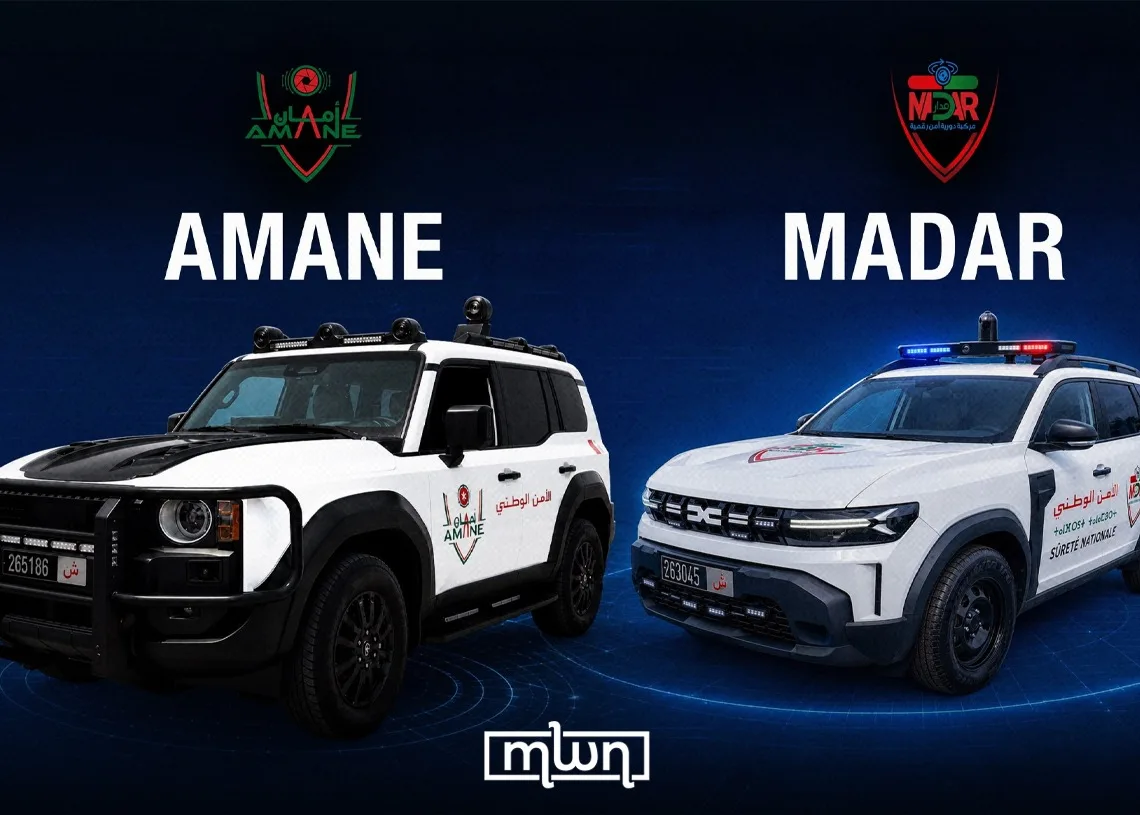
Morocco’s General Directorate of National Security has deployed a new generation of AI-equipped patrol vehicles in Casablanca, bringing facial recognition, automatic number plate reading and 360-degree real-time surveillance into routine police operations.
The two units, named “Amane” and “Madar,” entered service on Saturday as part of the DGSN’s push to modernise security operations and extend the capabilities of field officers through connected technologies. Both are designed for urban patrols, proximity policing, event monitoring, crowd management, smart city operations and the protection of critical infrastructure.
Amane
The Amane vehicle is built around an integrated system combining artificial intelligence, real-time reconnaissance and extended operational autonomy. It carries a 360-degree autonomous surveillance system with 11 customised cameras featuring optical zoom, including roof-mounted units providing full-angle coverage and a panoramic camera capable of a complete rotation in three seconds with zoom up to 40 metres.
Three Automatic Number Plate Recognition cameras identify Moroccan vehicle registration plates, which the DGSN puts at 90% accuracy, rising to 95% in operational conditions. An internal camera with facial recognition identifies the driver and assistant, adding a layer of in-vehicle authentication.
The vehicle connects directly to internal security networks, allowing officers to verify the identity of individuals or vehicles in real time against central databases. Detected events are automatically tagged with precise geolocation data, whether the subject is a vehicle plate or an identified person. Amane offers up to 16 hours of continuous operational autonomy.
Madar
Madar converts a standard vehicle into a connected mobile surveillance platform running the same AI system as Amane. Its 360-degree vision system monitors surrounding areas and identifies individuals and vehicles in real time.
The distinguishing hardware is its 3D-printed flashing beacon, which integrates high-resolution cameras capable of capturing fast-moving images without distortion. The system can monitor up to six traffic lanes simultaneously, with three cameras on each section of the beacon and a central 360-degree unit completing coverage. The cameras carry both licence plate recognition and pedestrian identification capability.
The governance question
The deployment places biometric identification and automated database matching into everyday street-level policing — a category of AI application that sits directly under the remit of Morocco’s National Commission for the Control of Personal Data (CNDP). The Ministry of Digital Transition and Administrative Reform signed an agreement with the CNDP in September 2025 to build a national responsible AI platform, and Minister Delegate Amal El Fallah Seghrouchni has positioned Morocco as a potential “third voice” on AI governance, distinct from US, European and Chinese frameworks and grounded in ethical and sovereignty-conscious principles.
The DGSN’s announcement does not address data retention periods, oversight arrangements, or how facial recognition and pedestrian identification data gathered during patrols will be governed. Those questions have driven substantial regulatory activity elsewhere — the EU AI Act classifies real-time remote biometric identification in public spaces as a prohibited practice with narrow law-enforcement exemptions — and are likely to shape how Morocco’s own AI governance framework develops as deployments scale.
The vehicles arrive as Morocco continues to build out AI capacity across both public services and infrastructure. The country’s customs authority launched an AI-driven risk management project with the World Customs Organization, and the $1.2 billion Nexus AI Factory — described as Africa’s first sovereign AI infrastructure platform of its kind — is being built in the Casablanca suburbs.