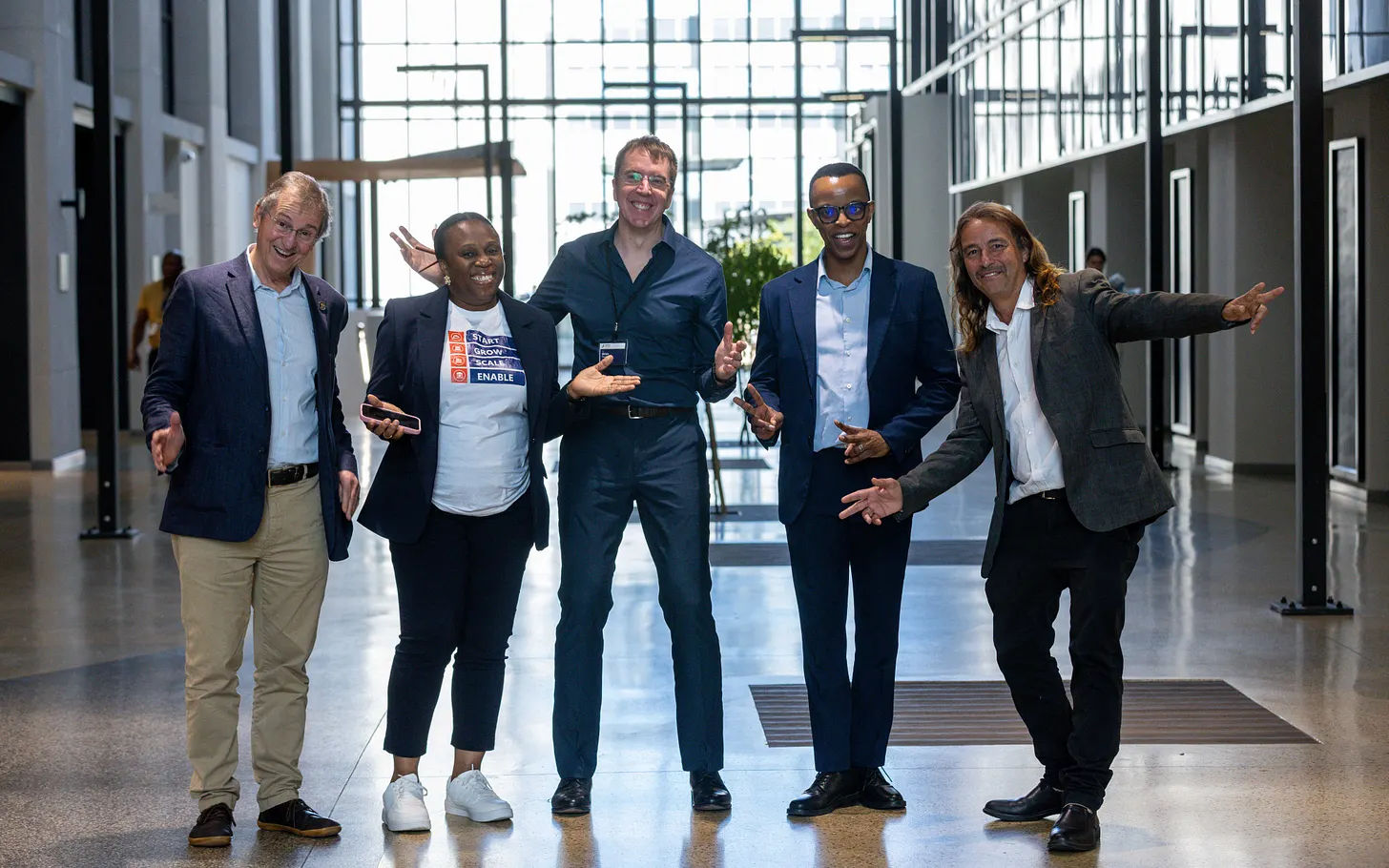
A Google.org-funded programme to teach advanced AI at African universities has launched in South Africa, with lecturers from five universities beginning a week of training at Stellenbosch University.
AI Research Foundations (AIRF) aims to reach 30 universities across Ghana, Kenya, Nigeria and South Africa — 10 of them South African — and ultimately 30,000 students. South Africa follows in-person training already held in Ghana, Nigeria and Kenya.
Beyond AI literacy
The curriculum, developed by Google DeepMind with teaching resources from University College London, covers deep learning, neural networks, transformers and generative language models, including hands-on building and fine-tuning of language models and responsible AI development. It is free on Google Skills.
The programme uses a train-the-trainer model. The five-day workshop at the Biomedical Research Institute on Stellenbosch University’s Tygerberg campus brings together lecturers from Stellenbosch, Venda, Mpumalanga, the Free State and the Western Cape, who will then teach the courses and supervise student projects at their own institutions. It is the first of four planned South African workshops.
FATE Foundation in Nigeria is the main grant holder, with AIMS South Africa as academic partner.
“We aim to train 30,000 students across our continent to understand foundational aspects of AI research through the lenses of large language models and responsible innovation,” said Prof Ulrich Paquet, AI director at AIMS South Africa and a research scientist at Google DeepMind.
Better science, not more
Prof Francesco Petruccione, director of the National Institute for Theoretical and Computational Sciences, said the goal was to improve research quality. “We should use AI to do not more but better science.”
Stellenbosch’s Centre for Epidemic Response and Innovation (CERI), which hosted the launch and applies machine learning to pathogen genomics and epidemic intelligence, will help deliver the curriculum across the university from 2027.
“It is important that university researchers and students receive advanced AI training, not only to use artificial intelligence ethically and effectively, but also to develop and programme their own models to address health and societal challenges across Africa,” said CERI director Prof Tulio de Oliveira.
Based on reporting by ednews.africa.