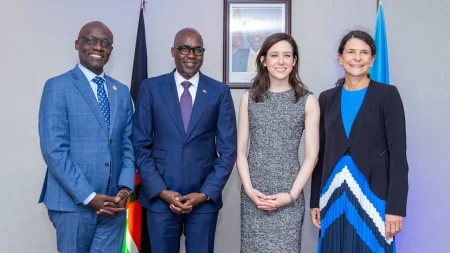
African countries should identify the problems facing their communities before deciding what data, infrastructure and technology to acquire, according to Girmaw Abebe Tadesse, a member of the UN’s Independent International Scientific Panel on AI.
“We are trying to bring the reality of our environment and integrate AI technology with the local problems we face,” Tadesse said. “It is important to ask ourselves what problems we want to solve first.”
Tadesse leads Microsoft’s AI for Good Lab in Kenya, and holds a seat on the UN scientific panel established in 2025 alongside South African computer scientist Vukosi Marivate.
A problem-first approach, he argued, would help African countries direct limited resources toward technologies with demonstrable social and economic benefit.
The fragmentation warning
Tadesse’s sharpest point concerned duplication.
“There is a need for African countries to collaborate more, share experiences and learn from each other’s successes instead of each starting from scratch.”
That has support in the record. COMESA has run national AI strategy consultations across 21 member states. The East African Community adopted a Kigali declaration coordinating a regional strategy. Six Francophone West African countries adopted a shared governance framework in July. The African Union has a Continental AI Strategy, La Francophonie has convened its own digital governance forum, and more than a dozen countries have published or drafted national strategies of their own.
Several countries sit inside three or four of those processes simultaneously. Kenya alone has engaged OpenAI, Anthropic, Google, Microsoft, Meta, NVIDIA, Mistral and Cohere within months, while participating in COMESA and EAC harmonisation work.
The Lawyers Hub and Agence Française de Développement made a related finding in May: African AI strategies are being written faster than the institutions required to implement them.
Rwandan Prime Minister Justin Nsengiyumva put the practical version at UNGA last week: “An application licensed in Rwanda should not have to be argued again in 54 jurisdictions.”
Why context is a technical constraint
Tadesse argued that knowledge sharing would help countries design systems accounting for local languages, infrastructure limitations and the realities communities actually face.
That is not a softening consideration. African languages account for under 0.1% of internet content, and the GSMA estimates fewer than 2% of the continent’s languages receive meaningful support from modern AI platforms. Thirty-two percent of rural schools in sub-Saharan Africa lacked regular electricity in 2024, and 68% lacked consistent internet. A system that assumes connectivity or English fails before it is evaluated.
He also called for cooperation across governments, universities, development partners, creative communities and technology companies. “When we bring together diverse stakeholders, we can use existing knowledge and wisdom to produce solutions needed by our communities.”
The window
Tadesse pointed to Africa’s young population and rising technology use as the basis for the continent becoming a centre of AI innovation.
“Many young people are already using technology to solve the challenges of their communities, while there are also investors and development partners willing to support these efforts.”
He closed on urgency rather than optimism: “If we work together, the future is bright. But we don’t have much time to wait.”
Tadesse did not cite specific projects from the AI for Good Lab, and the remarks contained no figures. His central argument — start with the problem, coordinate across borders, design for the conditions that exist — is one African policymakers have been making with increasing frequency. It carries additional weight from someone sitting on the panel advising the UN on what those conditions require.