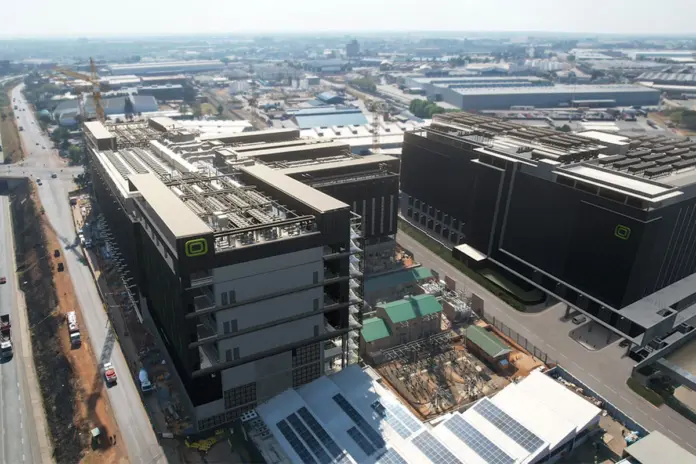
South Africa should not compete to host large AI data centres, according to an AI implementation expert whose argument cuts against a year of expansion announcements.
“My view is that South Africa should not chase this,” says Dr Francois du Plessis, who sets out three reasons.
The first is resource load: hosting a large data centre places heavy demand on water and electricity, both of which South Africa is already short of. The second is that the country does not need to host facilities to capture the benefits. “The computing infrastructure can be situated elsewhere in the world, yet the response can still reach the user within seconds.”
The third is distributional. “The cost of hosting these facilities could fall heavily on agriculture. The decision is therefore not only an economic one but also an environmental one, because farming communities depend directly on natural resources.”
His conclusion is that South Africa should “use AI extensively, rely on established international data centres where appropriate, and concentrate national efforts on developing AI-augmented industries.”
The argument he is arguing against
That position runs against the direction of travel. Cape Town approved two hyperscale facilities totalling around 174MW in July. Teraco is bringing its 30MW JB5 online to host its first AI workloads at scale. Equinix is scaling Johannesburg 1 toward 24MW. MTN named South Africa a priority market for its data centre platform. Microsoft has committed R5.4 billion by the end of 2027 on top of roughly R20.4 billion over the preceding four years.
The prevailing case is that regions with reliable energy are competing aggressively for AI infrastructure investment, that energy security has become an economic development lever, and that countries failing to address power constraints will miss the next wave of digital investment. New facilities generate demand across generation, construction, telecommunications, security and professional services.
Du Plessis’s counter is that latency is not the binding constraint most people assume, and that the resource cost is borne locally while the compute benefit is available regardless.
What the water numbers actually show
The strongest challenge to his first point comes from Teraco, which has now published figures.
The company states its closed-loop systems do not depend on continual water replenishment, and reports water usage effectiveness declining from 0.10 litres per IT kilowatt-hour in 2023 to 0.04 litres in 2024 — a 60% reduction in two years.
That is the first hard African data centre water figure iAfrica has been able to report, and it matters. A modern closed-loop facility uses far less water than an older evaporatively cooled one, though water is still required for sanitation, cleaning, maintenance and landscaping. A Schneider Electric and Microsoft life-cycle assessment found the shift from air to advanced liquid cooling can cut blue water consumption by up to 82%.
The distinction between cooling technologies is doing significant work in this debate. Facilities relying on evaporative cooling lose water to the atmosphere continuously. Those using closed-loop systems, air-cooled chillers or direct liquid cooling do not.
South Africa remains water-scarce with heavily allocated major systems. Du Plessis points specifically to the Vaal and Orange rivers, which support urban, industrial and irrigated agricultural demand simultaneously. Any large new allocation would have to be assessed against existing users downstream.
Heat, and where it goes
A consideration largely absent from South African data centre coverage until now is what happens to the heat.
Servers run continuously and produce substantial thermal output that must be removed without interruption. Du Plessis cautions that waste heat and the potential formation of localised heat islands could affect surrounding communities and agricultural activity, with severity depending on facility size, concentration, local climate and the heat rejection method used.
Where multiple facilities cluster — as they do in Johannesburg — that becomes a cumulative rather than individual question.
The grid problem does not solve itself
Hyperscale facilities require continuous, highly reliable power, unlike many industrial users. South Africa’s grid remains under pressure in several areas, particularly where transmission and distribution have not kept pace with new demand.
Adding large continuous loads could compete with households, farms and existing industry unless generation and grid capacity are developed alongside. There are no dedicated public electricity upgrades for each new facility; developers must comply with existing regulations and often finance connection infrastructure themselves.
Vantage Data Centres’ Johannesburg II facility illustrates the limit. It has multiple power feeds, a 35 MVA on-site substation and N+1 redundancy — arrangements that make the data centre reliable without resolving constraints in the wider network.
Teraco’s JB7 and the estate total
Teraco is developing JB7, a hyperscale facility at its Isando campus in Ekurhuleni providing 40MW of critical power. Once incorporated, the company’s stated critical power capacity will reach approximately 228MW.
Johannesburg remains the centre of South African development despite its constraints, because of proximity to the country’s largest concentration of banks, telecoms operators, cloud providers, corporate customers and internet interconnection infrastructure. Locating compute near major users reduces latency and simplifies direct network connection.
Cape Town’s actual advantage
Cape Town’s growth is often attributed to seawater cooling access. The report corrects this: its strategic value comes from submarine cables — ACE, Equiano, SAT-3, SAFE, WACS and 2Africa all connect through or near the Western Cape, making the city an international gateway and an alternative to Johannesburg for geographic redundancy.
Teraco’s CT1 provides roughly 2,500m² of data hall space and 3MW of critical IT capacity, with a planned expansion adding about 1,000m² and 2MW, due for completion in early 2027.
The South African Artificial Intelligence Association and the Western Cape Government launched the Western Cape AI Cluster to expand provincial AI opportunities. Association chairperson Dr Nick Bradshaw identified sovereign AI and a planned Cape Town AI factory as central themes — while adding the qualification that further infrastructure expansion “must be aligned with the capacity of the country’s electricity grid, water systems, and municipal infrastructure.”
That is close to Du Plessis’s position, stated more diplomatically. The disagreement between them is not about whether constraints exist. It is about whether they can be engineered around, or whether the attempt is worth making at all.