The East African Community and the German government have launched the second edition of the AI4EAC Challenge, targeting 20,000 people across all eight EAC partner states — a fivefold expansion on the inaugural round, and one that includes a new track dedicated to Ebola outbreak response.
The challenge carries $50,000 in prize funding for teams developing AI solutions to regional problems, and was launched following a high-level roundtable at EAC headquarters in Arusha. Equity Group Holdings and Germany’s Karlsruhe Institute of Technology join as new strategic partners.
The concentration argument
Joachim Schmitt, head of the East and Central Africa division at Germany’s Federal Ministry for Economic Cooperation and Development, set out the case for a regional approach with figures that frame the problem precisely.
“Since 2019, Africa has attracted $1.25 billion in AI investment, but 80 percent has gone to just four countries,” he said. “Africa also has less than one percent of the world’s data-centre capacity while it is home to 18% of the world’s population.”
East Africa reproduces the same imbalance internally, Schmitt said, with some partner states well ahead and others barely starting. “No single country can close this gap alone.”
That is the founding premise of the EAC AI Alliance, which IUCEA launched in May explicitly as a response to fragmented national approaches that have limited the scale and impact of AI investment across the bloc.
What’s new in edition two
The dedicated Ebola Response Challenge invites researchers, students and innovators to build AI models supporting outbreak detection, preparedness and response — extending the Alliance’s public health focus into a specific regional resilience question rather than a general health track.
Equity Group is anchoring a finance track. “We want participants to work on real-world challenges, benefit from the experience and develop solutions that can progress beyond the competition,” said Winnie Mangeni, the group’s director of innovation and technology.
That last phrase points at the recurring weakness in challenge-based programmes. Roger Jantio argued in a column published by iAfrica this week that Africa does not suffer from a shortage of pilots but from too few pathways converting successful pilots into contracts and companies — what he called a permanent pilot economy. Whether Equity Group’s involvement produces procurement rather than prizes is the more consequential question.
Building on edition one
The inaugural challenge, delivered by Zindi with IUCEA, EASTECO, GIZ, UNESCO Campus Africa and JICA, engaged 3,891 participants from 57 universities across Burundi, the Democratic Republic of the Congo, Kenya, Rwanda, Somalia, South Sudan, Tanzania and Uganda. Over six months of courses, webinars and hands-on training, participants built solutions in health, agriculture, finance and education, with top performers securing internships.
The 20,000 target represents a substantial scale-up. The $50,000 prize pool is modest against it — Zimbabwe’s national AI for Impact Challenge offers up to $80,000 — which locates the programme’s value in the skilling pipeline rather than the awards.
Speaking for the EAC Secretary General, Deputy Secretary General Aguer Ariik Malueth framed the initiative around workforce readiness. “Our priority is to ensure East Africans have the skills, knowledge and partnerships to harness AI to create jobs, improve public services and develop solutions to our region’s challenges,” he said.
Germany’s regional footprint
The EAC AI Alliance is commissioned by BMZ and implemented by GIZ with EASTECO and IUCEA. It succeeds the Digital Skills for an Innovative East African Industry project, under which 4,000 young people were trained across seven countries, engaging more than 300 private sector partners and 100 universities.
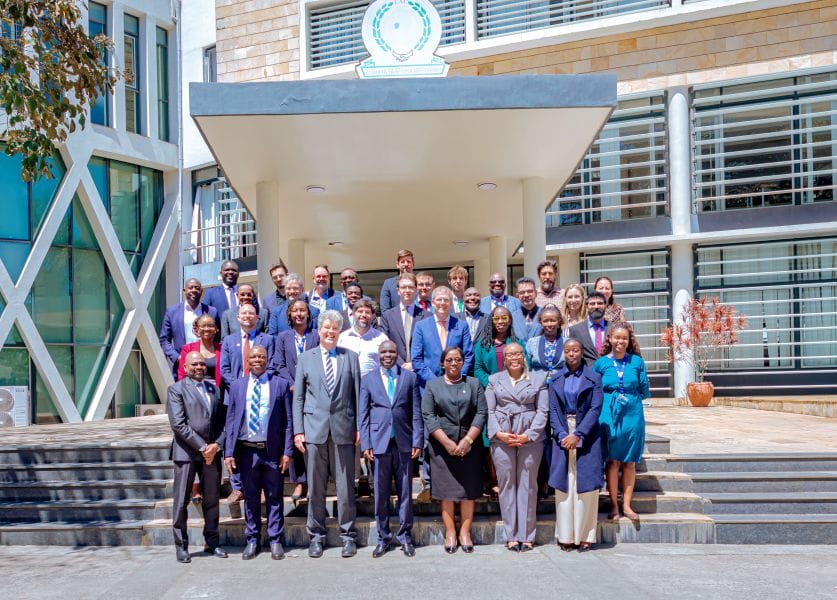
The roundtable brought together the EAC Secretariat, IUCEA, EASTECO, BMZ, the German Federal Foreign Office and Embassy, development partners, academia and private sector participants including Equity Group, Bayer, Cassava Technologies and Zindi.
The Alliance’s stated mission extends beyond skilling to modernising university teaching and research, closing regional digital skills gaps, and advancing a harmonised, gender-responsive regional AI policy framework across the eight partner states — the policy layer that IUCEA’s Regional AI Network of Universities, launched in Nairobi this month, is designed to support.