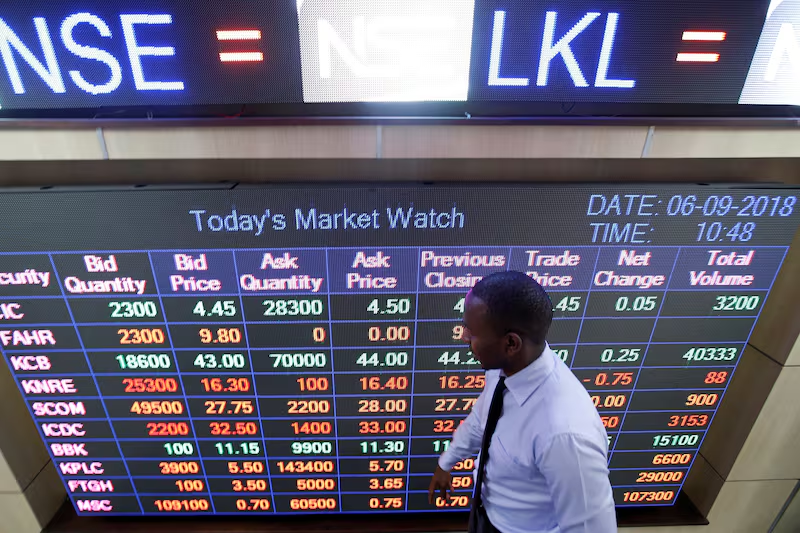
The Nairobi Securities Exchange is building East Africa’s first exchange traded fund focused on AI stocks, with plans to offer it to investors before year-end — though its chief executive says the launch could be delayed if the global AI rally starts to look overdone.
“We want essentially to be able to bring a product to our market where the underlying basket is a reflection of companies that have a direct exposure to AI,” NSE chief executive Frank Mwiti said. Microsoft, Anthropic and OpenAI could serve as references for the fund, he added. The exchange is discussing the proposal with Kenya’s market regulator.
The demand case is generational. Kenyan investors can already access AI-related products abroad, but the NSE wants to make trading them locally easier — and Mwiti says the appetite is strongest among newer, younger entrants to the market.
“Instead of cement manufacturing… they want to do AI,” he said.
That cohort has grown quickly. Safaricom began offering share trading on its M-Pesa mobile money platform in February, which Mwiti said alone brought in a million new investors, many entering the market for the first time. Kenya’s equity market has rallied just over 30% this year on strong company earnings and stable inflation and currency conditions, pushing the equities segment to a record 4-trillion shillings (about $31bn). Mwiti projects closing the year at 5-trillion.
The caution is the story
What distinguishes the announcement is how openly Mwiti hedged on it. The AI boom has driven global stock markets to record highs, but the surge has stoked concerns about a bubble that could drag world equities down sharply if it bursts. The NSE, he said, will study the rally carefully and delay the launch if necessary to avoid exposing investors to an overextended move.
“There is… a vibe in the market that there might be a bubble around AI, so maybe there is also an aspect of waiting and seeing,” Mwiti said.
An exchange chief publicly flagging bubble risk in his own flagship product is not the usual register for a launch announcement — and it lands as a notable counterpoint to the uniformly bullish framing that has dominated African AI coverage this year.
Structure and what comes next
The fund will most likely be denominated in Kenyan shillings to limit foreign exchange risk. “Kenyans are actually investing in foreign markets because of a lack of product diversity here,” Mwiti said.
One structural question the announcement leaves open: Anthropic and OpenAI are both privately held and not listed on any public exchange, so an ETF cannot hold their shares directly. Mwiti’s framing — that such companies “could be used as references” — suggests a thematic basket tracking AI exposure rather than direct holdings, but the mechanism has not been detailed.
The NSE is also considering a cryptocurrency ETF based on bitcoin, ethereum and solana, which could launch next year once Kenya passes legislation governing virtual assets.
Most African capital markets do not yet offer AI-focused ETFs, which are common in developed markets such as the US. Demand in Kenya, Mwiti said, is driven not only by interest in shares in the likes of SK Hynix or Samsung but by an increasingly investment-savvy young population.
The Nairobi market already attracts a sizeable share of foreign investors on the strength of its profitable banking sector and Safaricom, but offers no exposure to AI stocks at present. The proposed ETF is the exchange’s attempt to close that gap without sending capital offshore — and it fits a broader Kenyan positioning that has included the Qubit Hub AI research lab, the AI Everything GITEX event, and the country’s pitch of its renewable-heavy grid as an AI investment advantage.