Two-thirds of South African mining chief executives have not yet deployed artificial intelligence in their businesses, and nearly 70% of mines surveyed rate their AI readiness as poor or very poor — with digital skills shortages, not technology, identified as the primary obstacle.
The findings come from PwC South Africa’s report “Ten insights into 4IR in South African mining 2026: AI: Powering the future,” which draws on interviews with 10 mining CEOs, focus groups with operational managers and industry strategy sessions held with the Minerals Council during 2025. The methodology is qualitative rather than statistically broad, and the percentages sit on a small base of senior respondents.
The report frames AI in the sector as a business transformation tool rather than a technology purchase — capable of improving equipment reliability, strengthening safety, optimising exploration and enabling real-time operational decisions. What it is not, according to the executives interviewed, is a headcount exercise.
“What we see clearly is that AI is not being viewed as a replacement for people,” said Ian Mackay, associate director for mining transformation at PwC South Africa. Mining leaders, he said, see it as a way to strengthen human capability, with value emerging when technology and people are designed to work together.
One interviewed executive put it more bluntly: “The thinking here is not ‘I could have 40% less employees’… this is not necessarily a cost-cutting exercise – it’s actually a revenue-generating exercise.”
Strategy gaps start at the top
PwC argues that successful AI adoption begins in the executive suite and cannot be delegated to IT departments. The survey found 46% of CEOs rated their organisation’s AI strategy as merely “average,” while only 23% believed it was well-defined and aligned with business objectives. That tracks closely with PwC’s broader African findings from February, which showed only 41% of African organisations had a clearly defined AI roadmap and just 37% had formal processes for responsible AI.
The skills picture is the sharper constraint. The report describes an industry transitioning from relying on labour availability towards requiring skills readiness — creating demand for workers who can operate AI-enabled systems and capture quality operational data. It calls for significantly greater investment in continuous digital skills development, AI literacy and immersive training technologies including virtual and augmented reality.
Data foundations before AI
More than 85% of respondents rated their data management capabilities as average or poor, limiting their ability to generate reliable real-time insights across operations. PwC warns that AI initiatives will fail without robust data foundations first.
“One of the biggest pitfalls is that data doesn’t help if it’s just data,” one CEO observed. “It needs to be put through the funnel to get to wisdom.” The report argues mining companies should focus less on collecting more data and more on ensuring the right data reaches the right person at the right time.
Mackay identified change management as the most common source of failure in digital programmes. Where employees were engaged from the start and solutions aligned with real business needs, implementations succeeded; where change was imposed without support or understanding, even advanced systems failed.
A more cautious picture than the sector narrative
PwC found most respondents have looked at AI options and chosen not to invest yet, preferring clearly defined use cases over large-scale transformation. As one leader described it, the approach is iterative rather than a single strategy set and executed.
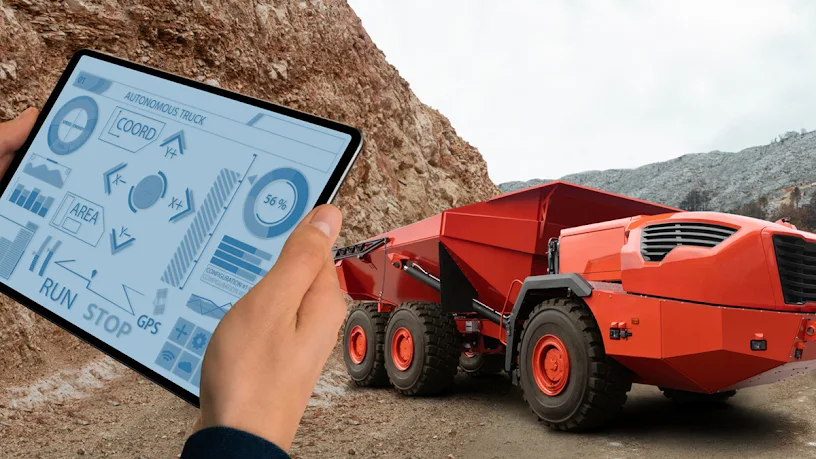
That assessment sits somewhat awkwardly against the more bullish framing that has dominated African mining-AI commentary this year. A Stellenbosch Business School analysis iAfrica covered in May argued that AI had already moved from experimental pilots to the centre of operational competitiveness in African mining, pointing to autonomous drilling and haulage, AI-driven fleet optimisation, digital twins and predictive tailings dam modelling as established capability. PwC’s South African data suggests that where such deployments exist, they are concentrated among a minority of operators — and that the majority of the sector is still assessing.
The gap also mirrors a pattern PwC has documented across African business more broadly. Its AI Fitness Index found African enterprises scoring above European and North American counterparts on organisational readiness measures, while median AI spend on the continent sits at 2% of revenue against 5% among global AI leaders. High intent, constrained investment.
The report concludes that South African mining stands at a crossroads where leadership, skills development and stronger data governance will determine whether AI delivers value. “The question is no longer whether AI will transform mining – it is whether South Africa’s mining sector will move with sufficient speed and discipline to lead that transformation.”