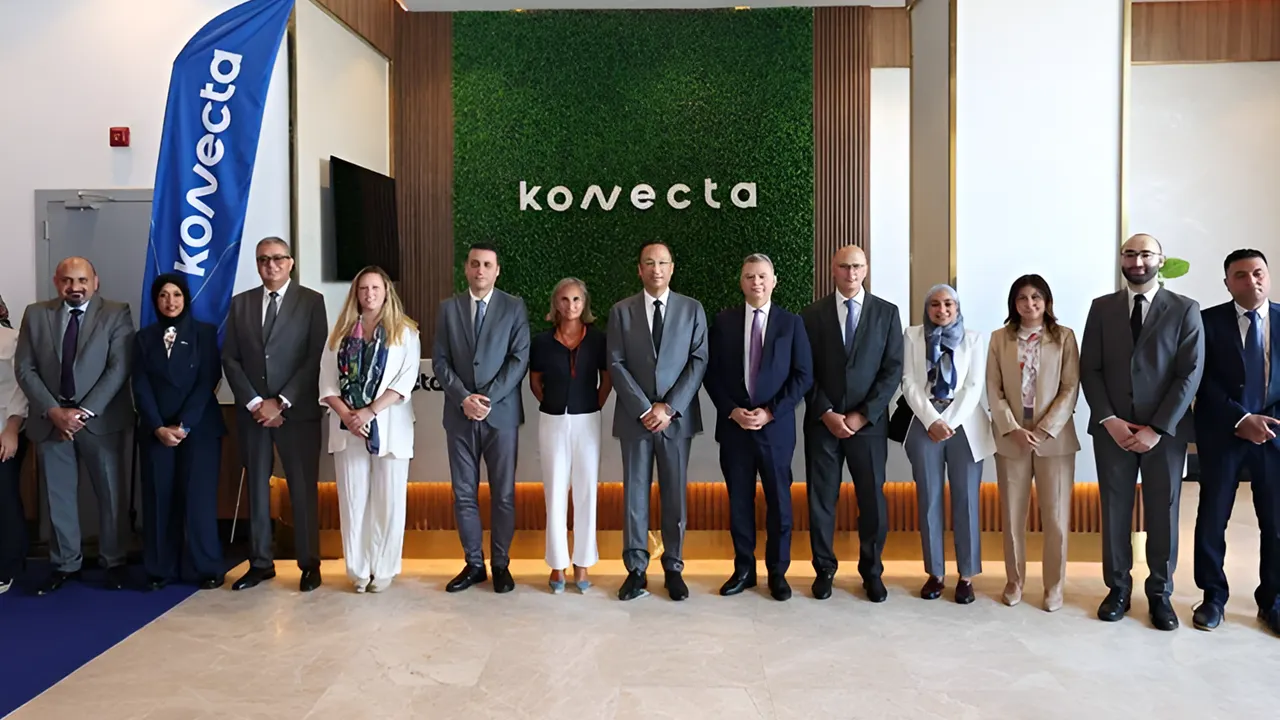
Spanish outsourcing group Konecta has opened its regional headquarters and first global centre of excellence for generative AI in New Cairo, as part of a $100 million investment plan in Egypt — placing Egyptian teams on the development and localisation of the company’s core AI products rather than solely on service delivery.
The facility was inaugurated by Egypt’s Minister of Communications and Information Technology, Raafat Hindi, and will serve clients across the Middle East, Africa, Europe and the Americas, offering digital customer experience, AI, data analytics, technical support and Internet of Things services.
Ahmed Al-Harrany, Konecta’s vice chairperson for the Middle East and Africa, was explicit that the designation matters: Egypt hosts the group’s first global centre of excellence in generative AI, not simply another operational site. That distinction puts Egyptian specialists on the development and localisation of Konecta’s own AI stack, including its Kolibri agentic AI platform — the kind of product-development work Egyptian officials have been courting as they try to move the country’s substantial outsourcing sector up the value chain.
The regional headquarters currently employs 800 Egyptian specialists working across seven languages — Arabic, English, French, German, Italian, Spanish and Dutch — with Konecta planning to grow the local workforce to approximately 3,000 by the end of 2028. Founded in Madrid in 1999, Konecta employs 109,000 people across 28 countries and delivers services in 40 languages.
The launch follows a memorandum of understanding signed between Egypt’s Information Technology Industry Development Agency and Konecta in January 2025, in the presence of Prime Minister Mostafa Madbouly. Hindi framed the expansion as evidence of Egypt’s push to attract investment and deliver high-value digital services into global markets.
The investment lands inside a New Cairo AI build-out that has accelerated sharply this year. Orange Egypt signed an agreement in April with smart urban developer Paragon Adeer and global innovation platform Plug and Play to launch Egypt’s first AI campus at the Sumou Boulevard development in New Cairo, targeting 100 growth-stage AI startups by 2030 across a 500-acre site. The same month, Talaat Moustafa Group and the National Bank of Egypt launched The Spine, an AI-powered “cognitive city” development in New Cairo’s Madinaty area with investments exceeding EGP 1.4 trillion. Konecta’s centre adds a corporate AI-services anchor to a district accumulating startup, real-estate and infrastructure AI plays simultaneously.
Egypt’s positioning in global outsourcing gives the investment its commercial logic. The country ranks 16th globally on the inaugural Global Outsourcing AI Readiness Index published by talent firm Ataraxis in June — second in Africa behind South Africa — with the index measuring population AI adoption, workforce AI literacy, enterprise AI adoption and AI education pipeline strength across 25 leading outsourcing destinations. Eight African countries made the global top 25, including Nigeria, Kenya, Morocco and Ghana. That ranking sits alongside Egypt’s first-place African finish on the Oxford Insights Government AI Readiness Index, which measures government rather than commercial AI capacity.
The distinction Konecta is drawing — between delivering AI-enabled services and developing AI products — maps directly onto Egypt’s own National AI Strategy 2025-2030, which targets $42.7 billion in AI-related economic value, more than 250 AI companies and a national AI talent pool of 30,000 people by the end of the decade. Foreign-backed AI development hubs have been accumulating in the country: Valeo’s AI development centre at Smart Village, the NVIDIA-backed SIGNALS accelerator launched with RiseUp, A15 and BitRoot, Huawei’s regional AI data centre design work, and now Konecta’s generative AI centre.
Whether that concentration of foreign-anchored AI development translates into durable Egyptian AI capability — companies, IP and talent that remain in the country — or reproduces the pattern of skilled Egyptian engineers being absorbed into foreign product roadmaps, is the question the National AI Strategy’s own targets will ultimately be measured against. Konecta’s plan to triple its Egyptian headcount by 2028 puts a number on at least one side of that ledger.