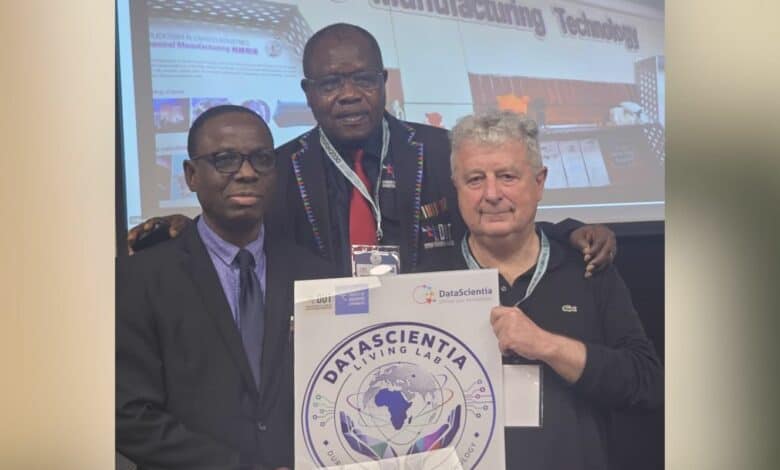
Durban University of Technology has become the first African institution to host the DataScientia International Symposium, ending a decade in which the global research gathering has been held exclusively in Europe — and using the moment to launch the first DataScientia Living Lab on the continent.
The three-day symposium, held under the theme “Diversity-Aware Sovereign AI,” has drawn more than 200 delegates from over 50 institutions across Europe, Africa, Asia, the Middle East and South America, and includes academics, policymakers, industry experts and representatives of international organizations. It is organized by the global DataScientia Initiative, an international collaboration focused on ethical AI, responsible data governance and citizen science.
Opening the event, DUT’s Executive Dean of the Faculty of Accounting and Informatics, Professor Oludayo Olugbara, framed the hosting as a watershed moment for Africa and a step toward advancing ethical, human-centered AI on the continent. The Living Lab launched alongside the symposium, he said, will operate as an open-innovation ecosystem where research, business, government and citizens across Africa can co-create, prototype and validate products and services aimed at improving human life.
The wider DataScientia initiative, Olugbara said, is trying to build a global citizen science community around what it calls person-centered general AI — an approach that treats people as active managers of their own data rather than as passive data sources. That framing lands sharply against the arc iAfrica has been tracking in recent months, from University of Johannesburg vice-chancellor Letlhokwa Mpedi’s warning against a “Digital Berlin Conference” on AI, to the Mpedi-Ikalafeng Business Day opinion piece calling for an “AI equivalent of geographical indication” to protect African cultural provenance, to the Singularity Summit’s expanding sovereign-AI programming in October and the Western Cape’s launch of a provincial AI cluster built around the same principle.
The initiative’s flagship global research project is a bid to digitize more than 7,000 human languages and build AI-powered language technologies that let people communicate in their indigenous languages. The project, Olugbara said, has the potential to reshape language technology while preserving cultural and linguistic heritage — a “web-of-languages” breakthrough that would place digital preservation at the centre of how AI systems handle multilingual reality. For African audiences, the framing dovetails with a wave of continent-built language-AI efforts iAfrica has been covering: Nigeria’s Veta Origin (Hausa, Igbo, Yoruba, Swahili), Egypt’s TokenAI (Arabic dialects and ancient hieroglyphics), South Africa’s Vambo AI, Kenya’s Qhala-anchored Qubit Hub, and the G6 African mobile operators’ open Swahili reasoning model demonstrated at MWC Barcelona in March.
Olugbara connected the hosting itself to the sovereign AI conversation. Sovereign AI, in his framing, is not primarily about compute or scale — it is about an AI approach that respects cultural diversity, local knowledge and regional autonomy over data and models. He also acknowledged what other iAfrica pieces have documented at length: that African institutions remain under-represented in DataScientia’s partnership network, and that bringing the symposium to Durban this year is partly an attempt to draw more African institutions into the initiative as it pursues AI sovereignty on the continent.
The programme runs two days of symposium sessions and dialogue on Diversity-Aware Sovereign AI, followed by workshops and tutorials focused on the DataScientia initiative and the development of lexicon datasets for language modelling — placing DUT alongside the small but expanding set of African universities positioning themselves inside the sovereign-AI conversation as substantive participants rather than case studies.