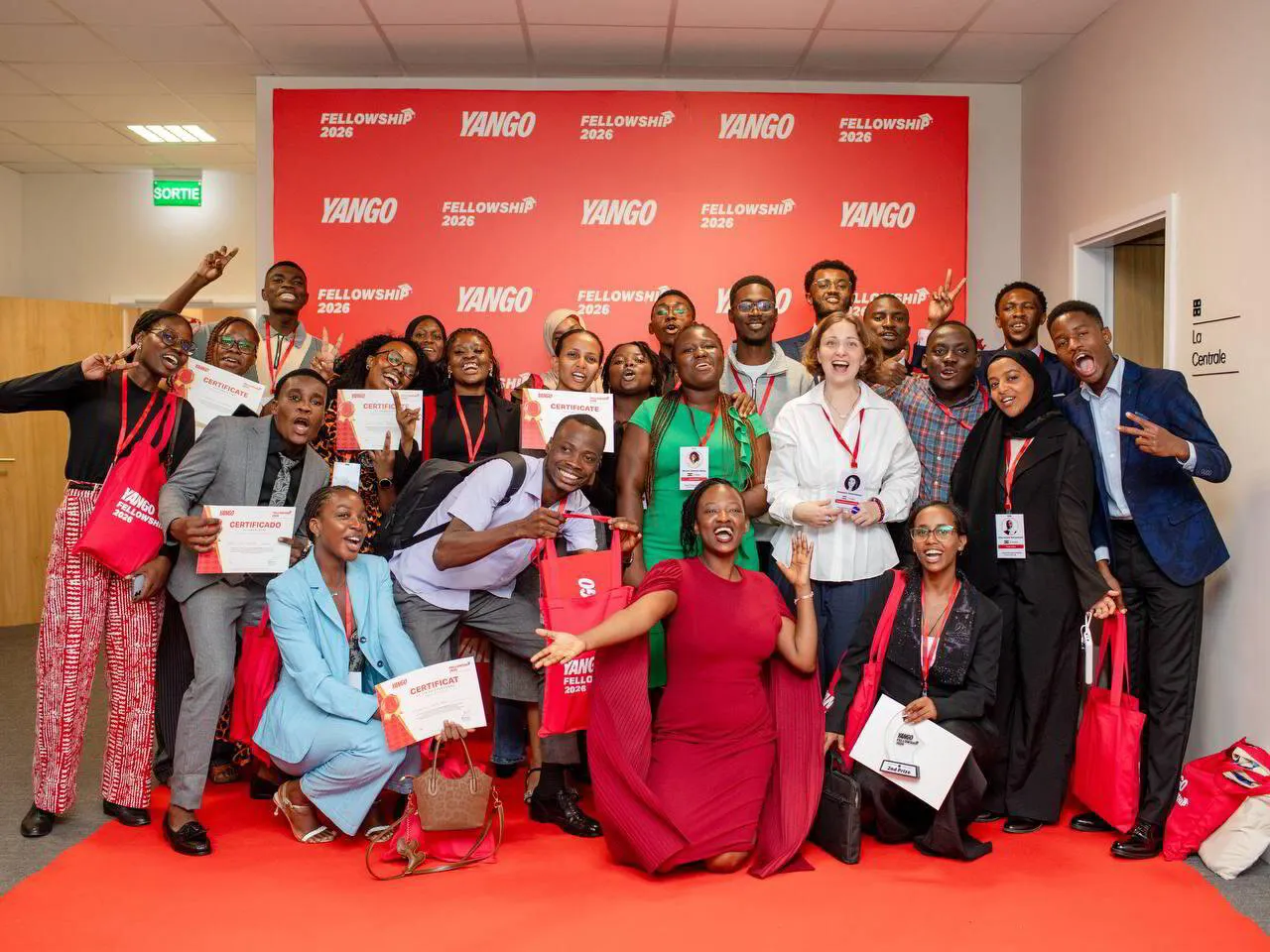
Yango Group’s Pan-African Fellowship concluded in Abidjan this week, with 24 fellows from six countries presenting projects built over 12 weeks — selected from more than 600 applicants.
“600 applications for 24 places doesn’t tell you Africa lacks talent, it tells you how much talent is waiting for structured access to mentorship and opportunity,” said Shashi Singh, Director of Operations for Yango Ride MEA and Asia. “What’s harder to find is a mentor, a network, and the opportunity to test an idea against a real problem.”
That ratio, 25 to one, echoes one iAfrica reported this month from LINGUA Africa, which drew more than 800 applications for 26 African language AI grants. Different programmes, same finding: the talent pool is deep, and the entry points are narrow.
Six teams, six problems
Fellows from Côte d’Ivoire, Ghana, Zambia, Senegal, Ethiopia and Mozambique worked in mixed-country teams, moving from problem framing through research, solution design, business modelling and prototyping to a final pitch.
The problems they chose are notable for how many sit in the informal economy: cashless payments for informal transport, digital financial identity for informal merchants, medicine supply visibility for community health workers, cross-border job matching, smart waste collection and recycling, and low-cost water-quality testing for rural communities.
The winners
Africoded took the $4,500 top team prize for an AI-assisted platform connecting African job seekers with cross-border employment, remote work and career development. Harambee placed second with $2,500 for a waste collection and recycling platform linking households, collectors and recyclers. Bloom came third with $1,500 for a cashless fare-collection system for informal public transport across East and West Africa.
In the individual category, Zambia’s Fredrick Mwepu won the $1,500 Best Individual Project award for RoboCore Zambia, a locally developed robotics platform intended to make practical STEM education affordable.
“Growing up, hands-on STEM tools were something I only saw in videos,” Mwepu said. “RoboCore Zambia exists to close that gap, so the next student who wants to build something doesn’t have to wait for the chance I almost didn’t get.”
Ghana’s Meshack Kwame Nartey received $1,000 as runner-up for Shuttle Smart Ghana, which tracks university shuttles in real time.
Oulimata Rose Dia won the $1,000 Best Technical/AI Contribution award for Smart Bin Collection, a solar-powered system that monitors bin fill levels and transmits over 2G.
That last choice deserves attention. Building on 2G rather than 4G or 5G is a deliberate design for the infrastructure most of the continent actually has, rather than the infrastructure policy documents describe. It is the same principle behind offline translation models and Uganda’s offline-capable health systems — and it is more often missing from African tech projects than present.
The programme closed with a session on AI for impact led by Celina Lee, co-founder of data science platform Zindi, alongside pitch coaching and meetings with Yango leaders from several markets. A total prize fund of $12,000 was awarded.
Talent, and capital
The prize money is modest, and the programme is explicit about being a talent pipeline rather than a funding vehicle. Yango frames the fellowship around a view that African markets differ enough in infrastructure, behaviour and need that strong local businesses require local expertise.
The group also invests directly. Yango Ventures participated in Egyptian startup Fincart’s $2.8 million seed round in August, alongside Launch Africa and Antler MENAP. Running a fellowship and a venture arm in parallel gives Yango a view of early talent and a mechanism to back it later — the kind of connected pathway the funding-gap figures suggest is scarce.