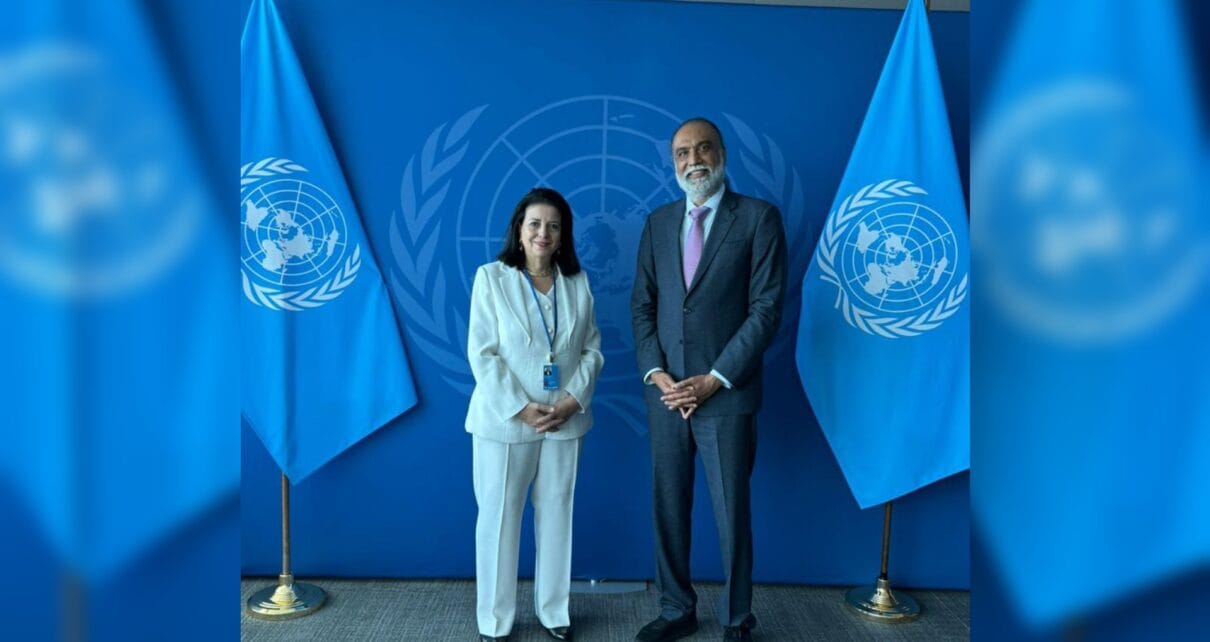
Morocco’s Minister of Digital Transition and Administration Reform, Amal El Fallah Seghrouchni, has held a series of high-level bilateral meetings with senior United Nations officials on the sidelines of UN Open Source Week at UN Headquarters in New York — strengthening the Kingdom’s partnerships in digital governance, artificial intelligence, sovereign digital infrastructure and international development cooperation.
During a meeting with UN Under-Secretary-General and Special Envoy for Digital and Emerging Technologies Amandeep Singh Gill, Seghrouchni presented the main pillars of Morocco’s AI strategy through 2030, driven by the “AI Made in Morocco” initiative, along with the Kingdom’s ambition to promote a “third digital path” reconciling technological sovereignty, open innovation and international cooperation. The talks also covered Morocco’s flagship initiatives — including its partnership with Mistral AI, participation in the European AI Factories initiative, the development of the Digital for Sustainable Development Hub, and the Al Jazari ecosystem — as well as enhanced cooperation with the UN in open-source technologies, AI governance and capacity building.
Seghrouchni met with UN Assistant Secretary-General and Director of the Regional Bureau for Africa at the UN Development Programme, Ahunna Eziakonwa, to discuss strengthening cooperation between Morocco and Timbuktoo, UNDP’s flagship pan-African initiative aimed at building an integrated African innovation market. The discussions highlighted Morocco’s assets to host a pan-African hub dedicated to smart cities and intelligent mobility, anchored in the Al Jazari Institute and integrated into the Morocco-based Arab-African Digital for Sustainable Development Hub platform.
The minister also held talks with UN Assistant Secretary-General and Chief Information Technology Officer Bernardo Mariano Jr., during which the two discussed digital sovereignty, critical digital infrastructure, sovereign data centres, data factories and the conditions necessary for developing trustworthy AI. The two sides shared a common vision for stronger African cooperation in digital infrastructure, data governance and the certification of open-source software and AI systems. The discussions also explored opportunities offered by the Digital Public Goods Registry to promote digital solutions developed by Moroccan companies and startups, as well as ongoing UN efforts to adapt international standards to AI systems.
Seghrouchni further met with Dima Al-Khatib, director of the UN Office for South-South Cooperation, in the presence of Ilaria Carnevali, UNDP Resident Representative in Morocco. The talks focused on the accession of the D4SD Hub to the Global Alliance for South-South and Triangular Cooperation — a UN-led platform bringing together governments, UN agencies, development banks, the private sector and research centres to accelerate development solutions. The discussions also underscored the synergies between that platform and the future AI Marketplace of the D4SD Hub, designed to facilitate the sharing of AI models, digital solutions, datasets and technical expertise.
Through the series of meetings, Morocco reaffirmed its role as a strategic partner of the United Nations in advancing a more open, inclusive and responsible global digital governance framework, while strengthening its position as a regional platform for cooperation, innovation and capacity development serving Africa and the Arab world.