In this edition: Africa’s evolving relationship with AI, from classrooms and boardrooms to career development.
South Africa’s University of the Free State is abandoning AI detection tools in favour of AI literacy and academic judgement, while a local startup is using AI to challenge established accounting software providers.
Meanwhile, Nigerian educator Akanni Isaac is equipping sales professionals with practical AI skills, underscoring the continent’s growing focus on AI adoption, innovation and workforce readiness.
Gambian scientist uses AI to guide immigrant students’ futures
Gambian-born immunologist Bubacarr J.B. Touray has launched Seedmap, an AI-powered academic counselling platform designed to help immigrant and first-generation students navigate education and career choices. The platform combines artificial intelligence with human guidance to create personalised student profiles, map career pathways, and provide tailored academic advice. Touray, a former Medical Research Council scientist, developed Seedmap to address the information and support gaps many immigrant students face when pursuing higher education and professional opportunities. The service’s founding programme covers 59 career pathways and aims to make educational planning more accessible and data-driven. Seedmap reflects a growing trend of African innovators applying AI to social and educational challenges, demonstrating how technology can support inclusion, improve decision-making, and expand opportunities for underrepresented communities.
Africa’s AI future depends on control, not just adoption
Africa’s push for AI sovereignty is less about accessing technology and more about controlling the infrastructure, institutions, and systems that create value. The article argues that debates around AI in Africa have focused heavily on skills, startups, and ethics while overlooking questions of power, ownership, and governance. It warns that Africa risks becoming a supplier of data, labour, minerals, and markets while foreign companies retain control of higher-value AI assets such as models, cloud infrastructure, and standards. To avoid this, governments must prioritise strengthening state capacity, investing in digital infrastructure, improving data governance, and applying AI to sectors like agriculture, energy, health, education, logistics, and public finance. The author contends that AI should be viewed as a strategic tool for building national capability, bargaining power, and long-term sovereignty rather than merely a technology for adoption.
VHS revival challenges streaming era and AI-driven filmmaking norms
South African-born filmmaker Robert dos Santos is challenging digital-first entertainment with This Is How the World Ends, the first film in two decades to be released directly on VHS. The dystopian sci-fi story explores a world threatened by AI, while its unconventional distribution model serves as a statement against algorithm-driven media consumption. Dos Santos argues that physical formats encourage intentional engagement and preserve the human element of storytelling. Despite the difficulty of sourcing tapes and requiring viewers to own VCRs, the release has tapped into growing interest in analogue media, ownership, and collectible formats. The project reflects wider debates about AI’s impact on creativity and the value of human-made art in an increasingly automated cultural landscape.
Quick Bites…
- A small South African startup is taking on global accounting software giants with an AI-powered platform built specifically for local accountants, auditors and tax professionals. Founded by a lean team led by entrepreneur Leandro Da Silva, CA Assistant combines generative AI with South African accounting, tax and audit knowledge to automate research, document drafting and compliance tasks. The platform has gained traction by addressing local regulatory requirements often overlooked by international tools.
- Akanni Isaac is helping African sales professionals move beyond AI theory through Quota and Code, a training programme focused on building AI agents and automating sales workflows. The initiative provides hands-on skills that participants can immediately apply in their jobs. Isaac believes early AI adoption is critical for competitiveness and aims to expand the programme across Africa, helping businesses improve productivity and digital capabilities.
- South Africa’s University of the Free State will stop using AI detection tools from July 2026, arguing that current systems are unreliable and can wrongly flag student work. The university will instead focus on academic judgement, authentic assessments and responsible AI use. Plagiarism detection will remain in place, while greater emphasis will be placed on AI literacy, ethics and critical thinking skills.On the radar…
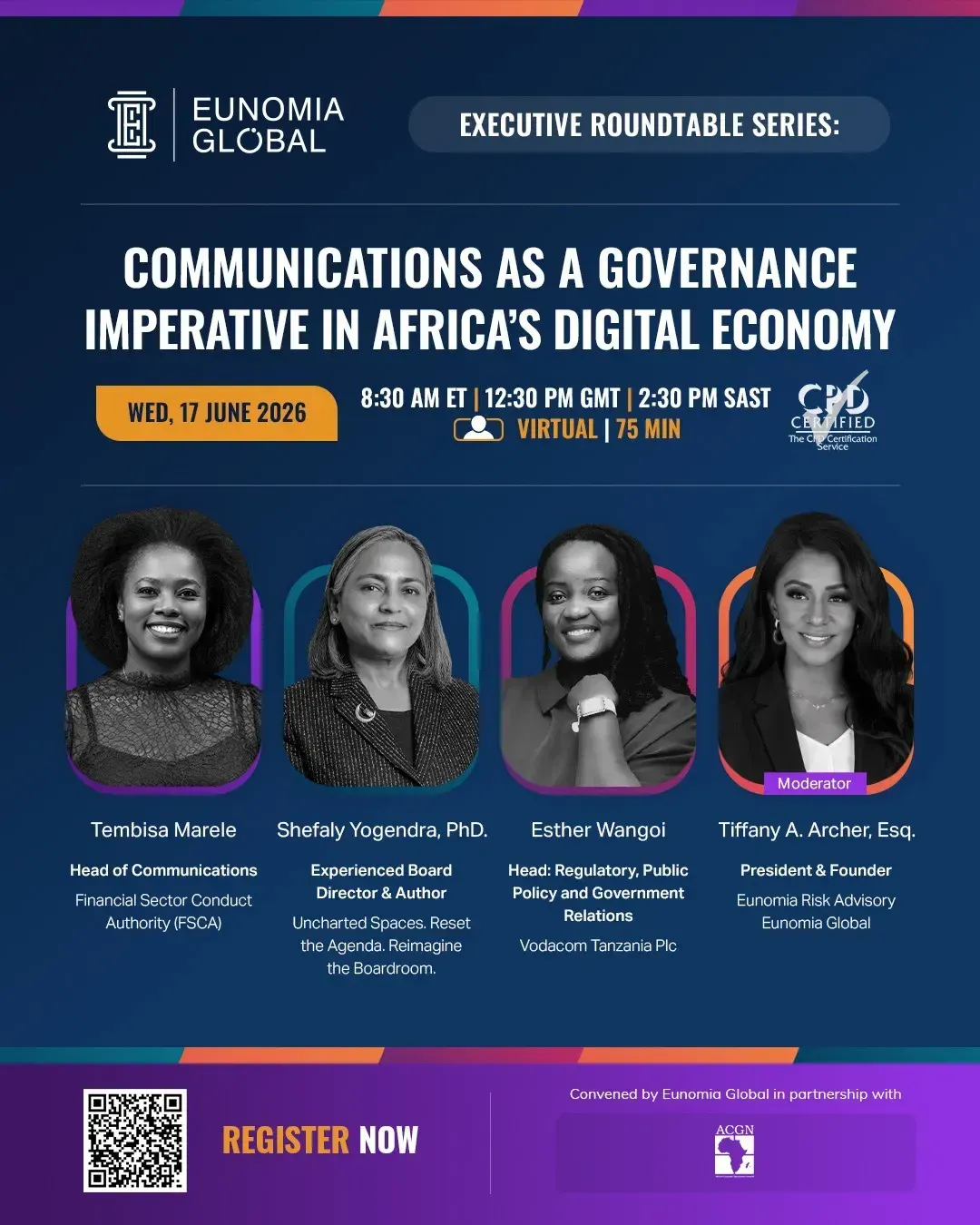
- This Wednesday, 17 June 2026, Eunomia Global is convening an all-women Executive Roundtable to examine what it truly means to give communications a seat at the governance table—and what it costs when it is left out of the room.